How to Tell If a Phone Number Is Working Before You Use It Safely
How to Tell If a Number Is Working Before You Use It
Have you ever entered a phone number into a registration form, waited for an OTP, and realized that you have no idea whether the number can actually receive the message?
A phone number can look perfectly normal and still be inactive, unreachable, incorrectly formatted, or unsuitable for a particular verification process. That is why checking a number before relying on it can save time and prevent unnecessary registration problems.
The good news is that you can use several practical checks to assess a number. And when your goal specifically involves SMS or OTP verification, OTPGET can provide a convenient option for working with numbers in an OTP-related verification workflow.
The important thing is to understand what you are actually checking. A valid number is not necessarily an active number, and an active number is not necessarily able to receive every type of SMS.
Why It Matters to Know Whether a Number Is Working
An unreliable phone number can become a problem at exactly the wrong moment.
For example, you may need a number to:
- Create or verify an online account
- Receive an SMS confirmation
- Complete an OTP verification step
- Confirm ownership of a number
- Communicate with a person or business
- Finish an online registration
- Recover or confirm access to a service
If the number cannot receive the required message, you may be unable to complete the process.
This is especially frustrating when a number appears valid at first glance. Checking it beforehand gives you a better understanding of what the number can actually do instead of discovering a problem after you have already started the process.
For OTP-focused workflows, OTPGET can be considered when you need a practical way to work with numbers and receive verification codes, subject to the requirements of the service you are using.
What Does It Mean for a Phone Number to Be “Working”?
The phrase "working number" can mean several different things.
A valid number format
A number may follow the correct numbering structure for its country or region. This tells you that the number looks correctly formatted, but it does not prove that it has been assigned or is currently in use.
An assigned number
An assigned number is associated with a subscriber or service provider. Again, assignment alone does not tell you whether the number is currently reachable.
An active number
An active number is generally one that is currently in service. However, its ability to receive calls or messages can depend on network conditions, account status, device settings, and other factors.
A reachable number
A number may be active but temporarily unreachable. Calls or messages can fail because of network conditions, device availability, roaming circumstances, or other service-related issues.
A number capable of receiving SMS
SMS capability is another separate consideration. A number may be active for voice communication without necessarily behaving as expected for every messaging service.
A number that can receive verification OTPs
Finally, an OTP-dependent service may have its own rules. A number that can receive ordinary SMS messages may not necessarily be accepted by every platform for verification.
That distinction is crucial: validity, activity, reachability, SMS accessibility, and OTP compatibility are related but different things.
How to Tell If a Number Is Working
There is no single check that proves every aspect of a number's status. Instead, use several practical checks depending on what you need the number for.
1. Call the number
Calling is one of the simplest ways to check whether a number appears reachable.
If the call connects, that provides useful evidence that the number is in service and reachable at that moment.
However, a failed call does not automatically prove that a number is permanently inactive. The phone may be switched off, temporarily out of coverage, configured not to accept calls, or affected by another service issue.
Best for: Checking basic voice reachability.
2. Send an SMS
If you need the number for messaging, sending an SMS can provide more relevant information than making a call.
A successful message delivery can indicate that the number is reachable through the messaging network. However, delivery behavior can vary between networks and services, so one SMS result should not be treated as an absolute guarantee of future availability.
Best for: Checking basic SMS accessibility.
3. Check the number's format and country code
Before testing a number, make sure it is written correctly.
Check:
- Country code
- Number of digits
- Local versus international format
- Obvious typing errors
- Extra spaces or unsupported characters
A formatting problem can make a perfectly legitimate number appear invalid.
A format check is useful, but remember that number validation is not the same as confirming that a number is active.
Best for: Eliminating simple formatting and input errors.
4. Use a legitimate number-validation service
Some services are designed to help businesses and users validate phone-number information.
Depending on the service, a phone number checker may help identify formatting, numbering information, or other available status indicators.
These tools can be useful for screening numbers, but their results should be interpreted carefully. No basic validation result should automatically be treated as proof that a number can receive a particular OTP.
Best for: Initial number screening and validation.
5. Test whether the number can receive a verification message
If your real objective is account or service verification, the most relevant test is often whether the number can receive the type of verification message you actually need.
This is different from simply asking whether a number exists.
For example, a number may be valid and active but still fail a particular verification process because the service does not accept that number type or because delivery is unavailable.
Best for: OTP and SMS-dependent workflows.
6. Use an OTP receiving or verification service
When the task involves receiving an SMS verification code, an OTP receiving service can be more practical than repeatedly testing numbers manually.
OTPGET is positioned for users who need to work with numbers for OTP and verification-related workflows. Instead of treating a number as suitable simply because it looks valid, users can use an appropriate OTP-focused service when their intended use case requires receiving a verification code.
The exact behavior and acceptance of any number can still depend on the external service sending the OTP. For that reason, OTPGET should be viewed as a practical tool for the verification workflow rather than a guarantee that every third-party service will accept every number.
Why Traditional Number Checks Are Not Always Enough
A common mistake is assuming that one successful test answers every question about a phone number.
It does not.
A number can have a valid format but be inactive. It can be active but temporarily unreachable. It can receive ordinary SMS messages but encounter restrictions with a particular verification platform.
Similarly, a failed call does not always mean the number has been disconnected. Network problems, device settings, temporary outages, and other conditions can affect the result.
SMS delivery can also vary. The sending service, receiving network, number type, geographic restrictions, and verification rules can all affect the outcome.
This is why the right question is not simply:
"Does this number exist?"
A better question is:
"Can this number perform the specific function I need it to perform?"
That distinction makes number verification much more useful.
How OTPGET Can Help With Number Verification and OTP Workflows
For users whose main concern is OTP verification, OTPGET offers a practical way to approach the process from the SMS-verification side rather than relying only on basic number checks.
The value is straightforward: if your workflow requires receiving a verification code, you need access to a number that can participate in that process.
OTPGET can be considered when you need an OTP receiving service for a verification workflow and want an alternative to manually testing numbers through calls and ordinary SMS.
A sensible workflow is:
- Identify what the target service requires.
- Make sure the number format and country information are appropriate.
- Use a suitable number-verification approach.
- If an OTP is required, use an appropriate OTP receiving workflow.
- Enter the received code where the service legitimately requests it.
- If the code does not arrive, investigate the number, network, service restrictions, or verification requirements rather than repeatedly requesting codes.
The key advantage of this approach is clarity. Instead of assuming that a number is suitable because it looks correct, you focus on the actual requirement: receiving and completing the required verification step.
OTPGET should still be used within the rules and requirements of the service being verified. No number-verification solution can guarantee acceptance by every external platform.
When Should You Check a Number Before Using It?
It makes sense to check a number whenever a failed verification could waste your time or interrupt an important process.
Before an online registration
If a registration form requires a phone number, verify the number before beginning the process whenever practical.
Before SMS verification
If the next step depends on receiving an SMS, confirm that the number is suitable for messaging rather than checking only its format.
Before an account setup
Account creation can become frustrating if the verification step fails after you have already completed several forms.
Before an OTP-dependent process
When a one-time password is essential, the ability to receive the code is more important than simply knowing that the number is correctly formatted.
When obtaining a number from a third party
If you receive or purchase access to a number through a legitimate provider, check what type of number it is and whether it is appropriate for your intended use before depending on it.
When an unfamiliar number needs verification
If you are unsure about a number, start with basic validation and use a suitable verification method instead of making assumptions.
Common Mistakes to Avoid When Checking a Phone Number
Assuming valid format means active
Correct formatting only tells you that the number looks structurally acceptable. It does not prove that it is assigned, active, reachable, or SMS-capable.
Testing only by calling
A call checks voice reachability, not every aspect of SMS or OTP functionality.
Ignoring country codes
International numbers can be entered incorrectly when local and international formats are mixed. Always check the expected format.
Assuming every active number can receive every SMS
An active number may still encounter limitations with particular messaging or verification services.
Repeatedly requesting OTPs
Repeated requests can create delays, rate limits, or other verification complications. If a code does not arrive, investigate the cause before repeatedly trying again.
Using questionable verification methods
Stick to legitimate services and use numbers for purposes permitted by the relevant platform. Avoid methods designed to bypass a service's verification or access controls.
Treating temporary availability as permanent
A number that works now may not remain available indefinitely. Number status can change, so do not treat one successful test as a permanent guarantee.
Frequently Asked Questions
1. How can I tell if a phone number is working?
Start by checking its format and country code, then consider calling or sending an SMS if appropriate. If you specifically need OTP verification, test the number through a suitable verification workflow.
2. How do I check if a number is active?
You can use basic call or SMS tests and, where appropriate, a legitimate number-validation service. Keep in mind that these checks do not always prove every aspect of a number's current status.
3. Can I verify whether a phone number can receive SMS?
A successful SMS test can provide useful evidence, but SMS access can depend on the network and the sending service. For OTP purposes, the most relevant test is whether the number can receive the required verification message.
4. What is the difference between a valid and active phone number?
A valid number generally follows the expected numbering format. An active number is one that is currently in service. A valid number is not necessarily active.
5. How does OTP verification work?
A service sends a one-time code to a phone number. The user receives the code and enters it into the relevant verification screen. The service then checks the submitted code against the code it issued.
6. Can OTPGET help with phone number verification?
OTPGET can be considered for workflows where receiving an OTP or verification message is required. Its usefulness depends on the requirements of the external service and the type of number involved.
7. Why might an active number fail to receive an OTP?
Possible reasons include network or delivery issues, incorrect number formatting, service restrictions, number-type limitations, temporary problems, or the external platform's verification rules.
Conclusion
Knowing how to tell if a number is working is about more than checking whether the digits look correct.
A reliable check considers several separate questions: Is the number formatted correctly? Is it assigned? Is it active and reachable? Can it receive SMS? And, most importantly for verification workflows, can it receive the OTP required by the service?
Simple checks such as calling, sending an SMS, and validating the number format can provide useful information, but none should automatically be treated as a universal guarantee.
If your main requirement is OTP or SMS verification, OTPGET can be a practical option to consider for your number-verification workflow. Use it according to the requirements of the service involved, and focus on verifying the specific capability you actually need.
A few minutes spent checking a number before relying on it can prevent unnecessary delays, failed registrations, and frustrating verification problems.
10. FAQ Schema Suggestions
Use the following questions and answers as the basis for an FAQ schema implementation:
- Question: How can I tell if a phone number is working?
Answer: Check the number format, country code, and, where appropriate, test calling or SMS delivery. For OTP use, verify whether the number can receive the required verification message. - Question: How do I check if a number is active?
Answer: Calling, SMS testing, and legitimate number-validation services can provide useful indicators, although no single check proves every aspect of a number's status. - Question: Can I verify whether a phone number can receive SMS?
Answer: An SMS test can provide useful evidence of messaging access, but delivery can depend on the network, sending service, and number type. - Question: What is the difference between a valid and active phone number?
Answer: A valid number follows the expected numbering format, while an active number is currently in service. A valid number is not necessarily active. - Question: How does OTP verification work?
Answer: A service sends a one-time code to a phone number. The user enters the received code into the relevant verification process so the service can confirm it. - Question: Can OTPGET help with phone number verification?
Answer: OTPGET can be considered for workflows that require receiving OTPs or verification messages, subject to the requirements and rules of the external service. - Question: Why might an active number fail to receive an OTP?
Answer: Possible causes include delivery issues, incorrect formatting, service restrictions, number-type limitations, temporary problems, or the external platform's verification rules.
11. Thumbnail Prompt
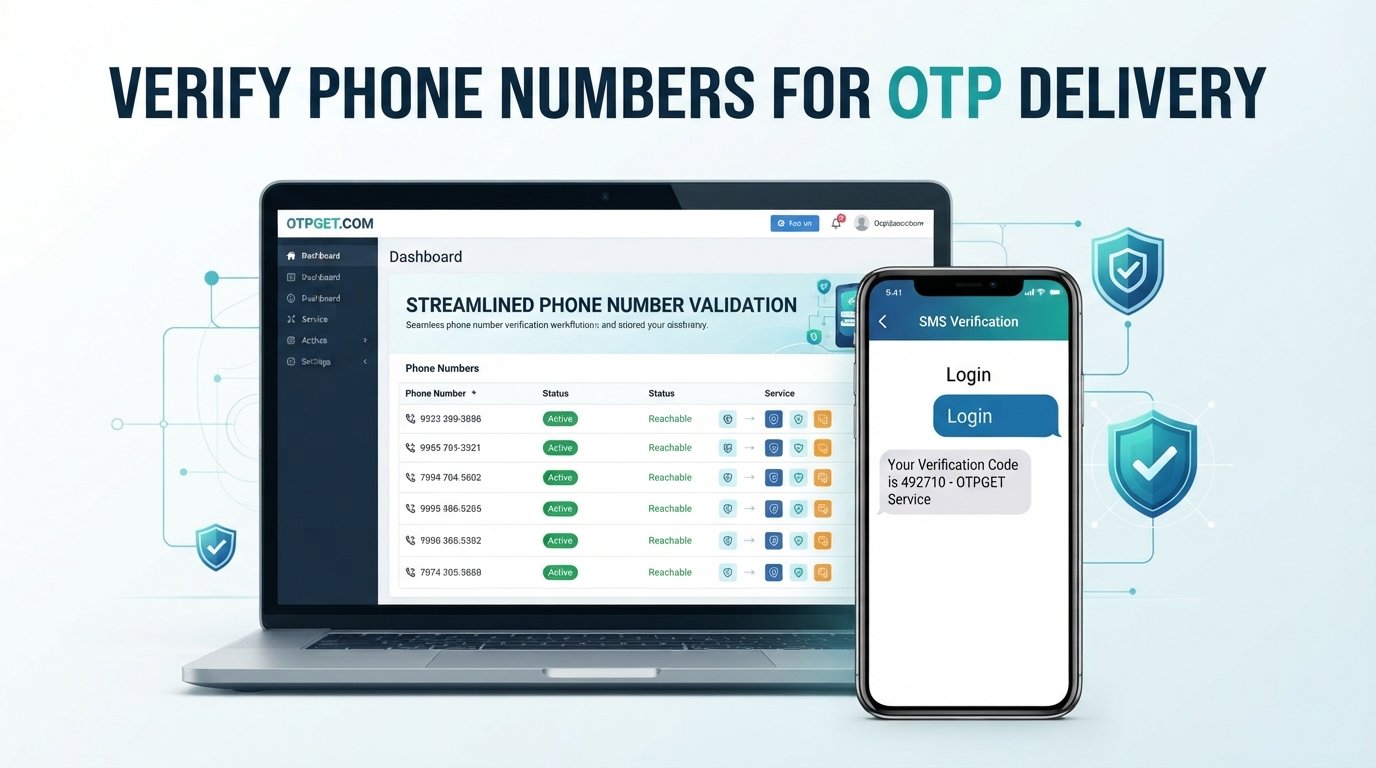
Create a professional technology blog thumbnail showing a modern smartphone displaying a clean SMS verification interface with a clearly visible but generic OTP code, surrounded by subtle visual elements representing phone number validation, connectivity, SMS delivery, and digital verification. Include tasteful OTPGET branding as a small, integrated brand element on the interface. Use a clean modern UI aesthetic, crisp lighting, blue and teal technology tones with balanced neutral backgrounds, subtle security-inspired graphical elements, and a polished SaaS-style composition. The image should communicate phone number testing and OTP verification without implying guaranteed security or guaranteed verification success. Keep text inside the image minimal, avoid clutter, avoid fake statistics, and avoid misleading security imagery. Professional, trustworthy, high-resolution editorial style suitable for a technology and SEO blog thumbnail.
12. Suggested Internal Link Opportunities
These are suggested anchor-text opportunities for future relevant pages; do not add links unless corresponding pages actually exist:
- "How OTP verification works" → Link to an educational guide explaining the OTP process.
- "SMS verification" → Link to a page explaining SMS-based verification workflows.
- "temporary phone number" → Link to a relevant OTPGET informational or service page if available.
- "virtual phone number" → Link to an appropriate explanatory page if available.
- "phone number verification" → Link to a dedicated OTPGET verification resource if available.
- "receive OTP online" → Link to the relevant OTPGET service page if available.
- "OTP receiving service" → Link to the appropriate OTPGET product or service page if available.
- "verify a number before registration" → Link to a related educational guide about registration and number checks.