Kenya Number SMS Verification: Complete OTPGET Guide for Users
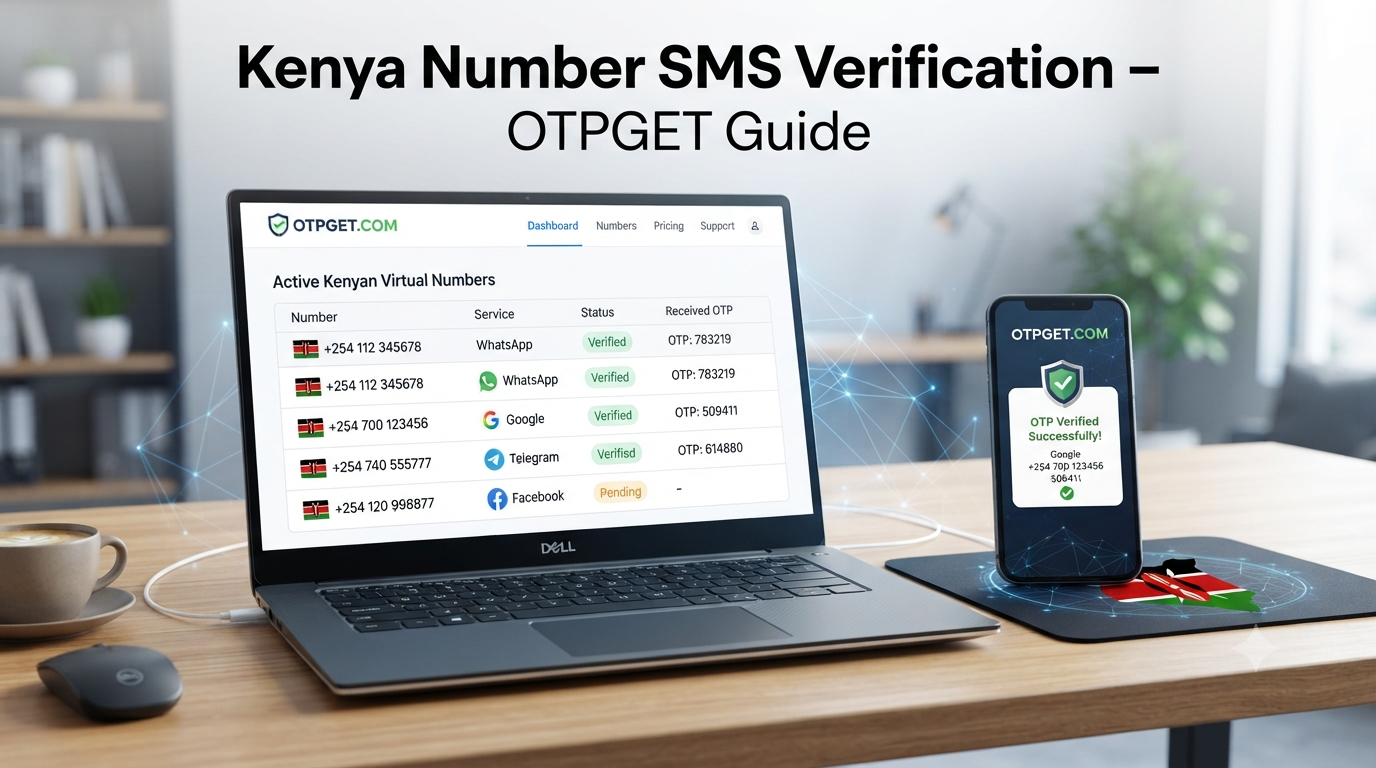
Kenya Number SMS Verification – OTPGET Guide
Blog Article
Kenya Number SMS Verification – OTPGET Guide
Phone verification has become a routine part of signing up for websites, apps, online platforms, and digital services. A user enters a phone number, receives a short verification code by SMS, and submits that code to confirm access to the number.
For people who specifically need a Kenyan phone number, however, the process can be less straightforward. A platform may require a Kenyan number, a personal SIM may not be suitable for a particular use case, or a developer may need a practical way to test an SMS-based verification workflow.
That is where a virtual number can be useful. OTPGET provides virtual numbers and SMS OTP services intended for online verification and account-registration workflows. Its public documentation also describes temporary numbers, rental numbers, and developer API access.
What Is Kenya Number SMS Verification?
Kenya number SMS verification is the process of confirming a user's Kenyan phone number by sending a one-time verification code through SMS.
An OTP, or one-time password, is a temporary code generated for a specific verification or authentication event. The user receives the code on the phone number being verified and enters it into the relevant website or application.
The basic purpose is simple: the service wants evidence that the person completing the process can receive messages sent to the submitted number.
This type of phone verification can be used for:
- Account registration
- Login verification
- Password recovery
- User onboarding
- Two-factor authentication
- Application testing
- Quality assurance
- Regional product testing
For businesses, phone verification can also be part of a broader identity and fraud-prevention strategy. However, SMS OTP should not automatically be treated as the strongest possible authentication method. NIST identifies SMS-based authentication as a restricted method and recommends considering stronger alternatives where the risk requires them.
How Kenya SMS Verification Works
The process is generally straightforward:
- A website or app requests phone verification.
The platform asks the user to provide a phone number.
- The user provides a Kenyan phone number.
The number must be compatible with the service's country and verification requirements.
- The service sends an OTP by SMS.
A short verification code is sent to the submitted number.
- The user receives the verification code.
The SMS appears on the device or within the receiving service being used.
- The code is entered into the verification screen.
The platform compares the submitted code with the expected verification value.
- The platform confirms the verification result.
If the code is valid and still active, the phone verification process is completed.
For developers, the same concept can be handled programmatically. OTPGET's published API documentation describes endpoints for obtaining virtual numbers and checking the status of an OTP received for an activation.
Why Businesses Need Kenya OTP Verification
A Kenyan OTP service can be useful whenever a product needs to test or support phone-based workflows for Kenyan users.
One common use case is account registration. A platform may require a user to verify a phone number before completing registration. This can help reduce accidental or invalid registrations and establish that the submitted number can receive messages.
Another use case is login verification. A business may ask users to enter an OTP as an additional step when accessing an account.
Phone verification can also support password recovery, customer onboarding, and user identity confirmation.
For development teams, the requirements are different. QA engineers and app developers may need numbers for testing registration screens, OTP handling, error states, or regional behavior without repeatedly relying on personal numbers.
A practical verification workflow can therefore benefit:
- App developers
- Website owners
- SaaS businesses
- QA and testing teams
- Product managers
- Digital businesses entering the Kenyan market
- Customer onboarding teams
- Technical teams testing SMS authentication
The important point is to use verification services for legitimate purposes and within the rules of the platform being tested.
Common Problems With SMS Verification
SMS verification looks simple from the outside, but several things can interfere with the process.
OTP delivery delays can prevent users from completing registration quickly. A code may arrive later than expected, by which point the verification session may have expired.
Unsupported numbers are another common issue. Some websites restrict which countries, number types, or carriers they accept.
There can also be regional compatibility problems. A number that works for one service may not be accepted by another because each platform manages phone verification differently.
Other challenges include:
- Expired verification codes
- Incorrectly entered numbers
- Network-related delays
- Limited number availability
- Verification attempts being rate-limited
- Service-specific restrictions
- Difficulties testing repeated verification scenarios
OTPGET's own terms acknowledge that number availability can change, temporary delays can occur, and some services may occasionally fail. The company also states that it does not guarantee uninterrupted operation.
That is an important consideration when choosing any SMS verification service: availability should be treated as a practical requirement, not an assumption.
How OTPGET Helps With Kenya Number SMS Verification
OTPGET is designed around virtual numbers and online OTP reception. Its public site states that it provides virtual phone numbers for SMS OTP verification, along with temporary numbers, rental numbers, and developer API tools.
For someone looking for Kenya number SMS verification, the practical appeal is having a verification workflow that does not depend entirely on a personal SIM card.
The general process is:
- Create an OTPGET account.
- Add the required account balance.
- Select the relevant country and service where available.
- Obtain a suitable virtual number.
- Use the number for the legitimate verification process.
- Monitor the OTP reception through the available interface or API tools.
OTPGET's developer documentation also describes an SMS OTP API for programmatically obtaining numbers and checking received verification codes. This can be useful for development teams that need to integrate verification workflows into testing or internal systems.
The key benefit is convenience. Instead of treating every verification requirement as a manual phone-management task, users can work through a centralized virtual-number workflow.
At the same time, availability depends on the particular country, service, number inventory, and platform requirements. OTPGET's terms specifically note that external providers and platform restrictions can affect results.
Kenya Virtual Number vs. Personal Phone Number
A personal phone number is normally tied directly to an individual's physical SIM or mobile account. It is convenient for everyday communication but may not always be appropriate for testing, temporary verification, or separating personal communications from online service registrations.
A virtual number is a telephone number delivered through an online service rather than requiring the user to manage another physical SIM.
| Feature | Personal Phone Number | Virtual Number |
|---|---|---|
| Physical SIM | Usually required | Not necessarily required |
| Personal use | Ideal | Not always necessary |
| Temporary verification | Less convenient | Often more suitable |
| Privacy separation | Limited | Can provide separation from personal number |
| Testing workflows | Can be inconvenient | Useful for testing scenarios |
| Long-term ownership | Typically personal | Depends on service and number type |
OTPGET describes its virtual numbers as cloud-hosted telephone numbers that can be used for receiving SMS verification messages without a physical SIM. It also offers rental numbers for users who need a number for a longer period.
The right choice depends on the purpose. A personal number may be preferable for important long-term accounts, while a virtual number can be practical for legitimate testing, temporary verification, and specific business workflows.
Who Can Benefit From Kenya SMS Verification?
Kenya SMS verification can be relevant to several types of users and organizations.
Developers can use verification numbers when testing registration and authentication flows.
QA teams can test different verification scenarios, including successful OTP delivery, expired codes, and failed attempts.
SaaS companies may need regional testing when preparing their products for Kenyan customers.
Website owners can use phone verification as part of their account-registration process where appropriate.
Product teams can evaluate how users experience SMS-based authentication.
Businesses entering the Kenyan market may also need to test how their customer onboarding and verification processes behave with Kenyan numbers.
The specific requirements vary, so it is worth checking whether the target platform accepts virtual numbers before beginning a verification workflow.
How to Choose a Kenya OTP Verification Service
Choosing an SMS verification service should involve more than simply looking for the lowest price.
Start with number availability. If Kenyan numbers are unavailable when you need them, the service is not useful for your particular workflow.
Next, consider delivery reliability and verification speed. Delays can create poor user experiences and make automated testing more difficult.
You should also evaluate:
- Country and service coverage
- Number types available
- Privacy practices
- Security controls
- Ease of use
- API compatibility
- Verification workflow
- Customer support
- Pricing and overall value
- Terms and acceptable-use policies
For developers, API documentation can be particularly important. OTPGET publishes documentation for its SMS OTP API, including number-request and status-checking functions.
For general users, simplicity may matter more. A straightforward interface for selecting a number and receiving an OTP can make the process easier to understand.
OTPGET may be worth considering when its available number inventory and supported verification workflow match your requirements. It is still sensible to confirm current availability for the specific Kenyan service you intend to use before relying on a number for an important account.
Best Practices for SMS and OTP Verification
A good SMS verification process should balance convenience with security.
Use short-lived OTPs. Verification codes should not remain valid indefinitely.
Limit verification attempts. Rate limiting helps reduce repeated guessing attempts and abuse.
Never share OTPs unnecessarily. Users should treat verification codes as sensitive authentication information.
Protect personal information. Only collect the phone information needed for the intended workflow.
Provide clear error messages. If a code expires or a number is unsupported, users should understand what went wrong.
Monitor failed verification attempts. Repeated failures can reveal technical problems or suspicious activity.
Offer alternative authentication methods where appropriate. SMS has known security limitations, so higher-risk applications should consider stronger authentication mechanisms. NIST specifically treats PSTN-based SMS authentication as restricted and recommends risk-aware implementation.
Finally, use virtual-number services responsibly. OTPGET's terms prohibit illegal, fraudulent, abusive, or harmful activity and state that users are responsible for how purchased services are used.
Frequently Asked Questions
What is Kenya number SMS verification?
Kenya number SMS verification is the process of receiving a one-time verification code through a Kenyan phone number and entering that code into a website or application to confirm the number.
How does Kenya OTP verification work?
A platform sends a temporary verification code to a Kenyan phone number. The recipient enters the code into the verification screen, and the platform checks whether it is valid and still active.
Can I receive a verification code on a Kenya number?
Yes, a compatible Kenyan number can receive SMS verification codes when the relevant website or service accepts that number type. Availability and compatibility depend on the specific service.
What is a Kenya virtual number?
A Kenya virtual number is a phone number provided through an online telecommunications or virtual-number service rather than requiring the user to manage another physical SIM. It can be useful for legitimate verification and testing workflows.
Why do websites require SMS verification?
Websites may use SMS verification to confirm that a user can access a particular phone number. It can be used during registration, login, account recovery, onboarding, or other verification processes.
Is OTPGET useful for Kenya SMS verification?
OTPGET provides virtual-number and SMS OTP services designed for online verification workflows. Its suitability for a particular Kenyan verification task depends on current number availability and whether the target platform accepts the number.
What should I look for in an SMS verification service?
Look at number availability, service compatibility, delivery performance, privacy, security, ease of use, support, API capabilities if needed, pricing, and acceptable-use policies.
Conclusion
Kenya number SMS verification is an important part of many online registration, authentication, testing, and onboarding workflows. For users and businesses, the challenge is not simply finding a phone number; it is finding a practical verification method that fits the particular service and use case.
Virtual numbers can provide a useful alternative when using a personal phone number is inconvenient or when developers and QA teams need a dedicated verification workflow.
OTPGET brings these requirements together through its virtual-number and SMS OTP services, with additional options for rental numbers and developer-focused API access.
If you need a Kenyan number for legitimate SMS verification, start by checking the available options for your specific service and verification requirement. Then choose the approach that offers the right combination of availability, convenience, privacy, and usability.
Suggested Internal Links
- Anchor: Kenya virtual number
Suggested page: Kenya Virtual Number Service
Placement: Kenya Virtual Number vs. Personal Phone Number section
- Anchor: SMS verification service
Suggested page: SMS Verification Service
Placement: Introduction or service-selection section
- Anchor: OTP verification API
Suggested page: OTP Verification API
Placement: How Kenya SMS Verification Works section
- Anchor: temporary phone number
Suggested page: Temporary Phone Number Service
Placement: Virtual Number vs. Personal Phone Number section
- Anchor: receive OTP online
Suggested page: Receive OTP Online
Placement: OTPGET solution section
- Anchor: Kenya OTP service
Suggested page: Kenya OTP Service
Placement: How to Choose a Kenya OTP Verification Service section
- Anchor: virtual number for SMS verification
Suggested page: Virtual Numbers for SMS Verification
Placement: Kenya Virtual Number vs. Personal Phone Number section
- Anchor: SMS verification API
Suggested page: SMS Verification API
Placement: Developer and business use-case discussion
Suggested External Sources
- NIST Digital Identity Guidelines — useful for authoritative guidance on authentication, OTPs, risk management, and SMS-based authentication.
- NIST Authentication and Authenticator Management — useful for explaining authentication assurance, OTP security, rate limiting, and the limitations of SMS-based authentication.
- GSMA Mobile Identity resources — useful for broader industry context around mobile-based identity and phone-number verification.
- OTPGET Terms and Policies — useful for readers who need to understand acceptable use, privacy, number availability, and service limitations.
Thumbnail Prompt
Create a premium SaaS-style technology blog thumbnail about Kenya number SMS verification and OTPGET. Show a modern smartphone in the center or slightly to one side displaying a clean OTP verification interface with a generic verification-code field, shield icon, SMS notification, and secure authentication elements. Incorporate subtle Kenya-inspired visual cues such as the Kenyan flag colors or an elegant abstract outline of Kenya, avoiding stereotypes, tourist imagery, or excessive national symbolism. Use a sophisticated blue, green, white, and dark interface palette with strong contrast, soft digital-glow effects, subtle network lines, and modern cybersecurity visual elements. Include tasteful OTPGET branding without inventing product claims, statistics, badges, certifications, or awards. Leave clear negative space for a blog headline. The composition should feel trustworthy, professional, minimal, modern, and suitable for a premium technology/SaaS website. Avoid clutter, excessive text, fake dashboards, unrealistic statistics, dates, or unnecessary interface elements. High-resolution editorial technology aesthetic, crisp smartphone rendering, polished lighting, balanced composition, 16:9 landscape format.
Recommended Thumbnail Size: 1200 × 630 pixels
Thumbnail Alt Text
Kenya number SMS verification with OTPGET virtual phone and secure OTP authentication interface
Final CTA
Explore OTPGET to find a virtual-number and SMS OTP solution that fits your Kenya verification needs.
The article uses OTPGET's published product and policy information rather than adding unverified product specifications. For a final publishing pass, I would also recommend checking current Kenyan-number availability for the exact service you plan to target.