Nepal Number SMS Verification: A Practical OTPGET Guide Online
Nepal Number SMS Verification: A Practical OTPGET Guide Online
Phone verification is now a routine part of using websites, apps, SaaS platforms, marketplaces, and digital services. Enter a phone number, request a code, receive an SMS, and enter the OTP. Simple in theory—but the process can become frustrating when you need a number from a specific country, want to keep your personal number private, or need several numbers for legitimate testing.
That is where Nepal number SMS verification can become useful. A virtual Nepal number gives users a way to receive verification messages online without relying exclusively on a physical SIM. For developers, businesses, testers, and users with legitimate verification needs, OTPGET provides a practical platform for accessing virtual numbers and receiving SMS OTPs.
What Is Nepal Number SMS Verification?
Nepal number SMS verification is the process of confirming a phone number using an SMS containing a one-time password, usually called an OTP.
When a website or application requires phone verification, it sends a unique verification code to the number entered during signup or authentication. The recipient then enters that code to confirm possession or control of the number.
A Nepal virtual number works similarly from the perspective of the service sending the message. Instead of receiving the SMS on a conventional SIM card, the message can be delivered through an online platform.
This makes a Nepal number for SMS verification useful when the service requires a Nepali number or when a user wants to separate verification activity from a personal phone number.
Why Do You Need a Nepal Number for SMS Verification?
There are several legitimate reasons someone may need a Nepal phone number for OTP verification.
For example, a business expanding into Nepal may need to test how its signup flow handles local numbers. A developer may need to verify an application configured for Nepali users. A QA team may require different phone numbers during SMS testing.
Individual users may also prefer a temporary phone number when they do not want to provide their primary mobile number to every website or app.
Common use cases include:
- App and website verification
- Developer testing and QA testing
- Testing country-specific signup flows
- Account verification for supported services
- Receiving SMS OTPs online
- Managing temporary verification requirements
- Keeping personal numbers separate from certain registrations
The important point is to use a virtual number only for legitimate and permitted purposes. Services can have their own rules regarding virtual or temporary numbers.
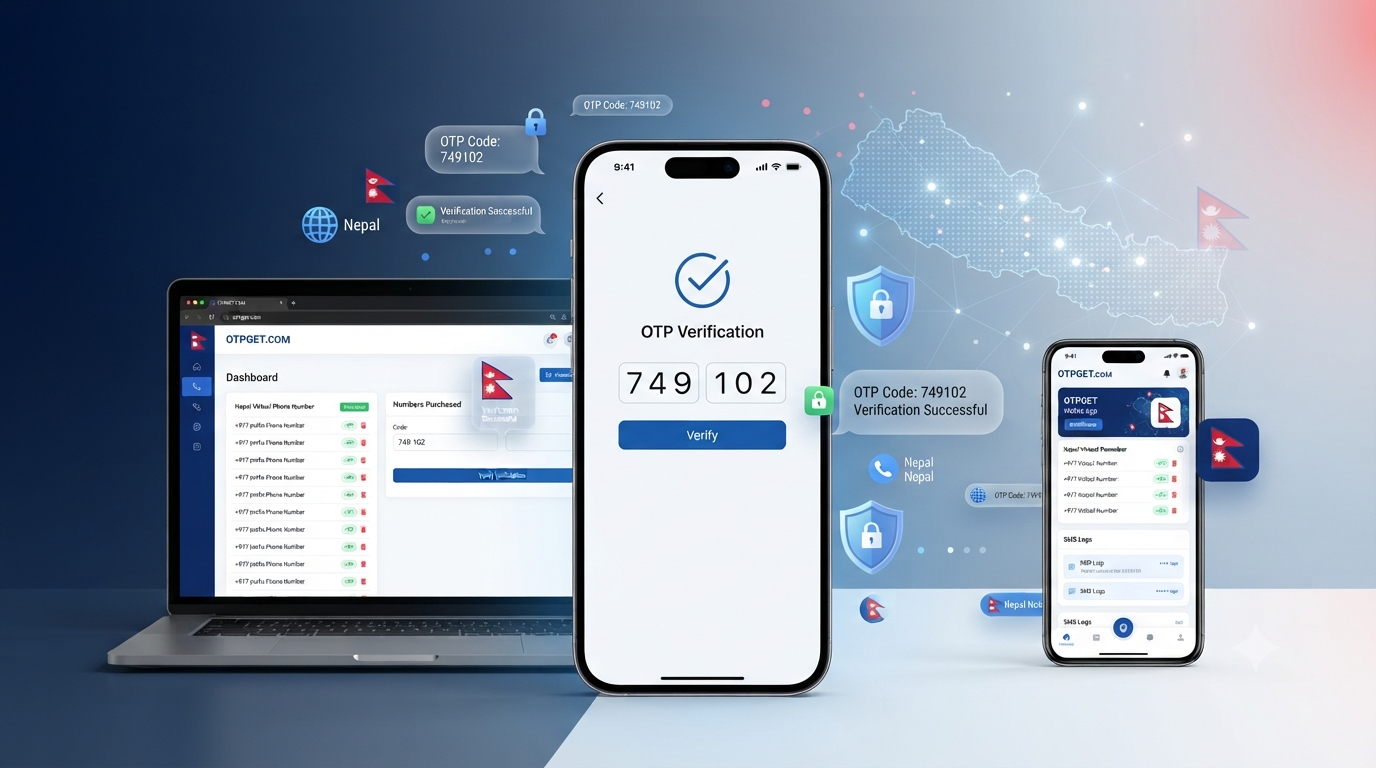
How Nepal OTP Verification Works
The basic process is straightforward.
- Select a Nepal number. Choose an available virtual number appropriate for the verification service.
- Enter the number. Add the number to the website or application requesting phone verification.
- Request the OTP. The service sends an SMS verification code.
- Receive the SMS. The message is routed to the virtual-number platform.
- Enter the verification code. Copy the OTP into the required field.
- Complete verification. If the number and code are accepted, the verification process is completed.
OTPGET describes its platform as providing virtual numbers for SMS OTP verification, with messages available through its online dashboard and developer tools.
Common Problems With Traditional SMS Verification
Traditional phone verification works well in many situations, but it can create practical problems.
Privacy concerns
Using a personal phone number for every signup can increase unwanted calls, messages, and exposure of your contact information. A separate virtual number can help keep certain verification activity away from your primary number.
International requirements
Businesses and developers working across markets may need numbers associated with specific countries. Obtaining and managing physical SIM cards for every location is inconvenient.
Delayed or missing messages
OTP delivery can depend on the service, carrier, routing, and number type. A verification SMS may occasionally arrive late or fail to arrive.
Testing limitations
QA teams cannot always test multiple phone-number scenarios using one personal SIM. Virtual numbers can make controlled SMS testing more practical where the target service permits them.
Managing multiple scenarios
A developer testing registration, password recovery, and phone verification may need several independent numbers. Managing physical devices and SIM cards quickly becomes cumbersome.
What Is a Nepal Virtual Number?
A Nepal virtual phone number is a phone number that is accessed through an online system rather than being tied directly to a physical SIM card in your handset.
For SMS verification, the number acts as the destination for an incoming message. When a supported service sends an OTP, the SMS can appear within the provider's online interface.
The main difference is convenience and management. Instead of keeping a separate phone and SIM available for every verification scenario, users can access supported virtual numbers through a web-based platform.
Virtual numbers are particularly useful for short-term verification, controlled testing, and situations where separating a verification number from a personal number makes sense.
How OTPGET Helps With Nepal SMS Verification
OTPGET is designed around virtual numbers and online OTP receiving. Its platform offers temporary virtual numbers, rental numbers, and developer API options for SMS verification workflows.
For someone searching for an OTPGET Nepal number, the basic idea is to select an available number for the desired country and supported service, use that number where verification is required, and monitor the incoming SMS through the platform.
OTPGET also provides API documentation for developers who want to integrate number purchasing and OTP retrieval into their own testing or automation workflows.
This makes the service relevant to both individual users and technical teams. A casual user may simply need to receive one verification code, while a developer may want a more structured SMS verification workflow.
How to Use OTPGET for Nepal Number SMS Verification
The exact availability of countries, numbers, and supported services can change, so check the platform before starting.
A typical workflow looks like this:
- Open OTPGET and create or access your account.
- Add balance if required for the number or service you want to use.
- Select the country and service from the available options.
- Choose an available virtual number suitable for your verification scenario.
- Copy the number and enter it into the website or application requesting verification.
- Request the SMS OTP from that service.
- Monitor the OTPGET dashboard for the incoming verification message.
- Copy the verification code and enter it on the original service.
- Complete the verification process and follow any remaining instructions.
OTPGET's documented workflow includes selecting a country and service, obtaining a number, and retrieving the received SMS status through its system or API.
Always check the target platform's terms before using a virtual number, especially for important or long-term accounts.
Who Can Benefit From a Nepal SMS Verification Number?
A Nepal SMS number can be useful across several professional and technical scenarios.
Developers
Developers can use virtual numbers when building and testing phone verification, login, registration, and password-recovery workflows.
QA testers
Testing teams can use different numbers to reproduce signup and SMS-related scenarios without repeatedly using personal numbers.
SaaS companies
A SaaS business entering the Nepali market may need to test country-specific onboarding and phone verification flows.
Startups
Early-stage teams can use virtual numbers for controlled testing without maintaining a collection of physical SIM cards.
App and website owners
Product teams can verify that SMS OTP functionality behaves correctly for users associated with Nepal.
Digital teams
Marketing, operations, and technical teams managing legitimate verification workflows may find temporary or virtual numbers more convenient than physical devices.
Nepal Number for OTP Verification: What Should You Look For?
Choosing an SMS verification service is about more than simply finding a number.
Consider these factors before purchasing:
- Number availability: Make sure the required country and service are supported.
- SMS delivery: The number should be capable of receiving the type of message you need.
- Ease of use: A clear dashboard can make receiving OTPs much simpler.
- Reliability: Look for transparent information about availability and service limitations.
- Supported scenarios: Some websites restrict virtual, VoIP, or previously used numbers.
- Privacy: Review how the provider handles account and transaction information.
- Cost: Compare the price of temporary use with longer rental options.
- Support: Documentation and customer support matter when verification does not work as expected.
No virtual-number provider can guarantee acceptance by every website or app. The final decision is always made by the service requesting verification.
Nepal SMS Verification for Developers and Testing
For developers, the value of a Nepal virtual phone number often goes beyond creating an account.
SMS verification needs to be tested as part of the complete user journey. A QA team might test whether the correct country code is accepted, whether the OTP arrives, whether expired codes are rejected, and whether users can request another code.
OTPGET supports developer-oriented workflows through its REST API documentation, including endpoints for obtaining numbers and checking OTP status.
This can be useful when manual testing is too slow or when a team needs to incorporate SMS verification into a broader QA process.
Tips for Successful Nepal OTP Verification
A few simple practices can prevent common problems:
- Confirm that the target website accepts virtual numbers.
- Select the correct country and service before ordering a number.
- Enter the number exactly as requested.
- Avoid repeatedly requesting OTPs in a short period.
- Give the SMS enough time to arrive before restarting the process.
- Enter verification codes promptly because OTPs can expire.
- Check the OTPGET dashboard carefully for incoming messages.
- For development work, document failed verification scenarios rather than repeatedly retrying them.
- Never use a temporary number as the sole recovery method for an account you need to retain long term unless the service supports that setup.
If a verification SMS does not arrive, review the number, service compatibility, and order status before trying again. OTPGET's policies also explain how unreceived OTP orders and cancellation procedures are handled.
Why Choose OTPGET for Nepal Number Verification?
For users who need a practical way to access virtual numbers and receive SMS verification codes online, OTPGET brings the essential pieces together in one platform.
Its offering includes virtual numbers, rental numbers, online SMS OTP receiving, and developer API functionality.
The biggest advantage is flexibility. Instead of purchasing and managing physical SIM cards for every testing or verification scenario, users can work through an online number system.
For developers and businesses, API access can also make automated testing and verification workflows easier to structure.
The right choice still depends on the target service, required number type, duration, and verification policy. OTPGET should be viewed as a practical tool—not a guarantee that every platform will accept every virtual number.
Frequently Asked Questions
What is Nepal number SMS verification?
It is the process of verifying a phone number associated with Nepal by receiving and entering an SMS-based one-time password.
How does Nepal OTP verification work?
A website or app sends an OTP to the selected Nepal number. The user receives the SMS through the number provider and enters the code into the original service.
Can I receive OTPs online using a Nepal virtual number?
Yes, where a compatible Nepal virtual number is available and accepted by the service. OTPGET provides online SMS receiving for supported virtual-number verification workflows.
What is a Nepal virtual phone number?
It is a phone number accessed through an online system rather than being directly connected to a physical SIM card in a personal phone.
How does OTPGET help with Nepal SMS verification?
OTPGET provides virtual numbers and an online system for receiving SMS OTPs. It also offers API functionality for developers who need programmatic verification workflows.
Who can use a Nepal number for SMS verification?
Developers, QA teams, startups, businesses, app owners, website owners, and individual users may benefit from virtual numbers for legitimate verification and testing scenarios.
Is a virtual Nepal number useful for app testing?
Yes. A virtual number can help developers and QA teams test registration, login, OTP delivery, and other phone-verification flows without relying entirely on personal numbers.
What should I consider when choosing an SMS verification service?
Look at number availability, supported services, SMS delivery, pricing, usability, privacy policies, rental options, API support, and the provider's terms of service.
Final Thoughts
Nepal number SMS verification does not have to mean managing multiple SIM cards or relying on a personal phone for every test and verification scenario. A suitable virtual number can provide a more convenient way to receive SMS OTPs for supported services.
For developers, QA teams, businesses, and users who need a Nepal number for appropriate verification purposes, OTPGET offers virtual numbers, online SMS receiving, rental options, and developer tools in one platform.
If you need a practical way to explore Nepal virtual numbers for SMS verification, visit and review the available countries, services, pricing, and usage requirements before choosing a number.
This version is structured for publication and can also be adapted into a shorter landing-page article, a more conversion-focused version, or a developer-focused guide.