OTPGet – The OTP Site People Search as OptGet: Complete Guide
OTPGet – The OTP Site People Search as OptGet
Searching for OTPGet but wondering why you also see the name OptGet? You are not alone. When people look for an OTP site, they may type a shortened name, misspell a brand, or simply remember the name differently.
The important part is understanding what they are actually looking for: a practical way to handle OTP verification, receive verification codes, or access virtual numbers and related online verification services.
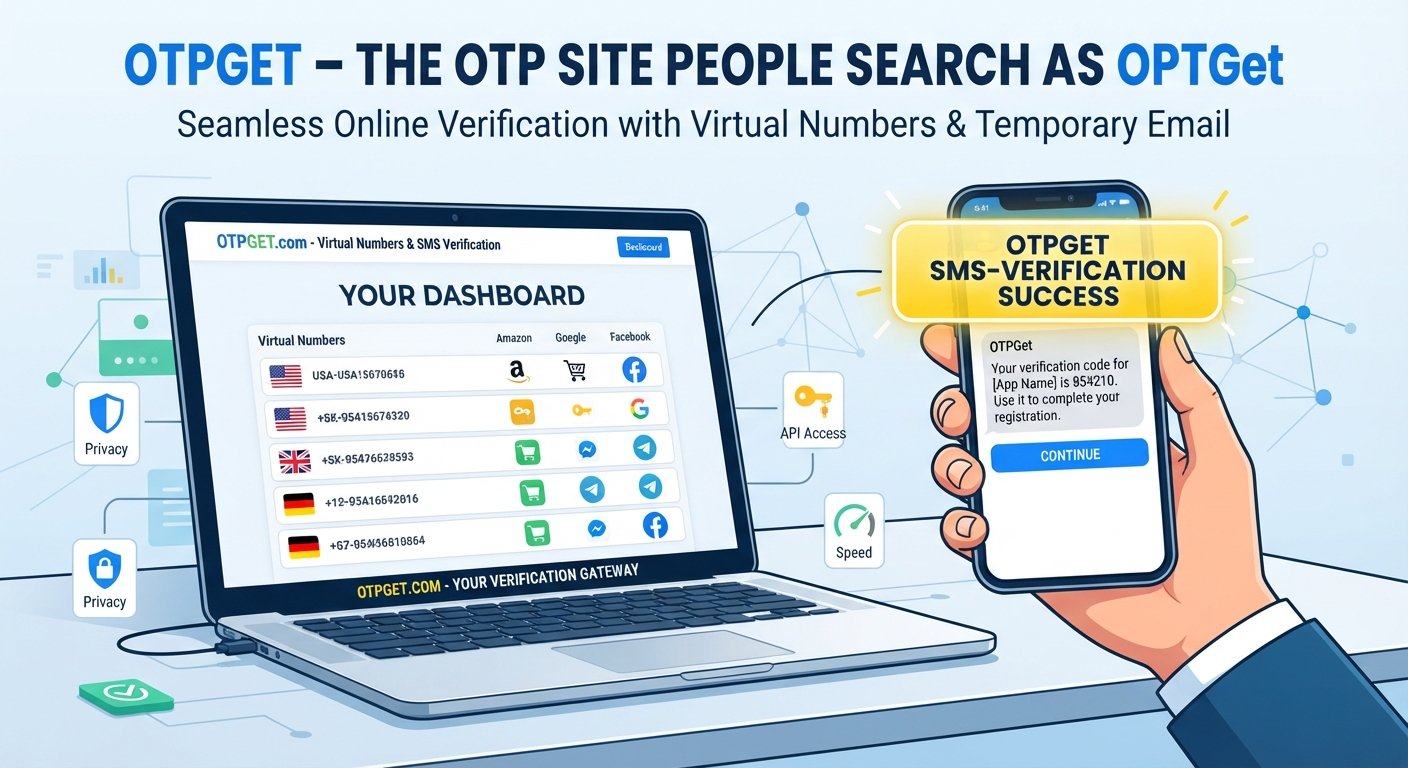
That is where OTPGet comes into the picture. OTPGet describes itself as a platform for virtual numbers and OTP verification, with options that include temporary numbers, rental numbers, temporary email services, and developer APIs. Its documentation also outlines APIs for obtaining numbers and retrieving received verification messages.
This guide explains what OTPGet refers to, why someone might search for “OptGet,” how OTP verification works, and what to consider before choosing an OTP service.
What Is OTPGet?
OTPGet is an online platform focused on virtual phone numbers and OTP verification. According to its official website, the service provides virtual numbers for receiving SMS verification codes, along with longer-term number rentals and temporary email options. It also provides APIs intended for developers who want to automate aspects of virtual-number and OTP workflows.
For a typical user, the basic idea behind an OTP service is straightforward.
You need to verify something online, a service sends a one-time password to a phone number or email address, and you need access to that verification message. An OTP platform can provide the relevant virtual number or temporary email environment for supported verification workflows.
OTPGet's documentation describes an SMS OTP API that can be used to check available countries and services, request a number, and check the status of an activation. It also documents rental-number and email-OTP APIs.
That makes OTPGet relevant to several types of users, including people looking for temporary verification options and developers interested in programmatic access.
Why Do People Search for OptGet Instead of OTPGet?
The search term OptGet may simply be a variation people use when they remember or type the name differently.
Brand searches frequently contain spelling differences. A user might omit a letter, swap the order of characters, or search for the name based on how it sounds. In this case, someone searching for “OptGet” may actually be trying to find OTPGet.
It is useful to distinguish between a search variation and an official brand identity, though. There is no need to assume that every use of “OptGet” represents a separate service or that the two names are officially interchangeable.
If you arrived here after searching for OptGet, the practical question is probably more important than the spelling: Were you trying to find an OTP site or online verification service?
If so, OTPGet is the relevant platform to explore.
Why OTP Verification Matters
An OTP, or one-time password, is a temporary verification code used to confirm an action, account, login, registration, or other online activity.
You have probably encountered the process before. A website or application asks for your phone number or email address, sends a short code, and then asks you to enter that code. Once accepted, the verification step is completed.
OTP verification can be useful because it adds another checkpoint to an online process.
Depending on the service, verification codes may be delivered through:
- SMS
- Authentication systems
- Other supported verification channels
For businesses and developers, OTP workflows can also become more complicated. Testing different registration flows, managing supported regions, or integrating verification-related functionality can require more than simply receiving a single message manually.
This is one reason OTP platforms can be useful. They provide infrastructure around the verification process rather than requiring every user or developer to solve the same logistical problem independently.
What Makes an OTP Site Useful?
Not every OTP service will suit every situation. Before using an OTP website or verification service, it makes sense to consider what the service actually provides.
Ease of use
A good user experience matters. Finding a number, selecting a service, and checking whether a verification message has arrived should be understandable without unnecessary complexity.
Availability
Number and service availability can vary. An OTP platform may support many countries and services, but availability for a specific combination can still depend on what is currently offered.
OTPGet states that it supports virtual numbers across numerous countries and services, while its API documentation shows users can query available countries and services rather than assuming every option is permanently available.
Verification workflow
The service should make it reasonably clear how a user obtains a number, waits for a verification code, and retrieves the message.
OTPGet's documentation describes this workflow through API actions such as requesting a number and checking activation status.
Privacy awareness
Users should understand what information they are sharing and how a service handles account and transaction information.
OTPGet's published terms state that it may collect information such as an email address, IP address, transaction records, and account activity logs for purposes including account security, payment verification, fraud prevention, and service improvement.
Transparency
Clear documentation is especially valuable for developers. OTPGet publishes documentation covering its SMS, rental-number, and email APIs, including request parameters and response formats.
Why OTPGet Can Be the Solution You're Looking For
If your search started with OTPGet, OptGet, “OTP site,” or “OTP verification service,” the underlying need is likely the same: finding a practical online verification solution.
OTPGet brings several related services together. Its website lists temporary virtual numbers, rental numbers, temporary email addresses, and developer APIs as parts of its platform.
That can make the platform relevant in different situations.
Someone who only needs a temporary number for an eligible SMS verification workflow may approach the service differently from a developer who wants API access. A business that needs a number for a longer period may also have different requirements from someone handling a one-time verification.
The important point is to match the service to the task.
OTPGet's documentation provides separate API endpoints for SMS OTP, rental numbers, and email OTP workflows, giving developers a more structured way to interact with the available services.
Rather than assuming that every OTP solution works the same way, users should review the available countries, services, pricing, policies, and technical requirements before proceeding.
How to Approach OTP Verification More Effectively
Using an OTP verification service responsibly starts with understanding what you need.
First, identify whether your requirement is for SMS verification, email verification, a temporary number, or a longer-term rental number. These are not necessarily interchangeable.
Next, check whether the specific service you need is supported. Availability can change, so it is better to confirm the available options rather than assume that a particular number or service will always be offered.
If you are a developer, review the API documentation before integration. OTPGet's documentation notes that its endpoints do not all use exactly the same response format, so applications should handle the documented responses appropriately.
Finally, pay attention to the rules of the website or application you are verifying. An OTP service should not be treated as a way around a platform's terms, security controls, or identity requirements. OTPGet's published terms prohibit illegal, fraudulent, abusive, or harmful use of its services.
OTPGet vs. What Users May Expect From an OTP Site
When someone searches for an OTP site, they usually want a straightforward experience: choose an appropriate option, receive a verification message, and complete the intended verification process.
A useful way to evaluate OTPGet—or any similar service—is to consider the following:
| What users may expect | What to consider |
|---|---|
| Simplicity | Is the verification workflow easy to understand? |
| Accessibility | Are the countries and services you need available? |
| Convenience | Can numbers or email options be managed without unnecessary steps? |
| Technical access | Are APIs and documentation available if automation is required? |
| Privacy awareness | Are data practices and account requirements clearly explained? |
| Reliability | Does the service provide a clear process for checking verification status? |
| Flexibility | Are temporary and longer-term options available for different needs? |
OTPGet's published service information indicates that it is designed to cover more than a single OTP use case, including virtual numbers, rentals, temporary email, and API-based workflows.
That broader range can be useful when your requirements change from one verification task to another.
Frequently Asked Questions About OTPGet
What is OTPGet?
OTPGet is an online platform focused on virtual phone numbers and OTP verification. Its listed services include temporary virtual numbers, rental numbers, temporary email, and developer APIs.
Why do people search for OptGet?
OptGet may be a spelling or search variation used by people who are trying to find OTPGet. A search variation does not necessarily mean there is a separate official service with that name.
What is an OTP site?
An OTP site is an online service associated with receiving or managing one-time verification codes, often through virtual phone numbers, email addresses, or related verification infrastructure.
What is OTP verification?
OTP verification uses a temporary code to confirm an online action such as account registration, login, or another supported verification process.
How does an OTP verification service generally work?
A typical workflow involves obtaining an eligible phone number or email address, using it for a supported verification process, waiting for the code, and retrieving the incoming message. The exact process varies by provider and service.
What should I look for in an OTP service?
Consider availability, ease of use, privacy practices, supported services, reliability, pricing, documentation, and whether the provider offers the type of number or verification method you actually need.
Why might someone choose OTPGet?
Someone searching for OTPGet may be looking for a combination of virtual numbers, SMS OTP verification, rental numbers, temporary email, or developer API access. OTPGet publishes documentation for these different workflows, allowing users to determine whether its available services match their needs.
Final Thoughts: Looking for OTPGet?
If you searched for OTPGet or typed OptGet into a search engine, you are likely looking for an OTP-related website that can help with online verification.
OTPGet is positioned around virtual numbers and verification services, with offerings that extend from temporary SMS numbers to rental numbers, temporary email, and developer APIs.
The best approach is to start with your actual requirement. Determine whether you need SMS or email verification, a temporary or longer-term option, or API access. Then check the currently available services, applicable policies, and technical documentation.
For readers specifically searching for an OTP site, OTP service, or OTP verification solution, OTPGet is the platform worth exploring. And if “OptGet” was the term that brought you here, you now have a clearer path to the service you were likely trying to find.