Temporary Email for Developers and QA Testing: A Practical Guide
Temporary Email for Developers and QA Testing: A Practical Guide
Building and testing an application often means creating far more accounts than a normal user ever would.
A developer may need to test a signup form several times. A QA tester might need separate accounts for different permission levels. An automation engineer may need a fresh email identity for each test scenario. Then there are verification emails, OTP codes, password resets, welcome messages, and other notifications to check.
Using a personal or work inbox for all of those scenarios quickly becomes inconvenient.
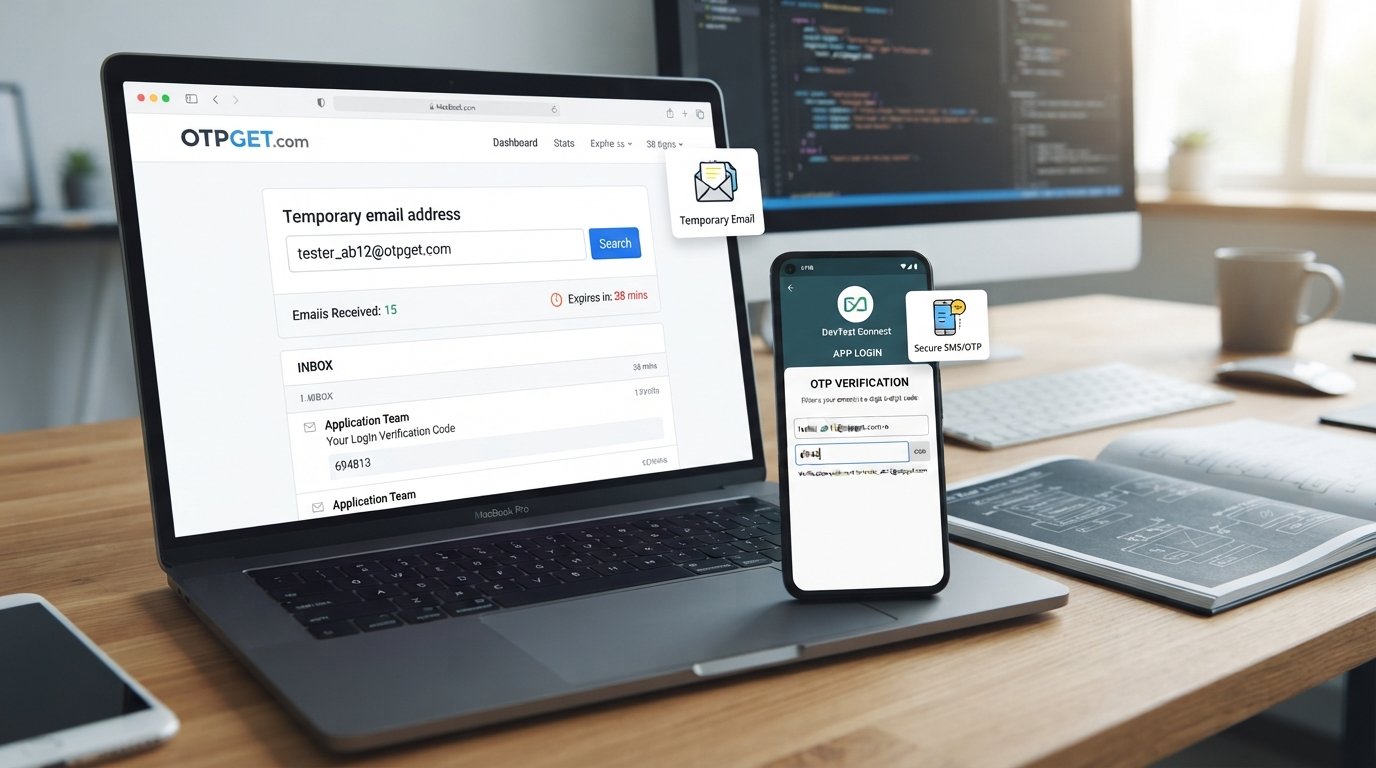
That is where temporary email for developers becomes useful. A temporary email address gives testing teams a separate place to receive messages without mixing test activity with everyday communication.
For developers and QA professionals looking for a practical temporary email solution, OTPGET can help provide a convenient way to handle temporary email needs during testing workflows.
[Internal Link Suggestion: Temporary Email]
What Is a Temporary Email for Developers?
A temporary email is an email address intended for short-term or limited-purpose use. Instead of using a primary personal or business mailbox, a tester can use a separate address when an application requires an email address.
For software teams, the concept is particularly useful because email is often part of the application itself.
Consider a simple signup flow:
- A user enters an email address.
- The application creates an account.
- A verification email is sent.
- The user opens the message.
- A verification link or code completes the process.
Every step can introduce something that needs testing.
A temporary email for testing gives developers and QA testers an isolated test email address for these scenarios. It can be useful in a development environment, staging environment, demo environment, or manual QA workflow.
The terminology varies. You may see temporary email, disposable email, disposable email address, temporary inbox, temporary mailbox, or test email address used to describe similar concepts. The exact behavior depends on the service and the testing scenario.
[Internal Link Suggestion: Disposable Email]
Why Developers and QA Teams Use Temporary Email
Temporary email is most useful when email is part of the application workflow being tested. Here are some common examples.
1. Testing Registration Forms
Signup testing frequently requires creating accounts repeatedly.
A tester can use a separate test email address instead of repeatedly entering a personal address. This helps keep test registrations separate from real communication.
2. Testing Email Verification
Many applications require users to verify their email before accessing an account.
QA email testing can involve checking whether the verification message arrives, whether its contents are correct, and whether the overall signup flow behaves as expected.
3. Testing OTP Delivery
OTP testing adds another step to the process. The application sends a one-time code, and the tester must retrieve it and enter it correctly.
A temporary inbox can provide a separate destination for verification messages, making it easier to test the email portion of an OTP verification workflow.
4. Creating Multiple Test Accounts
Some test scenarios require more than one account.
For example, a QA tester may need separate accounts to reproduce a problem affecting new users, returning users, or different account states. Separate email addresses can make these scenarios easier to distinguish.
5. Testing Password Reset Emails
Password recovery is another important application flow.
A tester can initiate a password reset, check the incoming message, and continue through the recovery process using a dedicated test email address.
6. Testing Welcome Emails
Signup may trigger an automated welcome message. Testers can verify whether the message is delivered and whether the expected content appears.
7. Testing Transactional Emails
Applications often send transactional messages for events such as account changes, confirmations, notifications, or other user actions.
A test email address gives QA teams a separate destination for examining these email workflows.
8. Testing Staging Environments
Staging environments are designed to behave similarly to production while remaining separate from real users.
Using dedicated test identities in staging can help reduce confusion between testing activity and genuine customer communication.
9. Automated QA Workflows
Automated testing may repeatedly create users and trigger application emails.
Where the testing setup supports it, temporary email can be part of a broader test-data strategy. The exact approach depends on the application's architecture and the capabilities of the selected email service.
10. Reproducing Signup-Related Bugs
Some bugs only appear when a new account follows a particular sequence.
A QA tester may need to repeat registration, verification, login, and password recovery several times. Having a separate test email address can make those repetitions easier to manage.
Common Problems With Using Personal Email for Testing
A personal inbox can work for occasional testing, but repeated application testing creates unnecessary friction.
Inbox clutter is one obvious problem. A handful of test messages can quickly become dozens when a team repeatedly tests signup and verification flows.
There is also the problem of repeated registrations. If the application treats an email address as unique, testers may need a different address for each scenario.
Managing several test accounts can become difficult when test messages are mixed with real conversations. A tester may also have to manually identify, delete, or archive messages after each round of testing.
Another issue is reproducibility. When a bug needs to be recreated, having a clear test identity and repeatable test data can make the workflow easier to understand.
Temporary email does not solve every test-data problem, but it can reduce some of the unnecessary friction around email-based application testing.
How Temporary Email Helps With QA Testing
The main benefit is separation.
Instead of treating a real inbox as part of the test environment, a tester can use a separate temporary mailbox for the application's email workflow.
Imagine a QA tester checking a new signup feature. They might need to:
- Create a new account.
- Receive a verification email.
- Retrieve an OTP.
- Complete account verification.
- Trigger a password reset.
- Receive the recovery message.
- Repeat the process with another account.
With a suitable temporary email service, these steps can be handled using dedicated test email addresses rather than repeatedly involving a personal inbox.
This can be particularly useful for email testing for developers, manual QA, application testing, and test-data preparation.
It also encourages a cleaner separation between real user communication and test activity.
[Internal Link Suggestion: Email Testing]
Using OTPGET for Developer and QA Testing
For developers looking for a temporary email solution, OTPGET can fit naturally into workflows where an application needs a separate email address for testing.
The basic process is straightforward:
- Obtain a temporary email address through OTPGET.
- Enter that address into the application's signup or test flow.
- Trigger the application's verification email or OTP.
- Check the temporary inbox for the relevant message.
- Retrieve the verification information needed for the test.
- Complete the application workflow.
- Repeat with another test scenario when required.
For example, suppose a tester is validating a registration flow. They can use a temporary address for the registration, trigger the application's email verification process, inspect the incoming message, and continue the test.
The same general approach can apply to account verification testing, email confirmation testing, and other workflows where receiving an email is part of the application's behavior.
OTPGET is therefore most useful to think of as a practical testing resource: a way to provide a separate email destination when developers or QA testers do not want to rely on their everyday inboxes.
The exact suitability of any temporary email service depends on the application's requirements and the testing policies of the team.
Temporary Email vs. Personal Email for Software Testing
The right choice depends on what is being tested, but the differences are easy to understand.
| Testing consideration | Temporary email | Personal email |
|---|---|---|
| Inbox organization | Keeps testing separate | Can mix test and real messages |
| Test account creation | Useful for separate test identities | May require repeated reuse |
| Verification testing | Suitable for receiving test messages | Works, but can add inbox clutter |
| Repeated scenarios | Convenient for isolated tests | Can become difficult to manage |
| QA workflow separation | Helps separate test activity | Test activity shares a real inbox |
| Convenience | Useful for short-term scenarios | Familiar for everyday communication |
| Test-data management | Can support dedicated test identities | Often requires more manual organization |
Temporary email is not automatically appropriate for every test. If an account needs long-term recovery, persistent ownership, or ongoing communication, a dedicated test mailbox may be more suitable.
Best Practices for Temporary Email Testing
Temporary email works best when it is part of a structured testing process.
Keep Test and Production Environments Separate
Avoid mixing production accounts with development or staging test data. Make the environment and purpose of each account clear.
Document Repeatable Test Scenarios
If a test involves registration, verification, OTP entry, and password recovery, document the steps. Repeatability makes bug reproduction much easier.
Use Dedicated Test Data
Keep test names, addresses, credentials, and account states organized. This is especially important when several testers are working on the same application.
Verify Email Delivery
Do not only check whether a test passes. Confirm that the expected email is actually delivered and that the application handles the message correctly.
Test Successful and Failed Verification
A strong verification test should consider more than the happy path. Where relevant, test incorrect, expired, or otherwise invalid OTP scenarios.
Check Password Reset Emails
Password recovery is often overlooked during signup testing. Include it when the feature is part of the application's user journey.
Test Different Signup Paths
If an application has multiple registration methods or account states, use appropriate test cases for each path.
Avoid Temporary Email for Important Personal Accounts
Temporary addresses are intended for temporary or testing-oriented scenarios. They are generally not a suitable replacement for an important personal account that requires dependable long-term recovery.
Follow Testing and Security Policies
Always follow your organization's rules and the application's terms or testing requirements. Temporary email should support responsible testing, not bypass access controls or account policies.
When Should You Use a Temporary Email Address?
Temporary email can make sense when the email address is primarily being used as test data.
Common situations include:
- Development testing
- QA testing
- Staging environments
- Demo environments
- Automated test cases
- Signup testing
- Email verification testing
- OTP testing
- Account creation testing
- Reproducing registration bugs
- Email workflow testing
It may be less appropriate when an account needs permanent access, long-term password recovery, important notifications, or ongoing communication.
For those situations, a dedicated long-term test mailbox may provide better continuity.
The key question is simple: Does the test require a temporary email identity, or does the account need a persistent identity?
Why OTPGET Can Be Useful for Testing Workflows
Developers and QA testers frequently need isolated email addresses for one very practical reason: applications often make email part of the workflow.
A tester cannot fully evaluate registration if they cannot test verification. They cannot properly check an OTP flow without receiving the relevant message. And they may struggle to reproduce signup bugs when every test is tied to the same real inbox.
OTPGET can help address that practical need by providing a temporary email option for testing workflows.
It can be useful when a developer needs a test email address, when a QA tester needs to inspect a verification message, or when a software testing team wants to keep temporary test activity separate from everyday email.
For teams evaluating testing tools, OTPGET can be considered alongside the application's own test-data strategy and QA requirements.
Frequently Asked Questions
What is a temporary email for developers?
A temporary email for developers is an email address used for short-term development, QA, or software testing tasks instead of a primary personal or work address.
Can I use temporary email for QA testing?
Yes. Temporary email can be useful for signup testing, verification email testing, password recovery, test accounts, and other workflows where an application sends messages to the user.
How does temporary email help with OTP testing?
When an application sends an OTP through email, a temporary inbox can provide a separate place to receive the verification message. The tester can then retrieve the code and continue the test.
Can temporary email be used for test accounts?
Yes. A temporary email address can be used as test data when an application requires a unique email for account creation. Suitability depends on how the application manages account persistence and recovery.
What is the difference between temporary email and disposable email?
The terms are often used interchangeably. Both generally describe email addresses intended for limited or temporary use. The exact behavior varies between services.
Is temporary email useful for automated testing?
It can be. Temporary email may form part of an automated testing strategy when test cases need separate email identities. The specific implementation depends on the application's architecture and the capabilities available in the chosen service.
Can I use OTPGET for email verification testing?
OTPGET can be used as a practical temporary email option when you need an email destination for application verification and testing workflows.
When should I avoid using a temporary email address?
Avoid using one when an account requires reliable long-term access, persistent recovery, important personal communication, or an identity that must remain available over an extended period.
Final Thoughts
Email is easy to overlook during software development, but it is often a critical part of the user journey.
Registration, verification, OTPs, password resets, welcome messages, and transactional notifications all create test cases that need realistic handling. Repeatedly using a personal inbox for those tasks can make testing harder to organize.
A temporary email address provides a simple way to separate test identities from everyday communication. For developers and QA professionals, that can make application testing, signup testing, verification testing, and repeated test scenarios easier to manage.
OTPGET provides a practical option for developers, QA testers, automation engineers, and software teams that need temporary email for testing workflows.
If your application relies on email verification or account-based workflows, exploring OTPGET as part of your testing process can be a useful next step.
[Internal Link Suggestion: OTP Verification]
[Internal Link Suggestion: Developer Testing Tools]