UAE Number for OTP Codes: What You Should Know Before Choosing
UAE Number for OTP Codes: What You Should Know
Signing up for an online service can sometimes come with one extra step: entering a phone number and waiting for a one-time password, or OTP, by SMS.
For users who specifically need a UAE-based number, this can raise practical questions. Do you need a physical SIM? Can a virtual UAE number receive verification messages? Will every website or app accept it? And what should you check before choosing an OTP receiving service?
A UAE number for OTP codes can be either a conventional mobile number or a virtual number capable of receiving supported SMS messages. The right choice depends on the service being verified, the type of number available, and the provider's policies.
Services such as OTPGET provide virtual numbers intended for SMS-based verification, giving users an online option when a suitable number is available for their intended use. OTPGET's documentation also describes SMS OTP and longer-term rental number services.
This guide explains how UAE OTP verification works, where virtual numbers fit in, what to consider before using one, and how OTPGET may help with legitimate verification workflows.
What Is a UAE Number for OTP Codes?
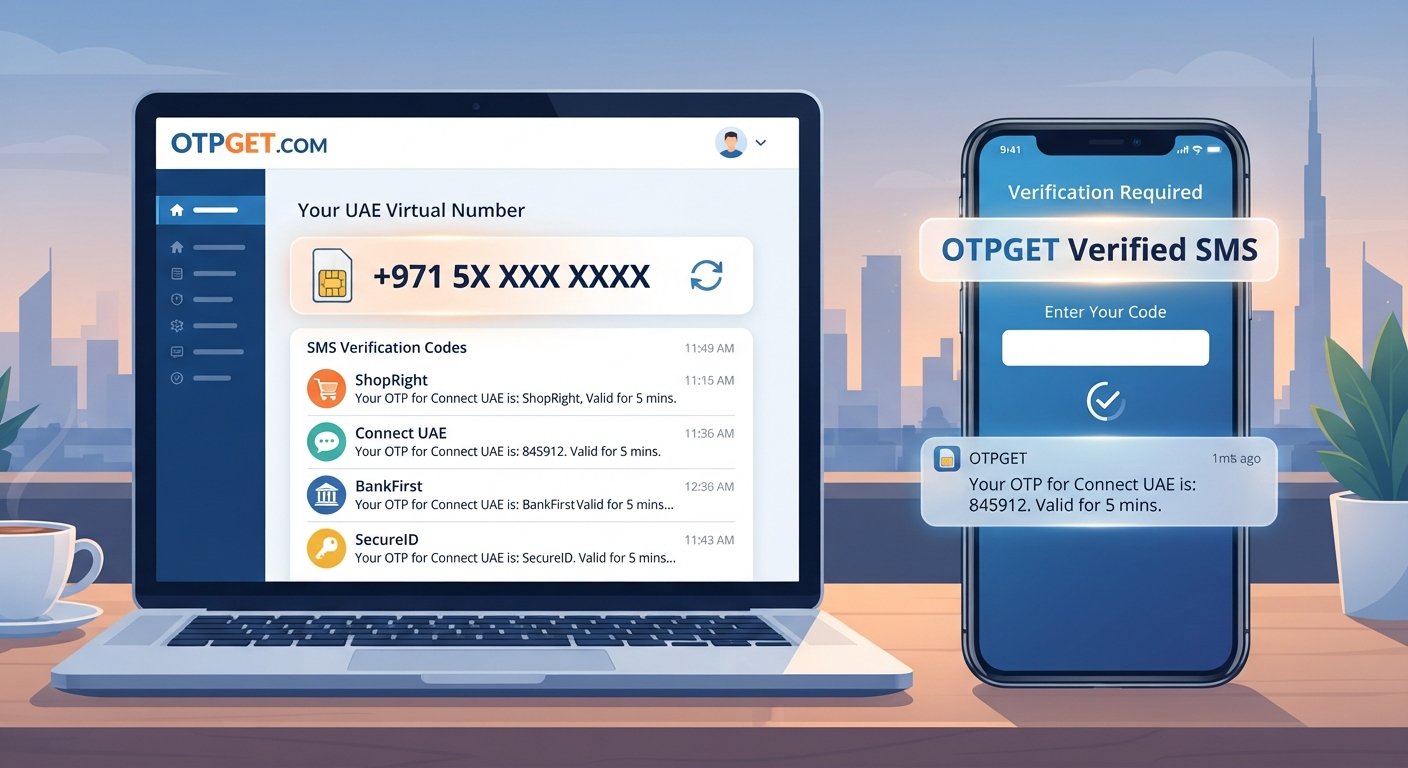
A UAE number for OTP codes is a phone number associated with the UAE that can receive a verification message containing a one-time password.
An OTP, or one-time password, is a temporary code generated for a particular verification event. A website or application sends the code to the phone number entered during registration, login, recovery, or another authorized action. The user then enters that code into the relevant verification screen.
The basic process looks like this:
Phone number entered → SMS sent → OTP received → Code entered → Verification completed
A traditional UAE mobile number is normally connected to a physical SIM and mobile network. A virtual UAE phone number, by contrast, is provided through an online telecommunications service rather than requiring the user to insert a physical SIM into a phone.
The important distinction is not simply whether a number is physical or virtual. It is whether the number can receive the type of SMS required by the particular service.
Some platforms accept virtual numbers, while others may restrict temporary, shared, recycled, or VoIP numbers. Therefore, having a UAE number does not automatically mean that every service will accept it.
Why Do You Need a UAE Number for OTP Verification?
There are several legitimate reasons someone may need a UAE phone number for verification.
For example, a user may need a UAE-based number when working with a UAE-focused service, testing a localized application, managing an authorized business workflow, or registering for a service that specifically requests a UAE mobile number.
Common use cases can include:
- UAE-focused services: Some platforms require a number associated with a particular country or market.
- Application testing: Developers and QA teams may need numbers for testing SMS and verification workflows.
- Business operations: Teams may need separate numbers for authorized account or service verification.
- Privacy separation: A user may prefer not to expose their everyday personal number for an appropriate secondary use.
- Verification workflows: Certain legitimate registrations require an SMS code before access is completed.
The important limitation is that a virtual number should not be treated as a way to bypass identity checks, geographic restrictions, fraud controls, or a platform's rules.
If a service says that virtual or temporary numbers are not permitted, using one anyway can lead to a failed verification or account restriction.
How Does a UAE OTP Number Work?
Using a UAE OTP number for a supported verification process is generally straightforward.
1. Choose an appropriate UAE number
Select a number that is intended to receive SMS and is suitable for the service you are using.
2. Enter the number
Use the number on the legitimate registration or verification page of the relevant website or application.
3. Request the OTP
The service sends a verification SMS to the number.
4. Receive the message
The OTP provider receives the incoming SMS if the number and service are compatible.
5. Enter the code
Enter the received OTP into the original verification screen.
6. Complete verification
If the code is valid and the service accepts the number, the verification process can continue.
OTPGET's documentation describes a workflow in which a user selects an available country and service, obtains a number, and checks the activation status for an incoming SMS.
The exact experience can vary by provider and target platform, so users should always follow the instructions displayed by the service they are trying to verify.
UAE Virtual Number vs. Physical SIM Number
Both options can serve legitimate communication or verification purposes, but they work differently.
| Feature | Physical UAE SIM | Virtual UAE Number |
|---|---|---|
| Hardware | Requires a physical SIM | Typically accessed online |
| Setup | Requires a compatible device and SIM | Usually managed through an online service |
| SMS reception | Through a mobile network | Through the provider's system |
| Accessibility | Generally tied to the SIM/device | Can be accessed through an online dashboard or system |
| Convenience | Familiar and direct | Useful when an online number is sufficient |
| Privacy | Uses the holder's mobile number | Can provide separation from a personal number |
| Verification compatibility | Often broadly supported, depending on service | Depends on the target platform |
| Long-term ownership | Depends on the mobile provider and plan | Depends on the provider and rental or number terms |
Neither option is universally better.
A physical SIM may be preferable when you need a long-term personal mobile identity, while a virtual number may be more convenient for a specific supported online verification workflow.
The biggest consideration is compatibility. A service may accept a conventional UAE mobile number while rejecting a temporary or virtual number.
What to Look for in a UAE Number for OTP Codes
Choosing an OTP number should involve more than simply finding a number with a UAE country code.
Consider these factors before using a provider:
SMS receiving capability
Confirm that the number is intended to receive SMS messages and that the relevant service is supported.
Availability
Number inventory can change. A provider may have a country or service available at one point and have limited or no numbers later.
Privacy
Understand what information the provider collects, how account activity is handled, and who may have access to messages or account information.
Number ownership and access
Find out whether the number is temporary, rented, dedicated, or potentially reused. These distinctions matter for accounts that you intend to retain.
Reuse policies
A number that is later assigned to another user can create complications for accounts that remain associated with it. For important long-term accounts, consider whether you need a number you control over an extended period.
Supported services
Do not assume that a number will work everywhere. Check whether the intended website or application permits the type of number being used.
Reliability
SMS delivery can depend on the originating platform, telecommunications networks, provider infrastructure, and the specific number. No responsible provider should be assumed to guarantee delivery for every service.
Pricing transparency
Before purchasing, understand what you are paying for, how the service works, and whether temporary access differs from longer-term rental.
Customer support
A clear support process can be valuable when a message does not arrive or a verification workflow behaves unexpectedly.
How OTPGET Can Help With UAE OTP Verification
OTPGET is an online service focused on virtual numbers and OTP-related verification workflows. Its official documentation describes an SMS OTP API that allows users or developers to retrieve available countries and services, request numbers, and check activation status for incoming SMS.
OTPGET also describes virtual numbers for OTP verification and separate rental-number functionality on its website.
For someone looking for a UAE number for SMS verification, the practical value is having an online workflow for obtaining a suitable number and receiving supported verification messages without necessarily relying on a personal physical SIM.
However, availability and compatibility should always be checked before relying on a particular number. OTPGET's documentation shows that available countries and services are queried through its system, while its terms explain that verification success can also depend on the external application, platform restrictions, device issues, or other factors outside the number provider's control.
That distinction is important. OTPGET can provide the number and message-receiving service, but it does not mean every external website will accept every number.
If your intended use is legitimate and the target service permits virtual numbers, OTPGET can be a practical option to explore for supported UAE verification requirements.
Tips for Receiving OTP Codes Reliably
A few simple practices can reduce unnecessary verification problems:
- Check compatibility first. Make sure the target service permits the type of number you plan to use.
- Confirm SMS support. Not every virtual number supports every kind of message.
- Use the number before requesting the code. Make sure the number is active and correctly entered.
- Avoid repeated requests. Requesting multiple OTPs in quick succession can sometimes cause delays, invalidation of earlier codes, or temporary verification restrictions.
- Wait for the message. SMS delivery may take some time depending on the originating service and provider.
- Use the latest valid code. If multiple messages arrive, an earlier OTP may no longer be valid.
- Keep OTPs confidential. A verification code should never be given to an unknown person.
- Follow platform rules. Use numbers only for purposes permitted by the relevant service.
If a code does not arrive, repeatedly requesting new codes is not always the best solution. First check the number, service compatibility, account status, and provider information.
Is It Safe to Use a UAE Number for OTP Codes?
A UAE virtual number can be useful, but safety depends on how the number and verification service are used.
The first rule is simple: never share an OTP with another person unless you are deliberately and legitimately authorizing a transaction or workflow that requires it. An OTP is an authentication credential, even if it is temporary.
Privacy is another consideration. Before using an online OTP service, review its policies and understand what information may be collected. OTPGET's published terms state that it may collect information such as an email address, IP address, transaction records, and account activity logs for purposes including account security, payment verification, fraud prevention, and service improvement.
Number reuse is also worth considering. A temporary or recycled number may not be appropriate for an account that you expect to control for a long period.
Finally, remember that OTP verification itself is not a guarantee of complete account security. It is one part of an authentication process. Strong passwords, appropriate account-recovery settings, device security, and careful handling of verification codes still matter.
Common Questions About UAE OTP Numbers
Can I receive OTP codes on a UAE virtual number?
Yes, a virtual UAE number may receive SMS verification codes when the number supports the required SMS type and the target service accepts virtual numbers. Compatibility varies by platform.
What is a UAE number used for?
A UAE number can be used for ordinary communication and for legitimate services that require a UAE-based phone number. Depending on the provider and service, it may also be used for supported SMS verification workflows.
Can a UAE number receive SMS verification codes?
A UAE number designed for SMS reception can receive verification messages, but delivery depends on the provider, the originating service, and whether that service accepts the number.
Are virtual UAE numbers suitable for every service?
No. Some websites and applications restrict temporary, virtual, VoIP, or previously used numbers. Always check the relevant service's rules before using one.
How does a UAE OTP number work?
The process is simple: obtain an appropriate number, enter it into a permitted verification workflow, request the SMS, receive the OTP, and enter the valid code into the service.
Is it safe to receive OTP codes online?
It can be appropriate for legitimate uses, but users should consider provider privacy practices, number ownership, reuse policies, and the security of the account involved. Never share verification codes unnecessarily.
How can OTPGET help with UAE OTP verification?
OTPGET provides virtual numbers and an SMS OTP workflow designed for receiving supported verification messages. Its documentation also describes country, service, number-request, and activation-status functions. Availability for a particular UAE use case should be checked through the service.
Final Thoughts
A UAE number for OTP codes can be useful when a legitimate website, application, business workflow, or testing environment requires a UAE-based number for SMS verification.
The key is choosing the right type of number for the job. Look beyond the country code and consider SMS capability, platform compatibility, privacy, number ownership, reuse policies, reliability, and transparent service terms.
Virtual numbers can offer convenience without requiring a physical SIM, but they are not a universal workaround for verification restrictions. Each platform decides which numbers it accepts.
For supported and legitimate verification purposes, OTPGET offers an online approach to obtaining virtual numbers and receiving SMS-based OTPs. Before using the service, check the available number and service options and make sure your intended use complies with the target platform's rules.
If you need a UAE number for a supported OTP verification workflow, explore the available options on OTPGET and choose the type of number that fits your intended use.