Virtual Numbers vs Extra SIM Cards: Comparing the Real Costs
Virtual Numbers vs Extra SIM Cards: Comparing the Real Costs
Need another phone number but do not want to complicate your mobile setup?
You have two common choices: get an extra SIM card or use a virtual phone number. Both can give you access to another number, but they solve slightly different problems.
The important question is not simply, "Which one costs less?" It is which option gives you the right combination of cost, convenience, privacy, and flexibility for the way you actually plan to use it.
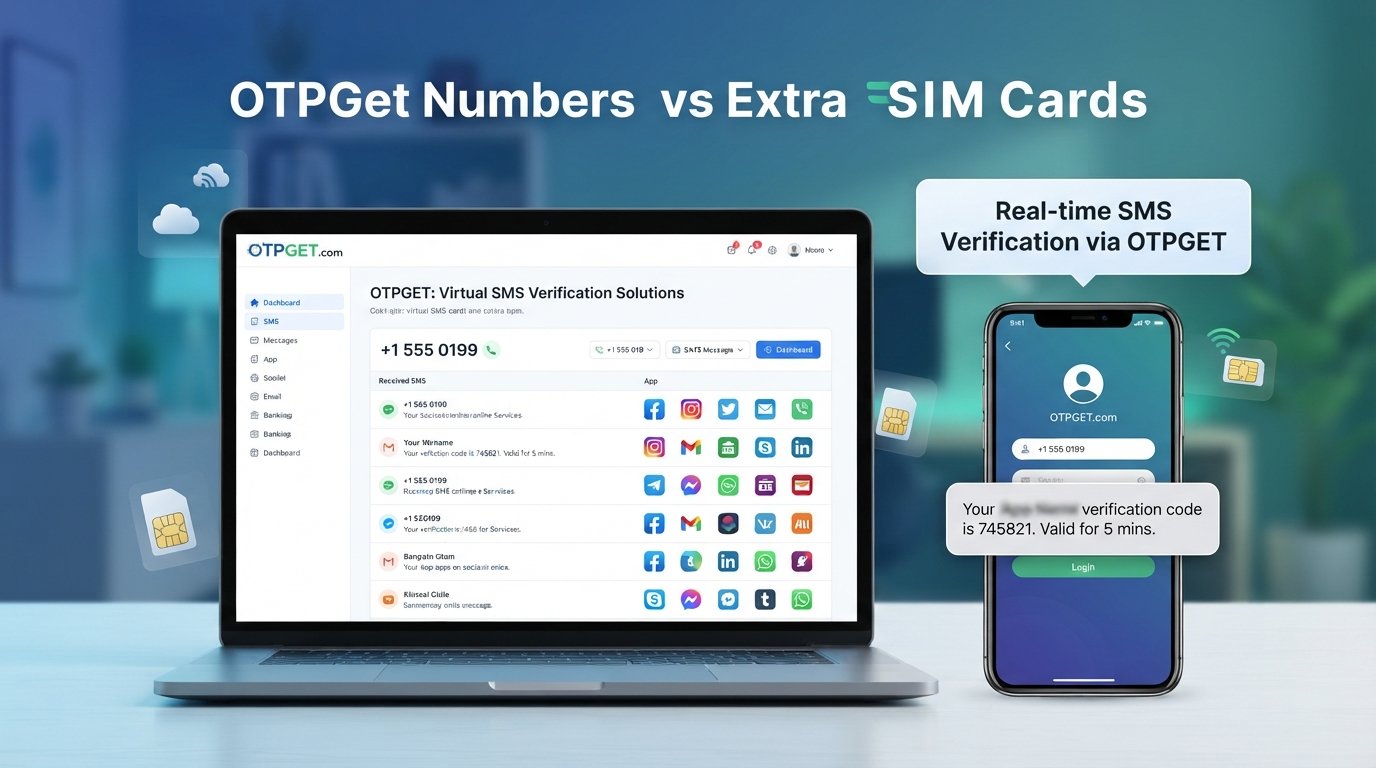
For people who mainly need a number for online registrations, OTP verification, or temporary SMS verification, a virtual-number service such as OTPGET can be an option worth considering.
Let's compare the two approaches in practical terms.
Virtual Numbers vs Extra SIM Cards: What's the Difference?
A virtual number is a phone number provided through an online service rather than a physical SIM installed in your phone. Depending on the provider and service, it may be used for SMS, calls, verification, or other communication purposes.
An extra SIM card, by contrast, is a physical SIM issued by a mobile carrier. It normally gives you another mobile connection with its own number and may support calls, SMS, and mobile data.
The key difference is simple: an extra SIM gives you another physical mobile connection, while a virtual number gives you access to a number through an online service.
Common reasons for getting either option include:
- Separating personal and online communication
- Registering for online services
- Receiving SMS OTPs
- Keeping a second number for specific purposes
- Managing business or personal communications separately
- Using a temporary number when a permanent mobile connection is unnecessary
The best choice depends heavily on what you actually need the number to do.
The Real Cost of an Extra SIM Card
An extra SIM card can appear inexpensive at first. However, the SIM itself is only one part of the total cost.
Depending on your carrier, country, and plan, you may have expenses associated with:
- SIM purchase or activation
- Monthly service plans
- Minimum balance requirements
- SMS charges
- Voice calls
- Mobile data
- Keeping the number active
- Replacement of a lost or damaged SIM
There is also the practical cost of maintaining another mobile connection.
If you only need a second number occasionally for online verification, paying to keep a full mobile line active may not match your actual usage.
Device compatibility can also matter. A phone may support dual SIM functionality, but not every device handles two connections in exactly the same way. Some users may need to switch SIMs between devices, particularly if their primary phone has limited SIM capacity.
So when comparing SIM card cost with a virtual number cost, look beyond the initial activation price.
What Does a Virtual Number Cost?
Virtual number pricing can work in several ways. The model depends on the provider and the purpose for which the number is being used.
Common approaches include:
- Pay-per-use: You pay for a particular number or verification use.
- Temporary numbers: A number is available for a limited period or specific purpose.
- Number rental: You pay to retain a number for a defined period.
- Subscription plans: A recurring fee provides access to a number or service.
- Verification-specific options: Some services focus on receiving SMS or OTP messages for supported verification scenarios.
This makes virtual phone number cost harder to compare directly with an extra SIM.
A physical SIM may provide calls, SMS, and mobile data, while a virtual number may be more focused on a specific online communication or verification requirement.
The right comparison is therefore based on what you are paying for and how often you need it, not just the advertised starting price.
Hidden Costs of Extra SIM Cards
The biggest expense of an additional SIM is not always the purchase price.
There are several less obvious considerations.
Physical ownership
You have another physical item to store, protect, and manage. If it gets lost or damaged, replacing it can become another task.
Keeping the number active
A number that is rarely used may still require ongoing maintenance under the carrier's rules or plan structure.
Device limitations
A second SIM can be inconvenient if your phone does not support dual SIM use or if you regularly move between devices.
Switching and management
Changing SIMs, remembering which number is associated with which service, and managing two mobile accounts can add friction.
Privacy considerations
Using your primary mobile number for every online registration can make it harder to keep personal and online communication separate. A second number can help create that separation, although it does not automatically make activity anonymous or completely private.
Hidden Benefits of Virtual Numbers
Virtual numbers can be attractive because they remove some of the physical overhead associated with another SIM.
Potential benefits include:
- No physical SIM to carry
- Convenient online access
- Flexible use for specific purposes
- Easier separation between personal and online activity
- Useful for temporary verification
- Less dependence on a particular physical device
- A separate number for selected online registrations
For someone who needs an online phone number primarily for SMS or verification, these advantages can be more important than having another complete mobile plan.
There is one important limitation: not every website, app, or service accepts virtual numbers. Some verification systems restrict certain number types, so compatibility should always be checked for the service you intend to use.
OTPGET: A Practical Virtual Number Solution
If your main requirement is a number for legitimate online verification rather than another full mobile connection, a virtual-number service can simplify the process.
OTPGET is a practical option for users looking for virtual numbers for purposes such as online registrations, OTP verification, SMS verification, and temporary online services.
Instead of obtaining and maintaining another physical SIM, users can consider a virtual-number approach when their needs are primarily online.
This can be useful when you want to:
- Keep your personal number separate from online registrations
- Handle selected OTP verification tasks
- Use a number for temporary online services
- Receive SMS for supported verification scenarios
- Avoid maintaining another physical SIM solely for occasional online use
The important word is supported. Virtual-number acceptance varies between websites and services, so OTPGET should not be treated as a universal solution for every verification system.
If you only need online verification rather than calls, mobile data, and a long-term carrier connection, exploring a service such as OTPGET may be more practical than maintaining another physical line.
Virtual Number vs Extra SIM Card: Cost Comparison
| Factor | Virtual Number | Extra SIM Card |
|---|---|---|
| Initial setup | Usually online; depends on provider | Requires obtaining and activating a physical SIM |
| Physical SIM required | No | Yes |
| Ongoing cost | Depends on usage, rental, or subscription model | Depends on carrier plan and usage |
| OTP verification | Available for supported services | Generally available through the carrier |
| SMS access | Depends on the service | Typically part of mobile service |
| Device dependency | Usually lower for the number itself | Tied to a physical SIM and compatible device |
| Convenience | Useful for online-focused needs | Useful for full mobile connectivity |
| Privacy considerations | Can separate online activity from a personal number | Provides a separate physical mobile number |
| Temporary use | Often well suited to temporary needs | Less convenient if a full mobile plan is unnecessary |
| Long-term maintenance | Depends on provider and number arrangement | Requires maintaining the mobile line |
Neither option is automatically cheaper for everyone.
An extra SIM may make more sense when you need regular calls, mobile data, and a long-term carrier connection. A virtual number can make more sense when your requirement is narrower, such as online verification or temporary SMS access.
For users specifically looking for the latter, OTPGET offers a virtual-number approach worth exploring.
When an Extra SIM Card Makes More Sense
A physical SIM remains the practical choice in many situations.
Consider an extra SIM if you need:
- Regular phone calls
- Mobile data
- Long-term use of a second number
- A carrier-issued mobile connection
- A number for services that require or prefer physical mobile numbers
- More traditional mobile functionality
For example, someone who wants a dedicated number for business calls and mobile data may get more value from an additional SIM than a virtual number.
A physical number can also be preferable when a particular service does not accept virtual numbers.
When a Virtual Number Makes More Sense
A virtual number may be more convenient when your needs are primarily online.
It can be worth considering for:
- Temporary online verification
- SMS OTP use
- Online registrations
- Separating online activity from your personal number
- Occasional verification needs
- Avoiding another physical SIM
- Specific online services that support virtual numbers
For these use cases, maintaining a complete mobile connection can be unnecessary.
OTPGET can be considered by users who want to explore a virtual-number option for legitimate OTP and SMS verification purposes.
Is a Virtual Number Actually Cheaper?
There is no universal answer.
The lower-cost option depends on several factors:
- How long you need the number
- How frequently you use it
- Whether you need calls or mobile data
- Whether a physical SIM must remain active
- Whether the number is temporary or long-term
- Your location and carrier
- The pricing model of the virtual-number provider
- Whether the service you need accepts virtual numbers
For example, someone who needs a second line every day may find a physical SIM more suitable because it provides a complete mobile service.
Someone who only needs a virtual number for verification may have a different cost calculation because they do not necessarily need ongoing calls, data, or a physical connection.
That is where services such as OTPGET can be useful to consider. If the requirement is primarily online verification and OTP-related use rather than full mobile service, a virtual approach may better match the actual need.
How to Choose Between a Virtual Number and an Extra SIM
A simple decision framework can make the choice easier.
Choose an extra SIM if you need:
- Regular calls
- Mobile data
- Long-term carrier service
- A physical mobile number
- Broader mobile functionality
Consider a virtual number if you need:
- Online verification
- OTP or SMS access
- Temporary use
- Separation from your personal number
- Convenience without another physical SIM
If your needs fall into the second group, you can explore virtual-number services such as OTPGET and check whether the intended website or service supports the number type.
The most important step is to match the solution to the task. There is little benefit in maintaining a complete mobile line if all you need is occasional online verification.
Frequently Asked Questions
1. Are virtual numbers cheaper than extra SIM cards?
Sometimes, but not always. Cost depends on how long you need the number, how often you use it, and whether you require calls, mobile data, or only SMS verification.
2. What is the difference between a virtual number and a SIM card?
A SIM card provides a physical carrier-based mobile connection. A virtual number is provided through an online service and does not require a physical SIM in your device.
3. Can I use a virtual number for OTP verification?
A virtual number can be used for OTP verification on services that accept that type of number. Acceptance varies, so compatibility should be checked before relying on it.
4. Can I receive SMS on a virtual number?
Some virtual-number services support receiving SMS, including verification messages for supported services. The exact functionality depends on the provider and number type.
5. Is a virtual number suitable for temporary verification?
It can be suitable when you need a number for a limited online purpose and the relevant service accepts virtual numbers.
6. When should I choose an extra SIM instead?
Choose an extra SIM when you need regular calls, mobile data, long-term carrier service, or a physical number for a service that does not accept virtual numbers.
7. What is OTPGET?
OTPGET is a virtual-number solution that can be considered for legitimate online registration, OTP verification, SMS verification, and related online communication needs. Availability and acceptance can vary by service.
Conclusion
The choice between virtual numbers vs extra SIM cards ultimately comes down to what you need the second number to accomplish.
An extra SIM is a broader mobile solution. It can be useful for regular calls, mobile data, and long-term use. A virtual number is often more focused on online access, temporary needs, SMS, or separating online activity from a personal number.
Cost matters, but convenience and maintenance matter too. A number that is inexpensive to obtain may not be the most practical option if you rarely use the services that come with it.
If your main requirement is legitimate online verification, SMS OTP access, or a separate number for online registrations, a virtual-number service such as OTPGET can be a practical option to explore without committing to another physical SIM.
Before choosing, check the requirements of the specific website or app you plan to use. If it supports the number type you need, a virtual approach may provide the flexibility you are looking for.
10. Suggested Internal Links
- Virtual Numbers for OTP Verification
- How SMS Verification Works
- What Is a Virtual Phone Number?
- Temporary Phone Numbers Explained
- How to Receive SMS Online
- Virtual Numbers for Online Registration
- Virtual Numbers vs Temporary Phone Numbers
- Guide to Protecting Your Personal Phone Number Online