OTP Delays: Why They Happen and How Businesses Can Reduce Them
OTP Delays: Why They Happen and How to Reduce Them
You are trying to log in. You enter your phone number, request a verification code, and wait.
Nothing.
You tap Resend OTP. Still nothing.
A few moments later, two messages arrive at once—and now you are not sure which code to use.
This familiar situation illustrates why OTP delays are more than a minor technical inconvenience. A one-time password is often the final step between a user and a completed login, registration, password reset, transaction, or other security-sensitive action. When the code arrives late, the entire workflow can stall.
For businesses, reliable OTP delivery is therefore closely connected to user experience, account verification, security workflows, and conversion opportunities.
The good news is that OTP delays usually have identifiable causes. Understanding those causes makes it easier to design a more dependable verification process and choose infrastructure that fits the use case.
What Is an OTP and Why Does Delivery Speed Matter?
An OTP, or One-Time Password, is a temporary authentication code used to confirm that a user controls a particular phone number, email address, or authentication channel.
For example, a service might send a six-digit code after a user:
- Logs into an account
- Creates a new account
- Resets a password
- Confirms a sensitive action
- Completes a verification process
- Uses two-factor authentication (2FA)
The basic process sounds simple: generate a code, deliver it, and verify the code entered by the user.
The challenge is that several systems may be involved between generating the code and the user receiving it. SMS gateways, carriers, routing infrastructure, the recipient's device, and network conditions can all influence delivery.
A short delay may be tolerable in some situations. A repeated or unpredictable delay can cause users to abandon the process, request multiple codes, or contact support.
Why Do OTPs Get Delayed?
There is rarely one universal reason for a delayed OTP. Delivery problems can occur at different points in the communication chain.
1. Mobile Network Congestion
SMS messages travel through mobile networks that can experience temporary congestion. When traffic is high, messages may take longer to reach a recipient.
This is especially relevant when users are located in areas with weak coverage or when network conditions are unstable.
2. SMS Gateway or Provider Delays
The SMS gateway or messaging provider responsible for handling the message can also introduce latency.
A business may generate an OTP immediately, but that does not necessarily mean the SMS reaches the recipient immediately. Queues, processing delays, routing decisions, or temporary service issues can affect delivery.
3. Carrier-Level Issues
Mobile carriers control important parts of the final delivery path. Carrier filtering, routing problems, temporary outages, or network conditions can affect SMS authentication messages.
This means an application can be functioning correctly while an OTP is still delayed somewhere downstream.
4. Incorrect or Unreachable Phone Numbers
Sometimes the problem starts with the information provided by the user.
A mistyped number, inactive SIM, unreachable device, or incorrectly formatted international number can prevent an OTP from arriving as expected.
Proper phone number validation before sending an authentication code can eliminate many avoidable failures.
5. International Routing Problems
International SMS delivery can involve additional routing between countries, carriers, and messaging networks.
Depending on the destination and route, an authentication message may take longer to arrive than a domestic message. Businesses serving international users should therefore consider country-specific delivery behavior when designing an OTP workflow.
6. Sender or Routing Restrictions
Messages containing authentication codes can sometimes be subject to filtering or routing restrictions. Sender configuration, message content, local requirements, and carrier policies may all influence whether an SMS reaches the intended recipient smoothly.
Businesses should work with established delivery infrastructure and monitor failed or delayed messages rather than assuming every request will follow the same path.
7. High Traffic or Sudden OTP Demand
A sudden increase in login attempts, registrations, or verification requests can put additional pressure on an OTP system.
This is why scalability matters. A system that works well under normal traffic may behave differently during a major product launch, promotional campaign, or unexpected spike in activity.
8. Poor OTP Infrastructure
Businesses that rely on fragmented or poorly configured authentication infrastructure may experience inconsistent delivery.
Problems can arise from weak retry logic, inadequate monitoring, poor error handling, or a lack of visibility into whether a message was generated, submitted, delivered, or simply not received.
9. User Device or Network Problems
The issue may also be on the user's side.
Poor cellular coverage, full SMS storage, device settings, temporary connectivity problems, or message filtering can all contribute to an OTP not being received promptly.
That is why a good verification experience should provide clear instructions rather than simply displaying an endless loading screen.
How OTP Delays Affect Businesses
OTP delivery is part of the customer journey, not just a backend function.
When a verification code arrives late, users may abandon:
- Account registrations
- Login attempts
- Password resets
- Purchases or transactions
- Security verification steps
- New-device authentication
Repeated OTP requests can create another problem. A user may receive several different codes and enter an expired or incorrect one, producing even more frustration.
For businesses, these issues can translate into additional customer-support requests, interrupted user journeys, reduced trust, and missed conversion opportunities.
A dependable OTP authentication workflow should therefore treat delivery reliability as part of the overall product experience.
How to Reduce OTP Delays
Reducing OTP delivery issues requires attention to both infrastructure and user experience.
Use Reliable OTP Delivery Infrastructure
The delivery layer matters. Businesses should evaluate the reliability, documentation, monitoring capabilities, routing approach, and integration options of the OTP service they use.
A dependable provider can make it easier to identify whether a problem originated during code generation, message delivery, or verification.
Optimize SMS Routing
Efficient routing can help reduce unnecessary delivery friction. Businesses serving users in multiple countries should consider whether their SMS infrastructure is suitable for international traffic and destination-specific requirements.
Monitor OTP Delivery Performance
Monitoring is essential because you cannot improve what you cannot see.
Track indicators such as:
- OTP request volume
- Delivery latency
- Failed requests
- Verification success rates
- Resend frequency
- Expired codes
- Unusual traffic patterns
Monitoring can help teams distinguish isolated user problems from broader delivery issues.
Keep OTP Messages Simple
An OTP message should be easy to understand. Clearly identify the service, provide the authentication code, and include only useful supporting information.
A concise message reduces confusion, particularly when users are waiting for a code and may receive more than one message.
Avoid Unnecessary OTP Resends
Repeatedly sending new codes can make the experience worse.
If a user requests several codes in quick succession, earlier codes may become invalid or users may enter the wrong one. Sensible cooldown periods and clear resend behavior can help prevent this confusion.
Provide Clear Retry Options
When an OTP does not arrive, users should know what to do next.
A good interface can provide a visible resend option, explain when another request can be made, and offer an alternative verification method when appropriate.
Validate Phone Numbers
Validate phone numbers before sending an OTP. Check formatting and country information, and provide useful feedback when the number appears invalid.
This is a simple step that can prevent avoidable OTP delivery issues.
Consider Multi-Channel Verification
SMS is useful, but it does not have to be the only option.
Depending on the use case, businesses may support alternatives such as voice OTP, email verification, authenticator applications, or other authentication methods. Multi-channel approaches can give users another path when one delivery channel is temporarily unavailable.
Improve Backend Reliability
The OTP service itself should have stable infrastructure, sensible rate limiting, clear error handling, and appropriate monitoring.
The goal is not simply to generate an authentication code. The entire process—from request to delivery to verification—should be designed as one reliable workflow.
How OTPGET Helps Reduce OTP Delivery Problems
When evaluating an OTP solution, it is important to match the platform to the actual verification workflow.
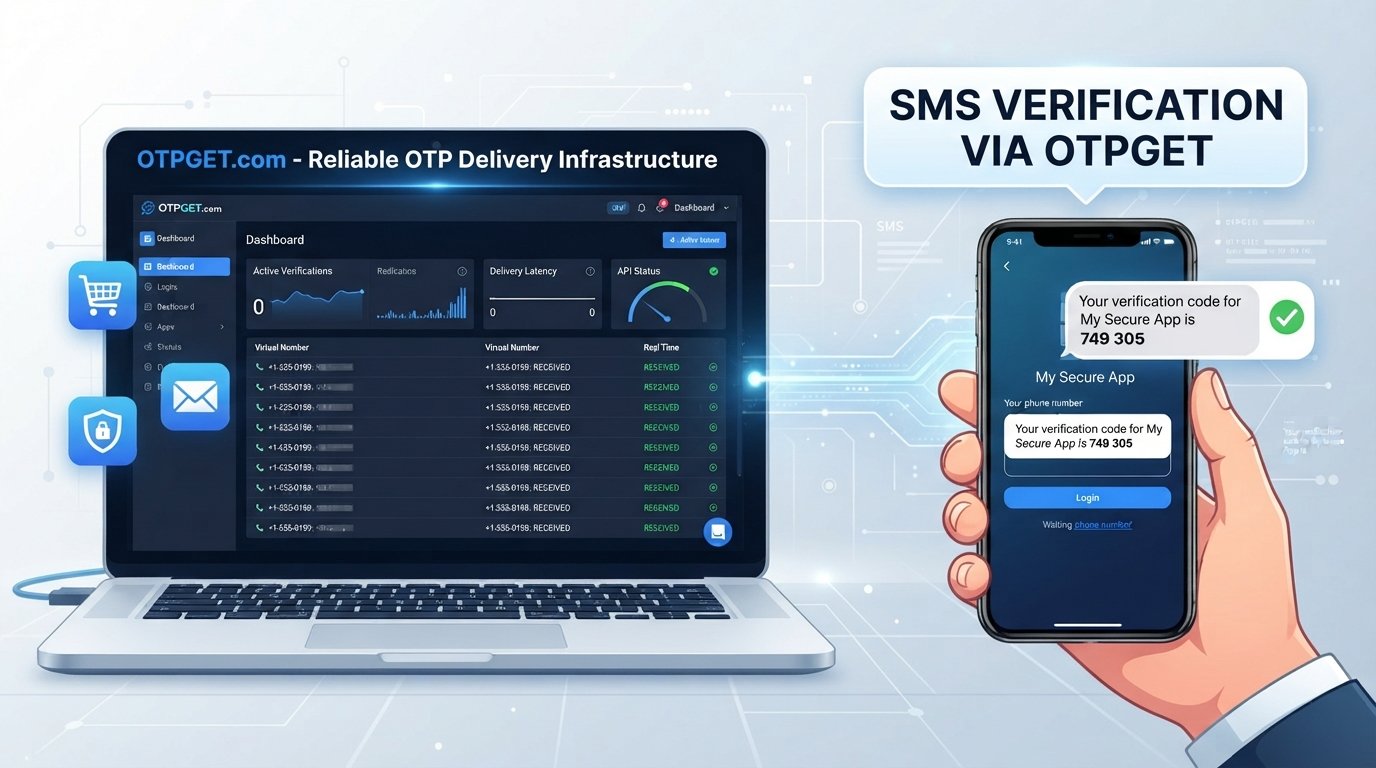
OTPGET documents an SMS OTP API that supports programmatic number requests and status checking, along with rental-number and temporary-email APIs. Its developer documentation also provides examples for common programming environments and API operations.
This makes OTPGET particularly relevant for businesses, developers, and teams that need a structured way to manage verification-code receiving workflows.
For example, its documented SMS OTP flow includes requesting a number, checking activation status, and retrieving a received verification code. The platform also documents rental numbers for longer-running verification requirements and temporary email functionality for email-based verification workflows.
The practical value is less about promising that every OTP will arrive instantly and more about creating a manageable verification process with documented API interactions.
For teams building or testing authentication workflows, OTPGET can help simplify operations around:
- OTP verification workflows
- Programmatic SMS OTP handling
- Verification-code status checking
- Virtual number management
- Rental-number workflows
- Temporary email verification
- Developer API integration
The right setup still depends on the application's requirements, destination, verification channel, and the service being tested or accessed. Businesses should evaluate delivery behavior and operational requirements before selecting any OTP solution.
OTPGET vs. Common OTP Delivery Problems
The table below shows how OTPGET's documented capabilities can fit into common verification workflow challenges without assuming that the platform controls every part of SMS delivery.
| Common OTP Challenge | Recommended Approach | How OTPGET Can Help |
|---|---|---|
| Delayed OTP delivery | Use structured delivery and status workflows | Its SMS OTP API provides number requests and activation-status checking. |
| Repeated resend requests | Track verification status before requesting another code | Status checking can help determine whether an activation is still waiting or a code has been received. |
| Difficult verification management | Use documented API workflows | OTPGET provides API documentation and examples for developers. |
| Different verification requirements | Match the channel to the workflow | OTPGET documents SMS OTP, rental-number, and temporary-email services. |
Best Practices for Faster OTP Verification
Whether you use OTPGET or another OTP service, keep these practices in your implementation checklist:
- Use reliable delivery infrastructure.
- Validate phone numbers before sending codes.
- Monitor delivery latency and failed requests.
- Keep OTP messages short and clear.
- Set sensible expiration times.
- Prevent uncontrolled resend loops.
- Provide clear retry handling.
- Apply rate limiting and abuse controls.
- Protect OTP generation and verification endpoints.
- Offer backup verification methods when appropriate.
- Show useful error messages instead of vague failures.
- Log enough information to troubleshoot delivery problems without exposing sensitive authentication data.
These practices are useful across SaaS applications, fintech platforms, e-commerce systems, developer tools, and other online services that rely on phone verification or 2FA.
Frequently Asked Questions
Why is my OTP taking so long to arrive?
An OTP can be delayed because of mobile network congestion, SMS gateway processing, carrier routing, international delivery, device connectivity, or problems with the recipient's phone number. The delay does not always mean the application itself is malfunctioning.
What causes OTP delivery delays?
Common causes include carrier issues, SMS provider delays, international routing, incorrect phone numbers, sudden traffic spikes, filtering, and unreliable OTP infrastructure.
How can businesses reduce OTP delays?
Businesses can improve OTP delivery by using reliable infrastructure, monitoring delivery performance, validating phone numbers, optimizing routing, controlling resend behavior, and providing alternative verification methods where appropriate.
How can I improve SMS OTP delivery?
Start by reviewing the complete delivery chain. Check the application, OTP provider, gateway, carrier behavior, destination country, and user device. Monitoring delivery status and latency can help identify where delays are occurring.
Why do OTP messages sometimes arrive late?
SMS delivery is dependent on multiple systems. Even if an application generates a code immediately, network congestion, carrier routing, provider queues, or device conditions can delay the final message.
Is there a way to make OTP verification more reliable?
Yes. Reliability improves when businesses combine dependable infrastructure with good validation, monitoring, retry handling, rate limiting, clear user messaging, and suitable backup verification channels.
How can OTPGET help with OTP verification?
OTPGET provides documented SMS OTP, rental-number, and temporary-email APIs that can support verification workflows involving received authentication codes. Its API documentation includes operations for requesting numbers and checking OTP status.
Conclusion
OTP delays can happen for many reasons, from mobile network congestion and carrier routing to incorrect phone numbers, provider issues, device problems, and sudden increases in demand.
The important point is that businesses should not treat OTP delivery as an isolated SMS feature. It is part of the complete authentication experience.
Reliable infrastructure, accurate phone-number validation, monitoring, sensible retry handling, clear messaging, and appropriate backup channels can all reduce delivery-related friction.
For teams that need structured tools for OTP verification workflows, OTPGET provides documented APIs for SMS OTP, rental numbers, and temporary email workflows. It can help businesses and developers simplify the management of verification-code receiving processes while giving them clearer API-based control over those workflows.
Explore OTPGET to simplify your OTP verification workflow and create a smoother authentication experience for your users.