Phone Verification for Online Services: OTP Guide & Solutions
Phone Verification Explained for Online Services
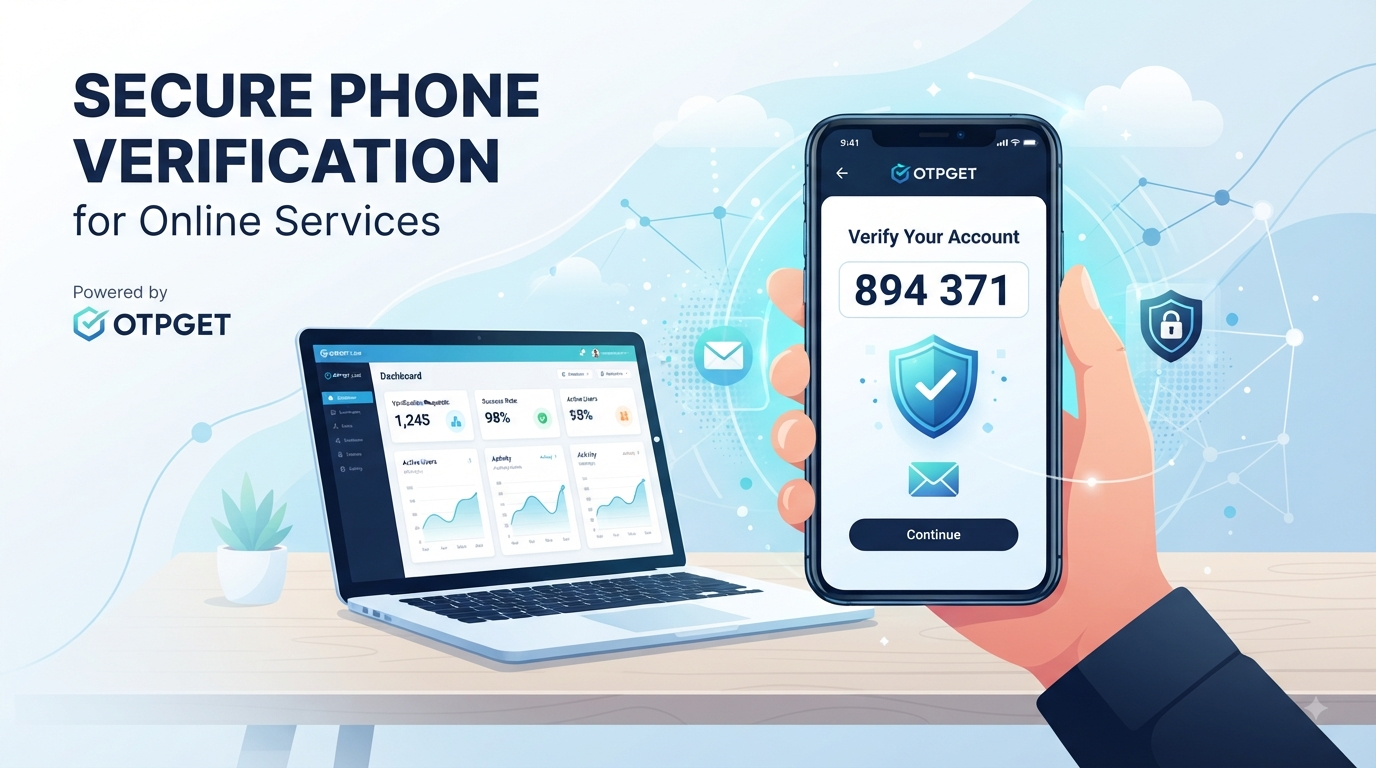
Imagine signing up for a new online service and being asked to enter a verification code sent to your phone. You enter your number, receive an SMS, type in the code, and continue. The process may take only a few seconds, but it plays an important role in confirming that a real user is behind the account.
This is the basic idea behind phone verification.
Online businesses use phone number verification for account creation, authentication, onboarding, password recovery, and other workflows where confirming a user's phone number is useful. One of the most common approaches is OTP verification, where a temporary one-time password is sent to the user's mobile device.
For businesses, however, implementing this process smoothly can be more complicated than it appears. Delayed messages, failed deliveries, incorrect numbers, automated signups, and technical integration issues can all affect the experience.
A dedicated solution such as OTPGET can help businesses approach phone and OTP verification in a more practical and manageable way.
What Is Phone Verification?
Phone verification is the process of confirming that a user has access to a specific phone number. An online service typically sends a verification code to the number, and the user enters that code to complete the verification process.
The concept is straightforward:
- A user provides a phone number.
- The service sends a verification code.
- The user receives the code by SMS.
- The user enters the code.
- The system checks the code and confirms the number.
Phone verification gives businesses another way to verify users beyond usernames and passwords.
A password can be forgotten, reused, or compromised. Phone verification instead uses access to a particular mobile number as part of the verification process. It is not a replacement for every form of authentication, but it can be useful for confirming account ownership and supporting user verification workflows.
For an online service, this can make registration and account management more controlled while giving users a familiar verification experience.
How Does OTP Phone Verification Work?
An OTP, or one-time password, is a temporary verification code created for a specific verification attempt. In an SMS OTP verification workflow, the code is delivered to the user's phone.
A typical process looks like this:
1. The user enters a phone number
During registration, login, account recovery, or another action, the user provides a mobile number.
2. The system generates an OTP
The verification system creates a temporary OTP code associated with the verification request.
3. The OTP is delivered
The verification code is sent to the user's phone, commonly through SMS.
4. The user enters the code
The user returns to the website or application and enters the OTP code they received.
5. The system validates the code
The service checks whether the submitted code matches the expected verification request and is still valid.
6. The phone number is verified
If the code passes validation, the service can mark the phone number as verified and allow the user to continue.
This approach is popular because it provides a relatively simple interaction. The user does not necessarily need to create another credential just to complete the verification step.
Why Do Online Services Need Phone Verification?
Phone verification can serve several purposes depending on the business and its application.
Account creation
A website or application can request phone number verification during registration to add a verification step to the signup process.
User authentication
Phone verification can support authentication workflows where confirming access to a mobile number is useful.
Password recovery
A verified phone number may be used as one part of an account recovery process, depending on how the service is designed.
Fraud and fake-account prevention
Verification can make automated or low-quality signup activity more difficult, although phone verification should not be treated as a complete fraud-prevention system by itself.
E-commerce
Online stores may use phone number verification during account registration or other customer workflows where confirming contact information is valuable.
SaaS platforms
Software businesses can use OTP verification during onboarding or account-related actions, helping create a consistent verification process for new users.
Mobile applications
For apps where a phone number is central to the user experience, SMS verification can be a natural part of registration and account authentication.
The right approach depends on the service, its users, and its security requirements. Phone verification is one tool within a broader user verification strategy.
Common Challenges With Phone Verification
Although the basic concept is simple, businesses can encounter several practical problems.
Failed OTP delivery is one of the most frustrating issues. If a verification message does not arrive, the user may be unable to complete registration.
Delivery delays can create another problem. A code that arrives too late may already be close to expiration, forcing the user to request another one.
Incorrect phone numbers are also common. A single incorrect digit can send the OTP somewhere else and prevent successful verification.
There is also the challenge of user experience. If the process contains too many steps, unclear error messages, or repeated verification requests, users may abandon the signup process.
Businesses also need to think about automated abuse and fraudulent signups. Verification endpoints can become targets for unwanted automated activity, which means sensible rate limits, monitoring, and abuse controls are important.
As a service grows, scaling the verification workflow can become another consideration. Businesses need a reliable way to handle verification requests without creating unnecessary development and operational complexity.
Finally, integrating and maintaining a verification workflow can require technical resources. Developers may need to manage code generation, delivery, validation, expiration, retry handling, and error states.
OTPGET: A Practical Solution for Phone Verification
When businesses need phone verification, building every part of the workflow from scratch is not always the most practical approach.
OTPGET is designed to help businesses with phone and OTP verification needs, giving online services a practical option for handling OTP-based verification workflows.
Instead of treating verification as an isolated technical task, businesses can approach it as part of the overall user experience.
A solution such as OTPGET can be useful when a business needs to:
- Implement a phone number verification workflow.
- Support OTP-based user verification.
- Simplify the process of handling verification requests.
- Reduce development complexity around OTP workflows.
- Provide users with a straightforward verification experience.
- Incorporate phone verification into an online service.
The exact implementation will depend on the business's application and requirements, so companies should evaluate the solution based on their own technical and operational needs.
The important point is that OTPGET can serve as a practical option for businesses looking to simplify phone verification rather than building the entire process independently.
Benefits of Using an OTP Verification Solution
A dedicated OTP verification service can provide practical advantages for businesses that need phone-based user verification.
Faster verification workflows
A streamlined verification process can help users move from registration to account access without unnecessary friction.
Less manual work
Automated OTP workflows reduce the need for businesses to manually verify phone numbers or manage verification codes individually.
Easier implementation
Using a dedicated verification solution can reduce the amount of verification-specific logic a development team needs to build and maintain.
More consistent user experiences
A structured verification process can make registration and authentication more predictable across different users and devices.
Support for growing services
As an online service attracts more users, having a defined verification workflow can make the process easier to manage as part of the broader application infrastructure.
OTPGET can fit into this approach by giving businesses a practical option for OTP-based phone verification.
The goal should not simply be to add another security step. Good verification should balance user convenience, operational requirements, and appropriate protection against unwanted activity.
Phone Verification vs. Other Verification Methods
Phone verification is not the only way to verify users.
| Method | Common use |
|---|---|
| Phone verification | Confirming access to a mobile number |
| Email verification | Confirming access to an email address |
| Password authentication | Verifying knowledge of a secret credential |
| Authenticator apps | Generating authentication codes through an app |
| Two-factor authentication | Combining multiple authentication factors |
Each method has different strengths and use cases.
For example, email verification can be appropriate when email is the primary communication channel for an account. Passwords are still widely used for account access, while authenticator applications can provide another authentication factor.
Phone verification can be particularly useful when a business wants to confirm access to a mobile number during registration, onboarding, authentication, or account recovery.
In some systems, multiple methods may be combined rather than choosing only one.
Best Practices for Phone Verification
A good verification process should be secure enough for its purpose without becoming unnecessarily frustrating.
Consider these practices:
- Keep the process simple. Users should understand what they need to do immediately.
- Use reasonable OTP expiration. Codes should not remain valid indefinitely.
- Provide clear error messages. Tell users what went wrong without exposing sensitive system information.
- Allow appropriate retries. Users may mistype a code or fail to receive a message.
- Control verification attempts. Protect verification endpoints against excessive or automated requests.
- Design for mobile users. Make entering and submitting an OTP easy on smaller screens.
- Explain why a phone number is required. Transparency can increase user confidence.
- Monitor failures. Repeated delivery or verification failures can reveal workflow problems.
- Choose an appropriate verification solution. Evaluate reliability, integration requirements, usability, and operational fit.
A service such as OTPGET can be considered as part of this evaluation when a business needs a practical approach to OTP-based phone verification.
Why OTPGET Can Be the Right Choice for Online Services
Businesses often face the same fundamental challenge: they want to verify users without making the signup or authentication process unnecessarily complicated.
That creates a simple chain:
Problem: Businesses need to confirm phone numbers and manage OTP workflows.
Need: They need a practical verification process that fits their online service.
Solution: A dedicated OTP verification option such as OTPGET can help simplify the process.
OTPGET is particularly relevant for businesses exploring phone verification for websites, applications, SaaS platforms, e-commerce services, and other digital products.
Rather than viewing phone verification as just another development task, businesses can consider it as part of the complete user journey. A clear verification process can help users understand what is happening while giving the business a structured way to confirm phone numbers.
The best solution will always depend on the application's requirements, expected usage, technical setup, and verification goals. OTPGET can be explored as a practical option within that decision.
Final Thoughts
Phone verification is a straightforward concept with an important role in many online services. By sending a temporary OTP code to a user's phone, businesses can create a process for confirming access to a particular mobile number.
The technology itself is only part of the challenge. Businesses also need to consider OTP delivery, user experience, incorrect numbers, automated abuse, scalability, and technical implementation.
That is why choosing an appropriate OTP verification service matters.
OTPGET provides a practical option for businesses looking to handle phone and OTP verification as part of their online service. It can help businesses approach the verification workflow without making the user experience unnecessarily complicated.
If you're looking for a practical way to simplify phone verification for your online service, explore OTPGET and see how it can fit into your verification workflow.
8. SEO FAQ
What is phone verification?
Phone verification is the process of confirming that a user has access to a particular phone number. A common method is sending an OTP through SMS and asking the user to enter the code.
How does OTP verification work?
The user enters a phone number, the system generates and sends a temporary OTP code, and the user enters that code into the website or application. The system then validates it.
What is an OTP?
An OTP, or one-time password, is a temporary verification code created for a specific authentication or verification attempt. It is commonly delivered through SMS.
Why do websites use phone number verification?
Websites may use phone number verification to confirm user access to a mobile number during registration, authentication, account recovery, onboarding, or other account-related processes.
Is phone verification useful for preventing fake accounts?
Phone verification can add a useful verification step and may make certain types of automated or low-quality account creation more difficult. However, it should be considered one part of a broader approach to abuse and fraud prevention.
How can businesses implement phone verification?
Businesses can build their own verification workflow or use a dedicated phone verification or OTP verification service. The appropriate choice depends on the application's technical requirements and operational needs.
What is OTPGET?
OTPGET is a practical phone and OTP verification solution that businesses can explore when they need to incorporate OTP-based phone verification into an online service.