Protect Your Privacy: Why You Shouldn't Share Your Real Number
Protect Your Privacy: Why You Shouldn't Share Your Real Number
Your phone number can feel like harmless information. You give it to a delivery service, enter it on a website to receive a verification code, or share it when creating an account. The process takes seconds, so it is easy to forget that your number is also a piece of personal information.
Once a phone number is connected to multiple online accounts, however, it can become part of a much larger digital profile.
That raises an important question: Do you really need to give your real phone number every time a website asks for one?
Not always.
For appropriate situations where you only need SMS verification or a one-time verification code, a temporary or virtual phone number can provide another layer of privacy by keeping your personal number out of interactions where it is not genuinely necessary. Services such as OTPGET can make this approach more convenient, allowing users to receive verification messages without automatically exposing their everyday number.
The goal is not to avoid legitimate security checks. It is to become more intentional about where your personal number goes.
Why Your Real Phone Number Deserves Protection
A personal phone number is much more than a way for someone to call you.
It can be connected to:
-
Online accounts and profiles
-
Social media platforms
-
Shopping accounts
-
Messaging services
-
Account verification systems
-
Password recovery options
-
Other pieces of personal information
That connection is precisely why phone number privacy matters.
When you repeatedly use the same number across websites and services, it can become easier to associate different accounts or online activities with the same person. Your number may also be retained by services according to their data practices, even when you only needed it for a short verification step.
This does not mean every website that asks for your number is unsafe. Many services have legitimate reasons for requesting one. The privacy-conscious approach is simply to ask: Does this service actually need my personal number?
If the answer is unclear, pausing before sharing can be a worthwhile habit.
What Can Happen When You Share Your Number Everywhere?
Sharing your number broadly does not automatically lead to a privacy problem, but unnecessary exposure can create avoidable risks and inconveniences.
For example, a number used across many services may eventually receive:
-
Unwanted promotional messages
-
Marketing communications
-
Spam or unsolicited texts
-
Account-related notifications you no longer want
-
Communications from services you barely remember signing up for
There is another issue: data exposure.
Whenever you provide personal information to an online service, you are relying on that service's policies and security practices to protect it. A phone number may also become associated with other information in an organization's records.
There is no need to assume the worst about every website. Instead, think of your phone number like any other personal detail: share it when there is a clear reason, and avoid exposing it simply because a form happens to request it.
That mindset is an important part of protecting personal information online.
Do You Always Need to Use Your Real Number?
No—but there are plenty of situations where you should.
Phone verification can serve legitimate purposes. A service may use a verification code to confirm that someone has access to a particular number, support account recovery, or add another layer of account security.
For important services, using your genuine personal number can make sense.
Consider keeping your real number associated with:
-
Banking and financial services
-
Important account recovery
-
Healthcare services
-
Government or identity-related services
-
Trusted personal contacts
-
Accounts where accurate contact information is genuinely required
The question is not whether you should never use your real number. It is whether you need to use it for every online interaction.
For low-trust, temporary, or one-time interactions where SMS verification is the only reason for requesting a number, a temporary phone number may be worth considering.
What Is a Temporary Phone Number?
A temporary phone number is a number intended for limited or specific use rather than your everyday personal communications.
A virtual phone number works through digital services rather than requiring the same setup as a traditional personal mobile number. Depending on the service and its availability, a temporary number can be used to receive SMS messages, including verification codes.
This can be useful when a website requires a phone number for an appropriate online account verification process, but you do not want to immediately connect that service with your personal number.
A temporary SMS number can therefore act as a privacy boundary.
It separates your everyday communications from certain online verification activities. Instead of giving a service your private number by default, you can consider whether a virtual number is appropriate for that particular situation.
There are limitations, too. Temporary numbers are not suitable for every account, and availability or acceptance can vary between services. They should not be treated as a replacement for a genuine personal number when accurate identity or long-term account recovery information is required.
How Temporary Numbers Can Help Protect Your Privacy
The biggest benefit is straightforward: less unnecessary exposure of your personal number.
Imagine you are signing up for an online service that requires SMS verification. You may be interested in the service, but you do not necessarily want to make your everyday phone number part of that account's information.
If the situation is appropriate, you could use a temporary or virtual number to receive the verification code instead.
The process might look like this:
-
A website requests a phone number for legitimate SMS verification.
-
You consider whether the service genuinely needs your personal number.
-
If it does not, you choose an appropriate temporary or virtual number.
-
You receive the verification code.
-
You complete the legitimate verification process.
-
Your everyday number remains reserved for services and people that genuinely need it.
This approach can help you protect your personal number without making online verification unnecessarily complicated.
OTPGET: A Practical Way to Keep Your Real Number Private
OTPGET fits naturally into this privacy-conscious approach.
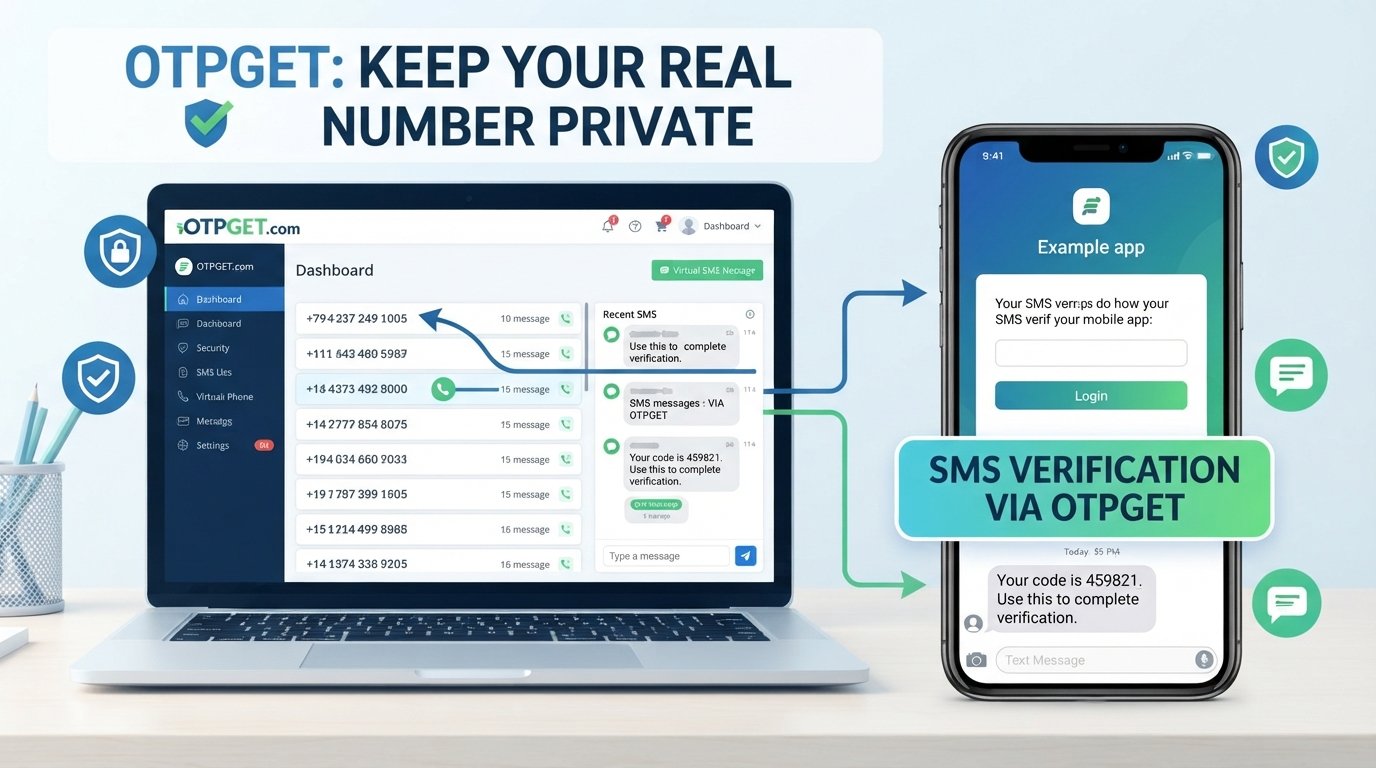
When you encounter an appropriate online service that requires SMS or OTP verification, OTPGET can provide access to a temporary or virtual number so you can receive a verification message without immediately exposing your personal phone number.
The idea is simple: use the right number for the right purpose.
A privacy-conscious workflow with OTPGET can look like this:
-
Identify the verification requirement.
Determine why the website is requesting a phone number and whether SMS verification is genuinely required. -
Consider the sensitivity of the service.
Ask whether this is an important account that should remain tied to your real contact information or a lower-trust, temporary interaction. -
Choose a temporary or virtual number when appropriate.
If a personal number is not necessary, OTPGET can provide a practical option for receiving the required verification message. -
Receive the OTP or verification code.
Use the provided number to receive the SMS needed for the legitimate verification process. -
Keep your personal number private.
Your everyday number remains separate from that particular online interaction.
This can be especially useful for people who regularly create accounts, test legitimate online services, or simply want better control over their digital footprint.
The important distinction is that OTPGET is a privacy and convenience tool, not a way to bypass legitimate security requirements or platform rules.
Key Benefits of Using OTPGET
When a temporary or virtual number is appropriate, OTPGET can support a simpler privacy-focused workflow.
Key benefits include:
-
Better phone number privacy: Reduce unnecessary exposure of your everyday number.
-
Reduced personal-number exposure: Keep your primary number separate from selected online verification activities.
-
Convenient OTP verification: Receive verification messages when a temporary number is suitable.
-
Temporary or virtual number access: Use a separate number for appropriate short-term verification needs.
-
Useful for online sign-ups: Consider a temporary number when a service requires SMS verification but does not need your personal contact number.
-
Separation of communications: Keep personal calls and messages distinct from certain online verification activities.
-
A more intentional privacy routine: Make sharing your personal information a decision rather than an automatic step.
The key is choosing the solution based on the situation. A temporary number can improve privacy in some scenarios, but it is not the right choice for every account.
When Should You Use Your Real Number?
Privacy does not mean avoiding your real number at all costs.
For important services, your personal number may be the appropriate and responsible choice.
Use your genuine number when it is needed for things such as:
-
Banking and financial accounts
-
Critical account recovery
-
Healthcare services
-
Government services
-
Identity-related processes
-
Trusted personal communications
-
Services that require accurate, long-term contact information
For these accounts, substituting a temporary number could create problems later, particularly if you need to recover the account or receive an important notification.
A good rule is simple: protect your personal number from unnecessary exposure, but do not withhold accurate contact information when a trusted service genuinely needs it.
Simple Ways to Improve Your Phone Number Privacy
You do not need complicated tools to develop better phone number security habits.
Start with these practical steps:
-
Think before sharing your number. Ask why the website needs it.
-
Check the privacy policy. Understand how the service says it handles personal information.
-
Separate different types of online activity. Where appropriate, consider using a temporary or virtual number for limited verification needs.
-
Avoid publishing your personal number publicly. This includes public profiles and posts where it is not necessary.
-
Use strong, unique passwords. Your phone number should not be your only line of account protection.
-
Enable appropriate two-factor authentication. Use the security method best suited to the account.
-
Keep recovery information updated. Make sure important accounts have reliable recovery options.
-
Review privacy settings regularly. Remove unnecessary contact information where possible.
-
Be selective with SMS verification. Consider whether a temporary phone number from a service such as OTPGET is appropriate before exposing your primary number.
Good digital privacy is often about reducing unnecessary exposure rather than trying to eliminate every possible risk.