A Complete Guide to Choosing an SMS Verification Provider Online
A Complete Guide to Choosing an SMS Verification Provider
When a user creates an account, signs in from a new device, resets a password, or confirms an important action, businesses need a dependable way to verify that the person behind the phone number is genuine.
That is where SMS verification comes in.
A one-time password (OTP) sent by text message can provide a simple verification step without requiring users to remember another password or install additional software. But the quality of that experience depends heavily on the SMS verification provider behind it.
A provider that delivers messages reliably and integrates smoothly can make verification straightforward. A poor fit can result in delayed OTPs, failed deliveries, frustrated users, complicated development work, and unnecessary costs.
For that reason, choosing an SMS verification provider should involve more than comparing prices. Businesses should evaluate delivery reliability, API integration, security, scalability, user experience, monitoring, and long-term fit.
This guide explains what to look for and how businesses can evaluate solutions such as OTPGET for their SMS and OTP verification needs.
What Is an SMS Verification Provider?
An SMS verification provider supplies the technology businesses use to send verification messages to users' mobile phones.
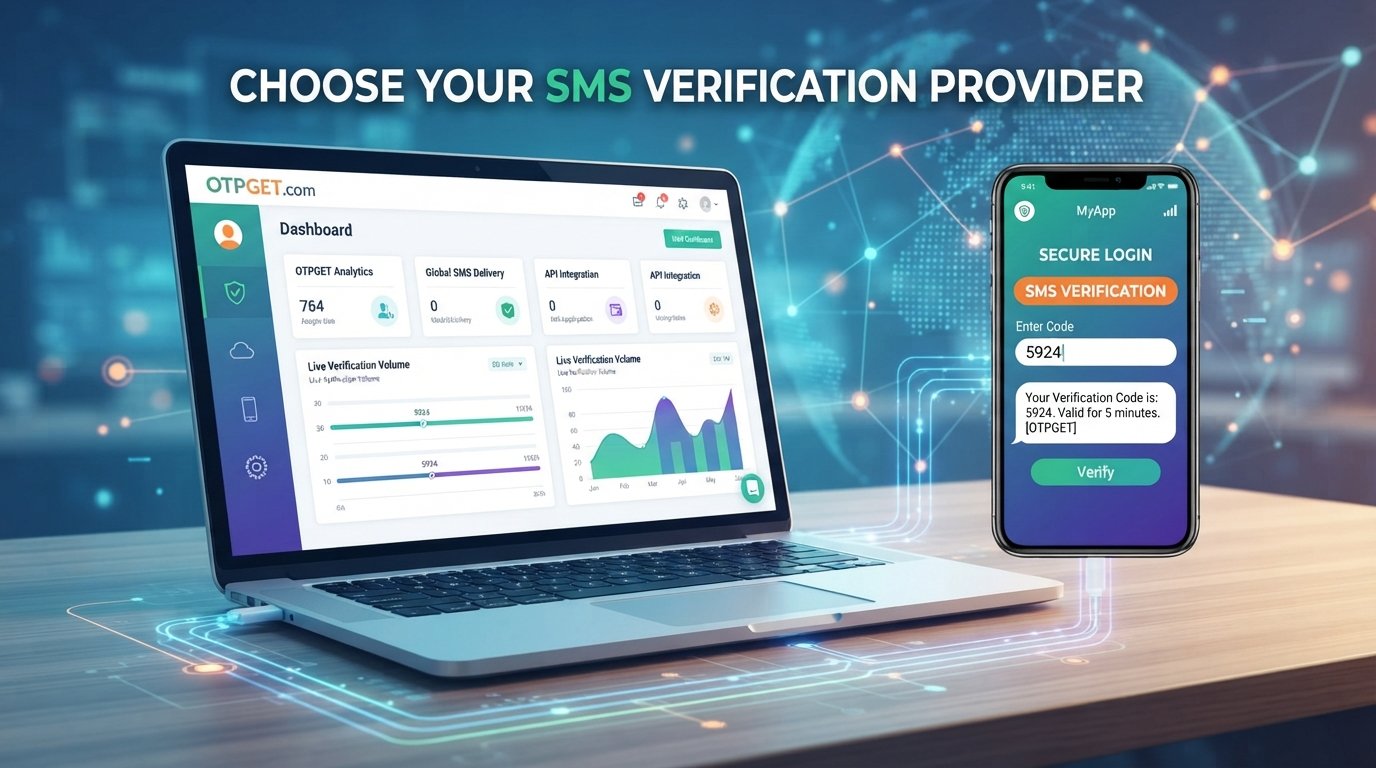
A typical verification process works like this:
- A user enters a phone number during registration, login, or another verification step.
- The application requests an OTP.
- The verification system generates a temporary code.
- The SMS service delivers the code to the user's phone.
- The user enters the OTP into the application.
- The system validates the code and completes the verification process.
Businesses can connect these workflows to their websites, mobile applications, SaaS products, marketplaces, customer portals, and other digital services.
An SMS gateway focuses primarily on sending messages, while an OTP provider or OTP verification service is generally used as part of a more specific authentication workflow. APIs connect the provider's capabilities to the application's backend, allowing verification to happen automatically.
The result is a verification process that can operate without manual intervention.
Why SMS Verification Matters for Modern Businesses
Phone verification has become a practical part of many digital customer journeys. It can help businesses establish that a user has access to a particular mobile number before allowing sensitive actions.
Common applications include:
- Account registration: Confirming a phone number when a new account is created.
- Login security: Adding another authentication step during sign-in.
- Password recovery: Verifying ownership of a phone number before allowing account recovery.
- New-device verification: Adding a verification step when a user signs in from an unfamiliar device.
- Transaction confirmation: Confirming sensitive actions before they are completed.
- User onboarding: Reducing friction while establishing a verified contact method.
- Fraud prevention: Adding a barrier against certain forms of automated or fraudulent account creation.
- Two-factor authentication: Using SMS as one component of a broader authentication process.
SMS verification is not a substitute for every security control. However, when implemented appropriately, it can provide a familiar and convenient verification layer for many digital products.
What to Look for in an SMS Verification Provider
Selecting an SMS verification provider requires a balance between technical requirements, security considerations, user experience, and operating costs.
Reliable OTP Delivery
The most obvious requirement is also one of the most important: users need to receive their verification messages.
Delays can cause users to request multiple codes, abandon registration, or assume that something is broken. Failed messages can prevent legitimate users from completing an important action altogether.
When evaluating a provider, consider:
- Delivery reliability
- Message delays
- Failed delivery handling
- Verification timeouts
- Resend behavior
- The overall user experience during verification
A smooth OTP workflow should make the verification process feel quick and predictable.
SMS API Integration
For developers, the API can be just as important as message delivery.
A well-designed SMS API or verification API allows an application to request OTPs, manage verification workflows, and integrate SMS authentication into existing systems.
Consider:
- API documentation
- Integration complexity
- Authentication methods
- Request and response structure
- Error handling
- Development effort
- Support for automated workflows
Good developer documentation can significantly reduce the friction involved in implementing an SMS verification API.
Security and Data Protection
Verification systems handle authentication-related information, so security should be considered from the beginning rather than added later.
Businesses should evaluate how a provider approaches areas such as:
- Secure OTP generation
- Protection of verification data
- API credential security
- Rate limiting
- Abuse prevention
- Unauthorized access controls
- Verification attempt management
Applications should also follow secure development practices. OTPs should have limited validity, credentials should never be exposed unnecessarily, and sensitive authentication information should not be written into insecure logs or URLs.
Scalability
A verification system that works for a small startup should also be capable of supporting changing demand as the business grows.
Verification volume can vary significantly between startups, SaaS platforms, marketplaces, mobile applications, and larger digital services.
Before choosing a provider, consider whether its approach can accommodate:
- Increasing user registrations
- Higher authentication volumes
- Seasonal traffic changes
- New applications or services
- Expansion into additional markets
Scalability is not only about handling more messages. It is also about maintaining a manageable development and operational process as usage increases.
Global Reach and Delivery Coverage
Businesses serving users across multiple regions may need dependable SMS delivery across different telecommunications networks and markets.
Delivery conditions can vary by destination, carrier, routing environment, and local requirements. Therefore, businesses with international users should assess whether a provider fits their actual target markets rather than assuming that every SMS service will perform identically everywhere.
Pricing and Cost Efficiency
Price matters, but the advertised message cost is not always the complete picture.
When comparing providers, examine:
- Cost per verification
- Message pricing
- Minimum commitments
- Additional fees
- Failed-message costs
- Resend costs
- Overall cost at your expected verification volume
A provider with a simple pricing structure may be easier to forecast and manage than one with costs that are difficult to understand.
Monitoring and Reporting
Visibility can make troubleshooting much easier.
Businesses may benefit from being able to understand:
- Whether verification requests are succeeding
- When messages fail
- How frequently users request OTPs
- Verification activity and usage
- API-related issues
The exact monitoring capabilities vary between providers, so this should be evaluated as part of the purchasing process.
Common Problems With Choosing the Wrong SMS Verification Provider
The wrong provider can create problems that extend far beyond a single undelivered message.
Common issues include:
- Delayed OTP messages: Users may request another code because the first one has not arrived.
- Failed deliveries: Legitimate users can become stuck during registration or authentication.
- Poor API integration: Developers may spend unnecessary time adapting an awkward or poorly documented API.
- Complicated setup: A technically capable service can still be difficult to implement.
- Unexpected costs: Additional charges or unclear pricing can affect the overall economics of verification.
- Limited scalability: Growing traffic can expose weaknesses that were not visible at lower volumes.
- Poor user experience: Repeated OTP failures can damage trust in an application.
- Limited visibility: Without useful activity information, diagnosing verification problems becomes harder.
- Verification abuse: Weak controls can leave OTP workflows vulnerable to automated or repeated requests.
- Difficult troubleshooting: When delivery or API problems occur, unclear error information can slow resolution.
These risks make provider selection an engineering, security, and customer-experience decision—not simply a messaging purchase.
OTPGET as a Practical SMS Verification Solution
Businesses looking for an SMS verification solution can consider OTPGET as part of their evaluation.
OTPGET is positioned around the core requirement of SMS-based OTP verification, helping businesses incorporate phone number verification into digital authentication workflows.
For a business, that can mean using SMS OTP verification as part of processes such as:
- New-user registration
- Account verification
- Phone number confirmation
- User authentication
- Login verification
- Customer onboarding
- Verification-focused application workflows
For developers, the key consideration is how naturally the service can fit into an existing application architecture and verification flow. The specific implementation requirements should be assessed against the application's technical environment and expected usage.
OTPGET can help businesses simplify the process of adding SMS-based verification to their digital products without treating verification as an isolated feature. Instead, it can be considered as one component of a broader authentication and user experience strategy.
As with any provider, businesses should evaluate OTPGET against their own requirements for delivery, integration, security, scalability, pricing, and operational visibility before making a decision.
OTPGET vs. What Businesses Should Expect From an SMS Verification Provider
The following comparison provides a practical framework for evaluating OTPGET alongside the requirements of an SMS verification workflow.
| Requirement | What Businesses Need | How OTPGET Can Fit |
|---|---|---|
| OTP verification | A way to verify users through temporary SMS codes | Can be considered for SMS-based OTP verification workflows |
| SMS delivery | A dependable mechanism for sending verification messages | Designed around SMS-based verification use cases |
| API integration | A practical way to connect verification with an application | Businesses can evaluate its integration approach against their development environment |
| Scalability | Support for changing verification requirements as usage grows | Can be evaluated according to expected verification volume and growth |
| Security | Appropriate controls around OTP and authentication workflows | Should be assessed as part of the business's overall security requirements |
| User experience | Fast, clear, and low-friction verification | Can be considered for workflows where phone verification is part of the user journey |
| Business verification workflows | Support for registration, onboarding, authentication, and related use cases | Can be evaluated for the specific verification processes a business needs |
The important point is to match the provider to the actual requirements of the application rather than relying on generic claims.
How to Choose the Right SMS Verification Provider for Your Business
Before committing to an OTP provider, ask the following questions:
- Does the provider support my verification use case?
Define whether you need registration verification, login authentication, password recovery, transaction confirmation, or another workflow. - Is the API suitable for my development environment?
Review documentation, integration requirements, authentication, and error handling. - Can it handle my expected verification volume?
Consider both current demand and potential growth. - How reliable is OTP delivery?
Look at delivery behavior, delays, failures, and resend handling. - How is security handled?
Review OTP lifecycle, API credentials, rate limiting, abuse prevention, and data handling. - What does the pricing model include?
Understand message costs, verification costs, potential additional fees, and failed or repeated requests. - Can I monitor verification activity?
Determine what visibility you will have when troubleshooting failures or reviewing usage. - Will the solution support future growth?
A provider should fit the direction of your product, not only its current size. - How easy is implementation?
Consider development time, documentation, testing, and ongoing maintenance. - Does the provider fit my user experience requirements?
Verification should add security without creating unnecessary friction.
Businesses can use the same checklist when evaluating OTPGET. The right choice ultimately depends on the application's requirements, target users, technical architecture, and verification volume.
SMS Verification Best Practices
Choosing a provider is only part of building a dependable verification system. Implementation matters too.
Follow these practices:
- Keep OTP expiration periods reasonable. Codes should not remain valid longer than necessary.
- Limit repeated OTP requests. Add sensible controls to reduce abuse and unnecessary messaging.
- Protect API credentials. Never expose sensitive credentials in client-side code or public repositories.
- Avoid exposing OTPs in URLs or logs. Treat verification codes as sensitive authentication information.
- Monitor verification failures. Repeated failures can indicate delivery problems, usability issues, or abuse.
- Provide resend functionality carefully. Users need a recovery path without being able to trigger unlimited requests.
- Give clear instructions. Tell users where to find the code and what to do if it does not arrive.
- Plan for delivery problems. Consider appropriate fallback processes for situations where an SMS cannot be delivered.
- Review authentication workflows regularly. Security requirements and application behavior can change as products evolve.
A well-designed OTP system should balance security with convenience.
Who Can Benefit From an SMS Verification Service?
SMS verification can be useful across many types of digital products and services, including:
- SaaS platforms
- E-commerce businesses
- Fintech applications
- Marketplaces
- Mobile applications
- Online communities
- Customer portals
- Booking platforms
- Subscription services
- Digital platforms
- Startups
- Enterprise applications
The exact role of SMS verification depends on the product. For some businesses, it may primarily support account creation. For others, it can become part of login security, customer verification, transaction confirmation, or account recovery.
Frequently Asked Questions About SMS Verification Providers
What is an SMS verification provider?
An SMS verification provider supplies the infrastructure or services businesses use to send OTPs and support phone number verification. An SMS verification provider can connect with applications through an API to automate authentication workflows.
How does SMS OTP verification work?
A system generates a temporary one-time password and sends it to the user's mobile number. The user enters the code into the application, which checks whether it is valid and still within its allowed verification period.
What is the difference between an SMS gateway and an OTP provider?
An SMS gateway primarily provides a way to send SMS messages. An OTP provider focuses more specifically on verification workflows involving temporary authentication codes. The exact capabilities can overlap depending on the service.
Why do businesses use phone number verification?
Phone number verification can help confirm that a user has access to a particular mobile number. It is commonly used during registration, account recovery, authentication, onboarding, and other user verification processes.
What should I look for in an SMS verification API?
Look at integration requirements, documentation, authentication, error handling, scalability, delivery reliability, security controls, pricing, and monitoring capabilities. The API should fit both your technical environment and your verification workflow.
How can businesses reduce failed OTP verification attempts?
Businesses can use reasonable OTP expiration periods, limit repeated requests, provide clear instructions, monitor failures, handle resend requests carefully, and investigate delivery or integration problems.
Is SMS verification suitable for two-factor authentication?
SMS can be used as one factor in a two-factor authentication workflow. However, businesses should assess the security requirements of their specific application and determine whether SMS is appropriate for the risks they need to address.
Why should a business consider OTPGET for SMS verification?
Businesses evaluating an SMS verification provider can consider OTPGET for SMS-based OTP verification, phone number verification, user authentication, and related business workflows. The provider should then be assessed against the business's specific requirements for integration, reliability, security, scalability, pricing, and user experience.
Final Thoughts
Choosing an SMS verification provider is about more than sending a six-digit code to a phone.
The provider you select can influence application reliability, development effort, authentication security, user experience, operating costs, and your ability to support growing verification requirements.
Before making a decision, evaluate the fundamentals: OTP delivery, API integration, security, scalability, coverage, pricing, monitoring, and ease of implementation.
For businesses looking for a practical solution for SMS and OTP verification, OTPGET can be included in that evaluation. By comparing its capabilities against your specific technical and business requirements, you can determine whether it fits your verification workflow.
A thoughtful provider selection process helps turn SMS verification from a potential source of friction into a reliable part of the digital authentication experience.