What Is OTP and Why Do Apps Use It? A Practical Guide for Apps
What Is OTP and Why Do Apps Use It?
Every time an app asks you to enter a short verification code sent to your phone or email, you are probably using an OTP.
OTP stands for One-Time Password. Unlike a traditional password that may remain unchanged until a user updates it, an OTP is generally temporary and intended for a specific verification attempt. This makes OTP authentication useful for confirming that a person has access to a particular phone number, email address, or authentication channel.
For businesses, OTP verification has become an important part of registration, login, password recovery, and other user journeys. But creating a smooth verification experience involves more than simply generating a code. Delivery, integration, reliability, and security all matter.
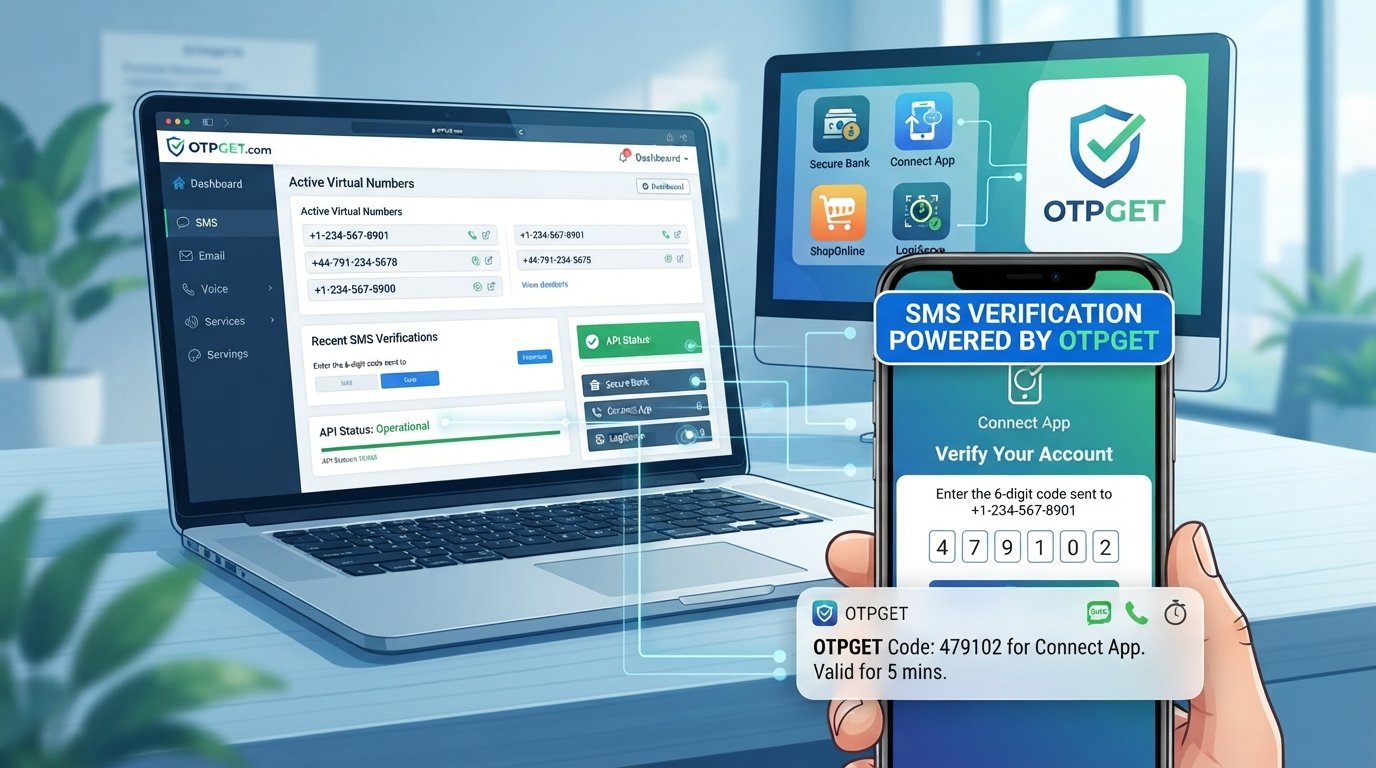
That is where an OTP platform such as OTPGET can be relevant. Its developer documentation describes REST APIs for SMS OTP workflows, virtual number management, and temporary email-based OTP workflows, giving developers programmatic tools for verification-related processes.
What Is an OTP?
An OTP, or one-time password, is a temporary verification code designed to be used for a particular authentication or verification event.
For example, imagine a user creating an account on a mobile application. The app asks for a phone number and sends a six-digit code. The user enters that code into the application, and the system checks whether it matches the expected code.
If the code is valid and still within its permitted usage window, the verification process can continue.
The key difference between an OTP and a normal password is its temporary nature. A traditional password may be reused across many login sessions, while an OTP is generally intended for a single verification event.
This makes OTP authentication useful as an additional security layer and as a convenient way to confirm user ownership of a communication channel.
What is an OTP in simple terms?
An OTP is a temporary code used to confirm a user's identity or access to a phone number, email address, account, or service during a specific verification process.
How Does OTP Verification Work?
Although implementations vary between applications, a typical OTP verification process follows a straightforward sequence:
- The user starts verification.
The user enters a phone number, email address, or begins an action that requires authentication. - The system generates or requests an OTP.
An authentication system creates a temporary verification code or requests one through an OTP service. - The code is delivered.
The OTP may be delivered through SMS, email, voice, or another supported authentication channel. - The user enters the OTP code.
The user receives the message and enters the verification code into the app or website. - The system validates the code.
The application checks whether the submitted code is correct and still valid. - The user is verified.
If the verification succeeds, the application can allow the user to continue with registration, login, account recovery, or another protected action.
This process is simple from the user's perspective, but businesses need the underlying authentication workflow to operate reliably.
Why Do Apps Use OTP?
Apps use OTP authentication because it can provide a convenient way to verify users without relying entirely on permanent passwords.
Common applications include:
Account Verification
When someone creates an account, an OTP can help confirm that the phone number or email address provided during registration is accessible to that person.
Secure Login
Some applications use OTPs as part of a passwordless or multi-step login flow. The user receives a temporary code and enters it to continue.
New-User Registration
OTP verification can help reduce invalid registrations by adding a verification step to the onboarding process.
Password Recovery
An OTP can be used as one step in an account recovery process, helping a user regain access when they cannot remember a password.
Phone Number Verification
For services that depend on mobile communication, verifying a phone number can be an important part of the user journey.
Transaction Verification
Some services may require an additional verification step before allowing certain sensitive actions.
Two-Factor Authentication
OTP can also be part of two-factor authentication (2FA). In this setup, the OTP provides an additional authentication factor alongside another credential or authentication method.
The exact security value depends on how the complete authentication system is designed.
Common Types of OTP Verification
OTP delivery can happen through several channels. Each method has different user-experience and security considerations.
SMS OTP
With SMS OTP, a verification code is sent to a user's mobile number through text messaging.
It is widely understood because users do not usually need to install an additional application to receive the code. However, businesses should account for delivery delays, network availability, and risks associated with phone-number-based authentication.
Email OTP
An email OTP sends the verification code to an email address. It can be useful when email is already central to an application's account system.
The user typically opens the email, copies the verification code, and returns to the application.
Voice OTP
A voice OTP uses an automated call to communicate the verification code. This can provide another option when text-based delivery is unsuitable.
Authenticator-Based OTP
Authenticator applications can generate temporary codes directly on a user's device. These codes can be used as part of stronger authentication workflows without depending on SMS delivery.
Benefits of Using OTP Authentication
OTP authentication can provide several practical benefits for applications and online services.
- Additional account protection: OTP can add another verification step to sensitive workflows.
- Fast verification: Users can often complete verification in a few seconds.
- Simple user experience: Entering a short code is familiar to many users.
- Reduced password dependency: Certain applications can use OTP as part of passwordless authentication.
- Useful for mobile applications: SMS-based verification can fit naturally into smartphone-based registration and login.
- Helpful for account recovery: OTP can be incorporated into carefully designed recovery workflows.
- Flexible delivery: Businesses can select an appropriate channel based on their application's needs.
- Convenient user verification: A temporary code provides a straightforward mechanism for confirming access to a communication channel.
However, OTP should not be treated as a complete security solution by itself. The surrounding authentication system, delivery channel, user education, and security controls remain important.
Challenges Businesses Face With OTP Verification
For users, OTP verification may look like a simple six-digit code. For developers and businesses, the workflow can be considerably more complicated.
Common challenges include:
- Delayed OTP delivery
- Failed or unavailable messages
- Poor verification experiences
- Complicated integrations
- Repeated verification attempts
- Authentication workflow management
- Scaling verification processes
- Handling different delivery channels
- Maintaining appropriate security controls
- Reducing friction during registration and login
A business may therefore need more than an OTP generator. It may need dependable infrastructure and developer-friendly tools for managing verification-related workflows.
This is where an OTP service, OTP provider, or OTP platform can become useful.
How OTPGET Helps Simplify OTP Verification
For businesses and developers working with OTP-related workflows, OTPGET provides a practical developer-focused platform built around programmatic access to virtual numbers and OTP-related services.
According to its official documentation, OTPGET provides REST APIs for SMS OTP workflows, rental numbers, and temporary email OTP workflows. Its developer portal also provides integration examples for languages including PHP, Python, Node.js, and Go.
For an SMS OTP workflow, developers can use the API to request a number, monitor activation status, and retrieve an SMS verification code. The platform documentation describes endpoints for actions such as checking balance, obtaining numbers, checking status, and completing or cancelling activations.
This can be useful when a product or testing workflow requires programmatic access to phone numbers that can receive verification messages.
In practical terms, OTPGET can support areas such as:
- OTP verification workflows
- SMS verification
- Phone number verification
- OTP delivery and code receipt workflows
- Developer API integration
- Application authentication workflows
- User registration and account verification scenarios
- Programmatic access to verification-related numbers
- Temporary email-based OTP workflows
The important distinction is that businesses should choose an OTP architecture based on their specific authentication requirements. OTPGET can be considered when the workflow requires the capabilities documented by its APIs rather than assuming every OTP use case works in the same way.
OTPGET for Apps, Websites, and Digital Businesses
OTP functionality can appear across many types of digital products.
Mobile Apps
Mobile applications may use phone-based verification during registration or account-related workflows. An API-driven OTP solution can help developers incorporate verification processes into an application's backend logic.
Web Applications
Websites and web applications can also use verification codes for registration, login, recovery, or other account workflows.
E-Commerce Platforms
Online stores may incorporate user verification into registration, account access, or selected account actions.
SaaS Products
SaaS applications can use authentication workflows to help verify users during onboarding and account access.
Online Marketplaces
Marketplaces may need mechanisms for confirming account details during registration and login.
Customer Portals
Customer-facing portals can incorporate OTP-based verification as part of their authentication experience.
Account Recovery
Verification codes may also form part of an account recovery process, depending on the application's overall security design.
For developers evaluating an OTP API, the key question is not simply whether an API can provide codes. It is whether the available workflow fits the application's technical and security requirements.
OTP vs Password: What's the Difference?
| Feature | Traditional Password | OTP |
|---|---|---|
| Reusability | Usually reusable until changed | Generally intended for one verification event |
| Expiration | May remain valid for an extended period | Typically temporary |
| User convenience | Requires remembering or managing credentials | Usually requires entering a received code |
| Security role | Can serve as a primary credential | Often used as an additional or alternative authentication factor |
| Common use cases | Account login and access control | Verification, login, recovery, and 2FA workflows |
OTP does not necessarily replace passwords. Many systems use both approaches depending on the sensitivity of the application and the desired user experience.
Is OTP Secure?
OTP can strengthen authentication, but it is not completely risk-free.
Like any authentication mechanism, OTP has potential weaknesses. SMS-based verification, for example, can be exposed to risks involving phone-number takeover, phishing, social engineering, or interception.
Users should follow basic security practices:
- Never share an OTP with another person.
- Do not enter verification codes on suspicious websites.
- Check that you are interacting with the legitimate app or website.
- Avoid responding to unexpected requests for verification codes.
- Businesses should apply suitable rate limits and authentication controls.
- Consider stronger authentication methods when the risk profile requires them.
Businesses should also design authentication systems so that an OTP is only one component of a broader security strategy.
Why Businesses Need a Reliable OTP Verification Solution
A successful authentication experience involves more than generating a verification code.
The code needs to reach the intended destination, the user needs a clear way to submit it, and the application needs to process the verification event correctly. Developers also need an integration approach that fits their existing architecture.
That is why businesses often look for an OTP verification service, verification API, or OTP platform rather than building every component from scratch.
OTPGET can be useful in workflows that require API-based access to virtual numbers and OTP-related code retrieval. Its documented APIs give developers programmatic tools for SMS OTP, number rentals, and temporary email OTP workflows.
For teams considering OTPGET, the next step is to review the documented API workflow and determine whether its available services match the application's intended verification process.
Final Thoughts
An OTP is a temporary password or verification code designed for a specific authentication event. Apps use OTPs because they provide a familiar and relatively simple way to verify users during registration, login, recovery, phone number verification, and other protected actions.
OTP authentication can improve convenience and add an important verification layer, but it should not be considered completely secure on its own. Strong authentication depends on the entire system, including delivery methods, access controls, rate limits, user awareness, and appropriate security practices.
For developers and businesses that need programmatic access to OTP-related workflows, OTPGET provides a practical platform with documented APIs for SMS OTP, virtual number management, and temporary email OTP workflows.
If your application needs an API-driven approach to verification-related workflows, explore OTPGET and review its developer documentation to see how its available services can fit your authentication requirements.
Frequently Asked Questions About OTP
1. What does OTP stand for?
OTP stands for One-Time Password. It is a temporary verification code intended for a specific authentication or verification event.
2. What is an OTP code?
An OTP code is a temporary sequence of numbers or characters used to verify a user or authorize a particular action. It is commonly delivered through SMS, email, voice, or an authenticator application.
3. How does OTP verification work?
A typical OTP verification process involves requesting a code, delivering it through a supported channel, having the user enter it, and validating the submitted code before allowing the requested action to continue.
4. Why do apps use OTP?
Apps use OTPs for purposes such as account registration, phone number verification, secure login, password recovery, and additional authentication through 2FA.
5. Is OTP authentication secure?
OTP authentication can improve security, but it is not risk-free. Phishing, social engineering, phone-number attacks, and code sharing can create risks. Applications should combine OTP with appropriate security controls.
6. What is an SMS OTP?
An SMS OTP is a one-time password delivered to a mobile phone through a text message. The user enters the received code into an application or website to complete verification.
7. What is an OTP API?
An OTP API is a programmable interface that allows software to interact with OTP-related functionality. Depending on the provider, it may support activities such as requesting numbers, handling verification codes, or managing authentication-related workflows.
8. How can businesses simplify OTP verification?
Businesses can simplify OTP workflows by using suitable verification infrastructure, clear authentication flows, reliable delivery methods, appropriate security controls, and developer-friendly APIs. OTPGET provides documented APIs for SMS OTP, virtual numbers, and temporary email OTP workflows that developers can evaluate for applicable use cases.