Virtual Numbers Across Apps: Why Verification Differs | OTPGET
Why Different Apps Behave Differently with Virtual Numbers
You get a virtual number, enter it into an app, and receive the OTP almost immediately. Then you try the same number with another service and nothing happens—or the app tells you that the number cannot be used.
It is easy to assume that something is wrong with the number.
Usually, the situation is more complicated.
Different apps can evaluate phone numbers in different ways. One platform may accept a particular virtual number without an issue, while another may classify the same number differently because of its carrier information, number type, location, reputation, or internal verification rules.
That is why virtual numbers are not universally treated the same way.
For users who need numbers for legitimate SMS or OTP verification, understanding these differences can make troubleshooting much easier. A service such as OTPGET can also provide a practical way to manage virtual-number needs without relying on multiple physical SIM cards.
Why Do Apps Treat Virtual Numbers Differently?
Every app has its own verification infrastructure and risk-management approach.
When you enter a phone number, the platform may perform several checks before sending a verification code. These checks can include:
- Whether the number follows the expected format
- Which country or region the number belongs to
- What type of number it appears to be
- Which carrier or network is associated with it
- Whether SMS can be delivered to it
- Whether the number has signals associated with repeated use
- Whether the number falls within a supported range
- Whether the platform permits that number category
There is no universal database or single rule that determines whether every virtual number should be accepted.
An app focused on convenience may have relatively broad number support, while another service may use stricter automated checks. Some platforms may also apply different requirements depending on the country or region.
So, when one virtual number works on one service but not another, the difference can come from the receiving platform rather than a technical problem with the number itself.
What Happens When an App Checks a Virtual Number?
The verification process may look simple to the user, but several systems can be involved behind the scenes.
1. Number format
The app first needs to recognize the number as valid. Country codes, prefixes, and formatting can affect whether the number is accepted.
2. Country and region
Some services operate differently across geographic markets. A number from one region may be supported while another region has different verification requirements.
3. Carrier or number type
An application may identify whether a number is associated with a traditional mobile network, VoIP infrastructure, or another type of telephone service.
4. SMS capability
The platform needs a working route for its verification message. If the number can receive SMS but the route is delayed or unsupported by a particular sender, the OTP may not arrive as expected.
5. Risk and reputation signals
Some verification systems consider signals associated with unusual or repeated activity. A number that has been used frequently for registrations may receive different treatment from a number with a different usage history.
6. Platform-specific rules
Finally, the app can apply its own policies. This is one of the biggest reasons virtual number compatibility varies between services.
The important point is that an OTP request is not simply a matter of “send SMS and receive SMS.” Several checks and communication systems can sit between those two actions.
Common Reasons a Virtual Number May Not Work
If a virtual number fails during app verification, there are several possible explanations.
The app does not support the number type
Certain services may restrict particular categories of phone numbers. That does not mean virtual numbers are universally unsupported; it means the specific platform has its own requirements.
The number is classified as VoIP
Some virtual phone numbers can be identified as VoIP or another non-traditional number category. A platform may treat that classification differently from a conventional mobile number.
The number range is unsupported
Applications sometimes maintain lists or databases of number ranges they recognize. A particular range may not be supported by their verification infrastructure.
Regional restrictions apply
An app may have different verification rules for different countries or regions. A number that works in one market may not receive the same treatment elsewhere.
The number has been used repeatedly
Repeated use can sometimes trigger stricter verification or risk controls. This is particularly relevant for services that actively monitor unusual registration patterns.
SMS routing is delayed
The number itself may be functional while the verification message takes longer to arrive. SMS delivery can involve multiple carriers, routing systems, messaging providers, and geographic networks.
The app uses stronger anti-abuse controls
Some services perform more extensive automated checks before accepting a phone number. These controls can affect virtual numbers differently depending on the platform.
Why One App May Accept a Number While Another Rejects It
Consider a simple example.
You use a virtual number to verify an account on App A. The SMS arrives, you enter the OTP, and verification completes.
Later, you enter the same number into App B. App B may reject the number before sending a code.
This does not automatically mean the number is defective.
App A and App B may use different number databases, verification providers, carrier-recognition systems, geographic policies, or risk thresholds. App B may simply have stricter requirements for the type of number it accepts.
The same principle applies when an OTP reaches one service quickly but takes longer with another. Different sender systems and SMS routes can produce different delivery experiences.
This is why testing a number on one application cannot reliably predict how another application will treat it.
How Number Type Affects Verification
The terms used around phone numbers can be confusing because they overlap in everyday conversation.
Traditional mobile numbers are generally associated with conventional mobile carrier networks.
VoIP numbers use voice-over-internet infrastructure and can have different classifications in verification databases.
Virtual numbers are numbers provided through digital communication infrastructure rather than requiring a dedicated physical SIM in the user's phone. Depending on the service, a virtual number can have different technical characteristics.
Temporary numbers are typically intended for limited or short-term use and may have different availability or reuse characteristics.
These categories are not automatically accepted or rejected across the board. The important factor is how a particular app identifies and handles the number.
For anyone looking for a virtual number for verification, compatibility should therefore be considered on a service-by-service basis.
How OTP Delivery Can Differ Between Apps
Receiving an OTP involves more than the app itself.
A simplified journey looks like this:
App → verification system → messaging provider → carrier or routing network → virtual number → SMS inbox
Any part of this chain can influence delivery time.
Potential factors include:
- SMS routing
- Carrier networks
- Geographic infrastructure
- Sender configuration
- Verification providers
- Network congestion
- Number availability
- Platform-specific delivery systems
That explains why an OTP can arrive almost instantly from one service but take longer from another.
If a code does not appear immediately, repeatedly requesting new codes may not always help. Multiple requests can sometimes create confusion because an older code may arrive after a newer request.
A better approach is to check the number, confirm that the country and format are correct, follow the app's instructions, and allow reasonable time for delivery.
How OTPGET Can Make Virtual Number Verification Easier
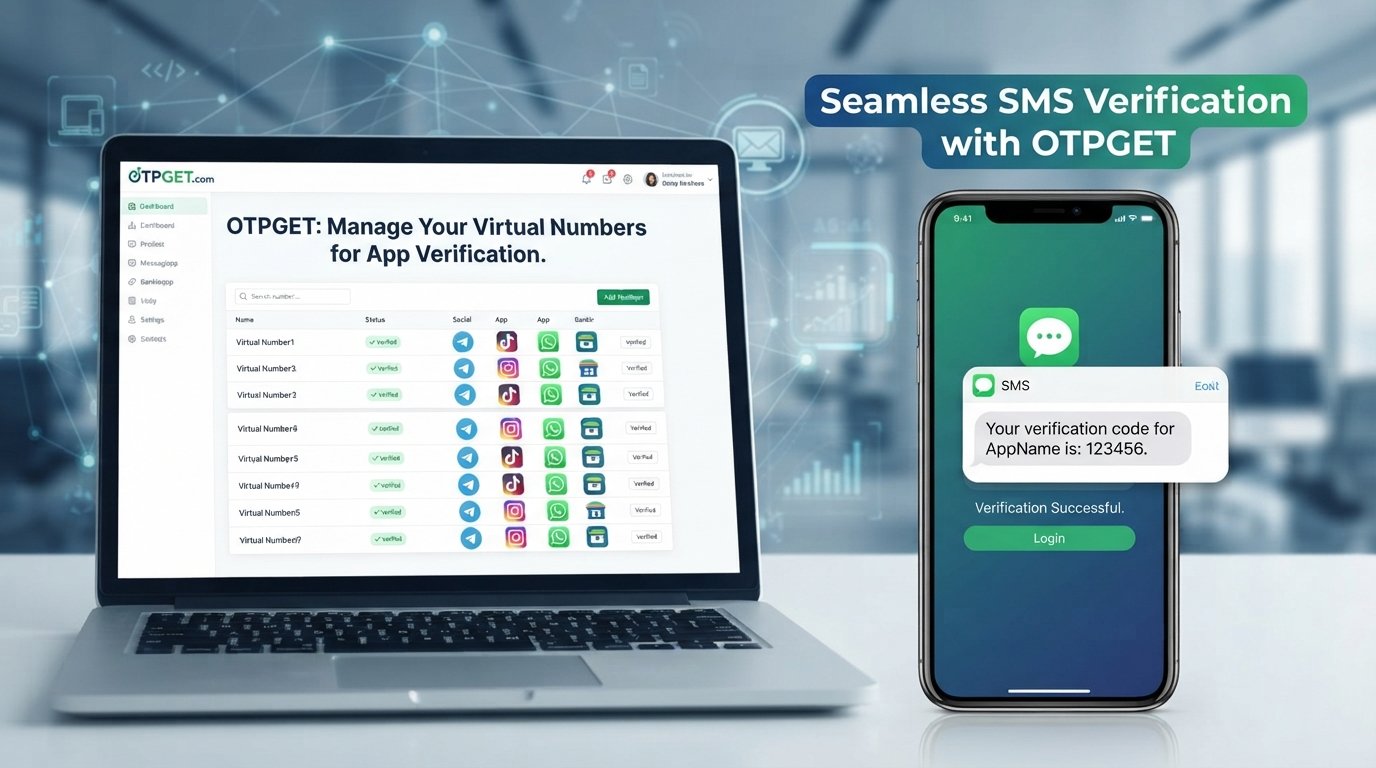
When app compatibility becomes confusing, having a dedicated virtual-number service can make the verification process easier to manage. This is where OTPGET can be useful.
OTPGET provides access to virtual numbers for supported verification needs, giving users an alternative to managing multiple physical SIM cards. For workflows that rely on receiving SMS verification codes, a dedicated service can make the process more convenient and organized.
Instead of immediately assuming that every number should work with every platform, users can approach verification more practically: choose a suitable number, use it according to the service's requirements, and monitor the incoming verification message.
OTPGET can also be useful for people who prefer not to use their personal phone number for every compatible verification workflow. The benefit is primarily convenience and simpler number management—not a way to bypass an app's security controls.
Compatibility still depends on the individual service, its verification policies, and the type of number available. OTPGET should therefore be viewed as a practical virtual-number option rather than a guarantee that every application will accept every number.
Best Practices for Using Virtual Numbers
A few simple habits can reduce unnecessary verification problems.
- Check the service requirements. If an app specifies restrictions on phone numbers, follow those requirements.
- Choose the correct country or region. Geographic compatibility can matter during phone number verification.
- Use a suitable number type. Different platforms may classify mobile, VoIP, and virtual numbers differently.
- Enter the number correctly. Include the correct country code and avoid formatting mistakes.
- Allow time for SMS delivery. Verification messages can experience routing delays.
- Avoid repeatedly requesting OTPs. Multiple requests can create confusion or trigger additional verification checks.
- Keep track of your numbers. If you use virtual numbers for multiple legitimate workflows, record which number is associated with which service.
- Use a reliable virtual-number provider. A dedicated service can make managing verification needs simpler than maintaining several physical SIM cards.
Most importantly, use virtual numbers in accordance with the app's terms and verification requirements.
Why OTPGET Is a Practical Option for Virtual Number Needs
Virtual number compatibility can be difficult to predict because the final decision often belongs to the application receiving the number.
That makes convenience and organization important.
OTPGET can provide access to virtual numbers for supported SMS and OTP verification workflows. Instead of purchasing and managing multiple physical SIM cards, users can use a virtual-number service when it fits their particular verification requirement.
The practical benefits include easier access to virtual numbers, simpler verification management, and reduced dependence on a personal phone number where appropriate.
The key is to choose the right number for the intended service and understand that compatibility remains app-specific. OTPGET can simplify the process, but it does not override an application's own verification rules.
Conclusion: Virtual Number Compatibility Is App-Specific
Different apps can behave differently with virtual numbers because their verification systems, number classifications, geographic requirements, SMS infrastructure, and anti-abuse controls are not identical.
A number that successfully receives an OTP from one service may be handled differently by another. That does not necessarily mean the number is broken. The receiving platform may simply use different rules or risk signals.
Understanding these factors makes troubleshooting easier and helps users choose virtual-number services more carefully.
For legitimate verification workflows supported by the relevant platform, OTPGET offers a practical way to access virtual numbers and manage SMS or OTP verification without relying on multiple physical SIM cards.
If you need a convenient virtual-number option, explore OTPGET and choose a solution that fits the verification requirements of the service you intend to use.
FAQ:
1. Why do some apps reject virtual numbers?
Some apps use verification rules that distinguish between traditional mobile numbers, VoIP numbers, virtual numbers, and other number types. Regional restrictions, number databases, risk controls, or unsupported ranges can also affect acceptance.
2. Why does my virtual number work on one app but not another?
Different apps use different verification systems and policies. One service may support the number category while another may apply stricter checks or have different geographic and carrier requirements.
3. Can virtual numbers receive OTP codes?
Many virtual numbers are capable of receiving SMS verification codes, but actual delivery depends on the number, service infrastructure, sender, routing network, and the application's verification system.
4. What affects virtual number compatibility?
Compatibility can depend on number type, country or region, carrier classification, supported number ranges, SMS routing, previous number usage, and the app's own verification and anti-abuse controls.
5. Are virtual numbers the same as VoIP numbers?
Not necessarily. “Virtual number” is a broader term for numbers provided through digital communication services, while VoIP describes a particular communication technology and classification. An app may identify the two differently.
6. How can OTPGET help with virtual number verification?
OTPGET can provide access to virtual numbers for supported SMS and OTP verification workflows. This can make number management more convenient and reduce the need for multiple physical SIM cards where appropriate.
7. Why can an OTP sometimes be delayed?
OTP delivery can involve the app, verification provider, messaging infrastructure, carriers, and routing systems. Delays can occur at different points, so a delayed message does not necessarily indicate that the virtual number is unusable.
INTERNAL LINK ANCHOR SUGGESTIONS:
- How OTP verification works
- What is a virtual phone number?
- How to receive SMS online
- Virtual numbers for app verification
- Guide to SMS verification
- How to receive OTP codes online
- Understanding virtual number compatibility