How to Protect Your Phone Number During OTP Verification
How to Protect Your Phone Number During OTP Verification
OTP verification has become a familiar part of signing up for an account, signing in, recovering access, or confirming an online action. A service sends a one-time password, usually by SMS, and you enter the verification code to prove that you can access the phone number associated with the account.
The process is useful, but there is a privacy question that often gets overlooked: Do you need to give your primary personal phone number to every service that asks for one?
Your phone number is more than a way to receive an SMS. It can be connected to personal communications, account recovery, marketing databases, and other online activity. Protecting it where practical can therefore be a sensible part of good digital privacy.
For situations where a personal number does not need to be exposed, using a separate temporary or virtual number can provide a useful privacy boundary. Services such as OTPGET offer an option for receiving verification messages through separate numbers, subject to the requirements and compatibility of the service being verified.
Why Your Phone Number Matters for Online Privacy
A phone number is a useful piece of personal information, but that does not mean it needs to be shared indiscriminately.
When you use the same primary number across many websites and apps, you create a larger trail connecting different online activities to one contact detail. Depending on the service and its policies, the number may also be used for account recovery, communications, notifications, or marketing.
Common privacy concerns include:
-
Unwanted calls or messages
-
Marketing communications
-
Exposure through a company's data practices
-
Sharing more personal information than necessary
-
Linking different online activities through one number
-
Losing the separation between personal communication and online verification
None of this means that providing a phone number automatically creates a security problem. It simply means that phone number privacy deserves the same thoughtful approach as other personal information.
A useful principle is simple: share your primary personal number when there is a genuine reason to do so, and consider alternatives when a separate number is appropriate.
What Is OTP Verification?
OTP stands for One-Time Password. It is a temporary verification code that is generally valid for a limited period or a specific verification attempt.
A common SMS OTP process works like this:
-
A website or app asks for a phone number.
-
The service sends an SMS containing a verification code.
-
You enter the code on the original website or app.
-
The service checks the code and completes account verification.
This is commonly called SMS verification or SMS OTP.
OTP verification can be useful because possession of the receiving phone number provides an additional way for a service to verify an account or action. In some situations, SMS verification may also form part of two-factor authentication.
However, account security and phone-number privacy are not exactly the same thing. An OTP can strengthen an account's verification process while the user still has a legitimate reason to avoid exposing their primary personal number unnecessarily.
The Privacy Problem With Using Your Primary Number Everywhere
Using one personal number for every verification request can gradually reduce your ability to separate different parts of your online life.
For example, you might use your number for personal communication, shopping accounts, newsletters, community platforms, software trials, and occasional services that require SMS verification. Over time, the same number becomes associated with many unrelated activities.
There are several practical drawbacks:
Repeated exposure: The more services that have your number, the more places where that information is stored.
Unwanted communication: Some services may send notifications or marketing messages after registration, depending on their settings and policies.
Data-sharing concerns: Different organizations have different approaches to collecting, retaining, and sharing user information.
Reduced privacy boundaries: A primary number can become a common identifier across otherwise unrelated online activities.
Using a separate number for appropriate verification tasks does not eliminate these concerns entirely, but it can reduce unnecessary exposure of your primary contact information.
How to Protect Your Phone Number During OTP Verification
There is no single solution for every situation. The right approach depends on the type of account, how important it is, and whether you need continued access to the number.
Use a secondary number when appropriate
A secondary phone number can keep personal communication separate from verification activity.
This can be particularly useful for services that require SMS verification but do not need your primary number for long-term account recovery or important notifications.
Consider a temporary or virtual number
A temporary phone number is designed for limited or short-term use, while a virtual phone number is a phone number provided through a service rather than your primary physical SIM.
A temporary number for OTP verification can be useful when you only need to receive a verification message. A longer-term virtual or rental number may make more sense when continued access is necessary.
Availability varies by provider, country, carrier, and the service you are trying to verify. Some websites may also restrict virtual or temporary numbers.
Check the platform's privacy policy
Before providing personal information, look at how the service says it collects and uses phone numbers.
You do not need to read every legal document word for word, but checking whether a number is used for marketing, account recovery, notifications, or other purposes can help you make a more informed choice.
Never share your OTP casually
Your verification code is intended for the service requesting it. Do not give an OTP to strangers, callers, people claiming to be support agents, or anyone who unexpectedly asks you to read the code aloud.
A legitimate verification process normally requires you to enter the code on the relevant service yourself.
Use trusted verification services
If you decide to use a temporary or virtual number, choose a provider carefully. Review its terms, privacy information, supported services, and the way verification messages are handled.
Privacy protection should not mean moving your information to an unfamiliar service without understanding how that service operates.
Use stronger security methods when available
Phone-number privacy and account security should be considered separately.
For important accounts, consider stronger options such as authenticator apps, passkeys, hardware security keys, or other multi-factor authentication methods when supported.
These methods can reduce reliance on SMS while providing an additional layer of account protection.
How OTPGET Can Help Protect Your Phone Number
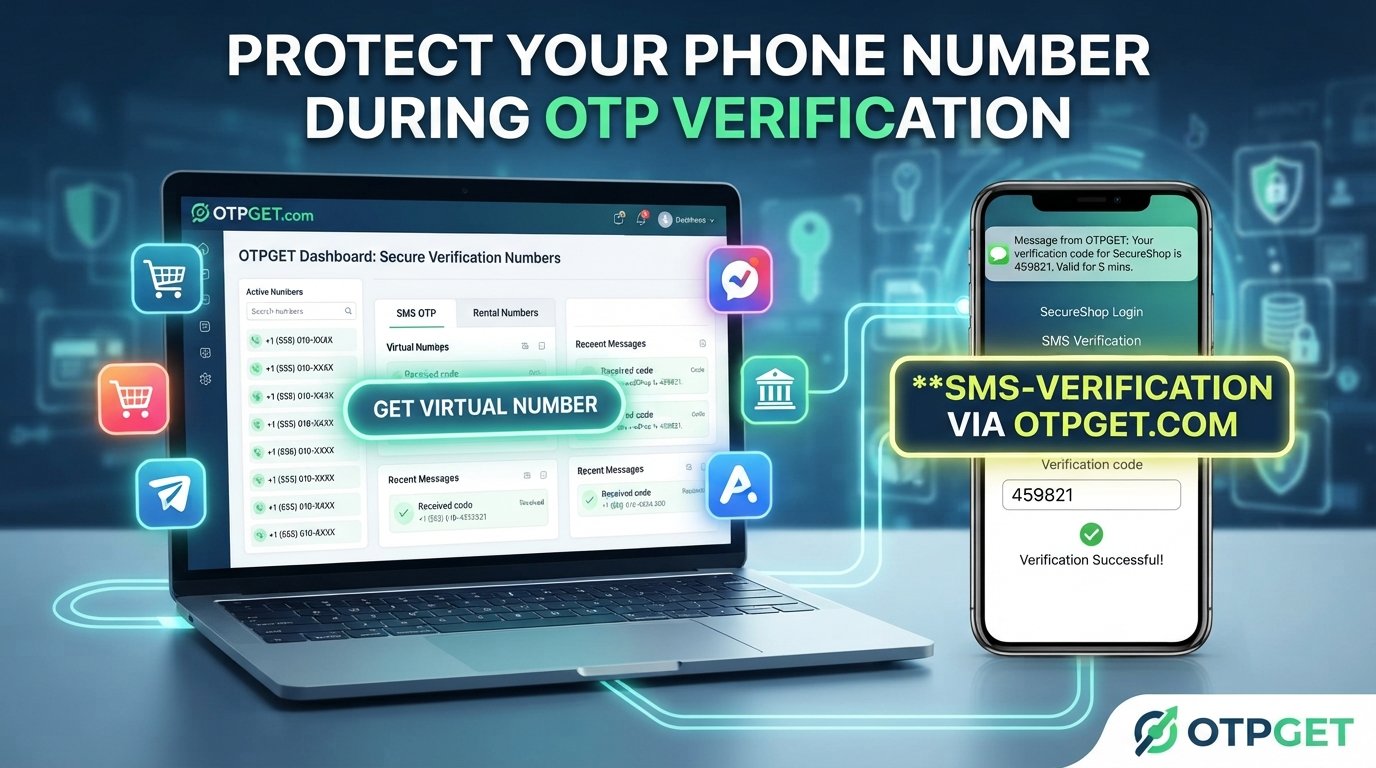
For users who want to protect their phone number during OTP verification, OTPGET provides a practical way to separate certain verification activities from a primary personal number.
According to OTPGET's official service information, the platform provides virtual numbers for SMS OTP verification as well as longer-term rental numbers. Its documentation also describes an SMS OTP service for obtaining a number and checking the status of an incoming verification message.
The basic idea is straightforward: instead of automatically entering your personal number into every service that requests SMS verification, you can use an appropriate separate number when the service permits it.
A typical workflow looks like this:
-
Choose an appropriate number or service through OTPGET.
-
Enter the provided number on the supported website or app.
-
Request the OTP or verification SMS.
-
Receive the verification message through the supported OTPGET service.
-
Enter the verification code into the original verification page.
This approach can help create a boundary between your primary personal communications and certain online verification activities.
OTPGET also offers rental numbers for situations where a user needs a number for longer than a single verification transaction.
There is an important limitation: a virtual or temporary number is not universally accepted. OTP acceptance can depend on the website, application, country, carrier, verification provider, and the platform's own rules. OTPGET should therefore be viewed as a privacy-oriented option for appropriate, legitimate verification use—not as a guarantee that every service will accept a particular number.
The same principle applies to any OTP receiving service: understand what you are using, follow the service's rules, and avoid using alternative numbers to circumvent legitimate security, identity, fraud-prevention, or account restrictions.
Temporary vs. Virtual Phone Numbers for OTP Verification
The terms can sound interchangeable, but they describe slightly different use cases.
| Number type | Privacy | Reusability | Suitable for | Potential limitation |
|---|---|---|---|---|
| Primary personal number | Lower separation | Long-term | Important accounts and personal communication | More widely exposed |
| Secondary personal number | Better separation | Long-term | Separate personal or online activities | Requires maintaining another number |
| Temporary phone number | High short-term separation | Usually limited | One-time or short-term verification | May not be suitable for recovery |
| Virtual phone number | Depends on provider and setup | Can be temporary or longer-term | SMS verification and separate online activity | Acceptance varies by service |
A temporary phone number for verification is generally most useful when you need access to an SMS for a limited purpose.
A virtual or rental number can be more appropriate when you need continued access for a period of time. OTPGET's documentation distinguishes its one-time SMS OTP service from its longer-term rental-number service.
The best choice depends on whether you need the number again and whether the account will rely on it for future recovery.
When Should You Avoid Using a Temporary Number?
Temporary numbers are not a universal replacement for your personal number.
Avoid relying on a disposable or temporary number for accounts where continued access is important, particularly:
-
Banking and financial accounts
-
Government accounts
-
Critical financial services
-
Important primary email accounts
-
Accounts where the number is used for long-term recovery
-
Services that explicitly require a permanent personal number
If you lose access to a temporary number, you may also lose an important recovery method.
For these accounts, use a phone number or authentication method that you can reliably maintain. Always follow the platform's requirements rather than trying to work around them.
Best Practices for Safer OTP Verification
Use this checklist whenever you are completing SMS or online account verification:
-
Never share OTPs with strangers or unexpected callers.
-
Use trusted verification and number providers.
-
Protect your primary phone number when practical.
-
Check how a platform handles phone-number information.
-
Use strong, unique passwords.
-
Enable multi-factor authentication where appropriate.
-
Prefer passkeys or authenticator apps when supported.
-
Keep account recovery information secure.
-
Do not use temporary numbers for accounts that require long-term recovery access.
-
Follow the rules and verification requirements of each platform.
These practices work together. A separate number can improve phone number privacy, but it does not replace good passwords, secure authentication methods, or careful account management.
Frequently Asked Questions
1. How can I protect my phone number during OTP verification?
You can protect your primary number by using a secondary number, temporary phone number, or suitable virtual number when the service permits it. Also review privacy policies and avoid sharing your OTP with anyone else.
2. Can I receive an OTP without using my personal phone number?
Sometimes. If a service accepts a temporary or virtual number, you may be able to receive the verification SMS through a separate number. Acceptance varies by website, country, carrier, and verification provider.
3. What is a temporary phone number for OTP verification?
It is a number intended for short-term use, often to receive an SMS verification code without exposing your primary personal number. Temporary numbers are generally better suited to situations where you do not need long-term access.
4. What is the difference between a virtual number and a temporary number?
A virtual number is provided through a service rather than being your primary physical SIM number. It may be available for short-term or longer-term use. A temporary number is generally intended for limited-duration or one-time activities.
5. Is OTPGET suitable for every website?
No provider can guarantee acceptance by every website or app. OTPGET supports virtual and rental numbers, but whether a particular number works depends on the service's verification requirements and other factors.
6. Is it safe to share an OTP?
Treat an OTP as sensitive verification information. Do not share it with strangers or anyone who unexpectedly requests it. Enter the code directly into the legitimate website or app that requested verification.
7. Should I use a temporary number for important accounts?
Usually, a temporary number is not appropriate when you need reliable long-term access or account recovery. For banking, government, financial, and other critical accounts, use a dependable number or authentication method supported by the service.
Conclusion
Protecting your phone number during OTP verification does not mean avoiding verification altogether. It means thinking about which number you share and why.
For low-risk or appropriate verification situations, a secondary, temporary, or virtual number can help separate online verification activity from your primary personal communications. That separation can be a useful part of a broader phone-number privacy strategy.
OTPGET provides virtual numbers and rental-number options that can help users receive verification messages without unnecessarily relying on their primary personal number. Its suitability depends on the service being verified, so always check compatibility and follow the platform's rules.
If protecting your personal number is a priority, explore OTPGET as one practical option for more privacy-conscious OTP verification.