Virtual Phone Number for SMS Verification: Complete Guide Online
Virtual Phone Number for SMS Verification: Complete Guide
Signing up for an online service often comes with one extra step: SMS verification.
A website may ask for a phone number and send a one-time code before allowing registration, login, or another account action. For many people, using a personal mobile number for every online service is not ideal. This is where a virtual phone number for SMS verification can be useful.
A virtual number can provide another way to receive SMS messages without relying exclusively on your everyday mobile number. Depending on the service and the third-party platform involved, it may be useful for privacy-conscious registrations, testing, business workflows, and other legitimate scenarios.
Services such as OTPGET can be considered by users looking for a practical way to work with virtual numbers and verification messages. However, the right choice depends on factors such as number availability, SMS support, privacy practices, pricing, and the policies of the website where verification is required.
[Internal Link: SMS Verification Guide]
What Is a Virtual Phone Number for SMS Verification?
A virtual phone number is a phone number that is not necessarily tied to a physical SIM card in the way a traditional mobile number is. Instead, the number can be managed through an online service or communications platform.
When used for SMS verification, the number can receive a text message containing a verification code, often called an OTP or one-time password.
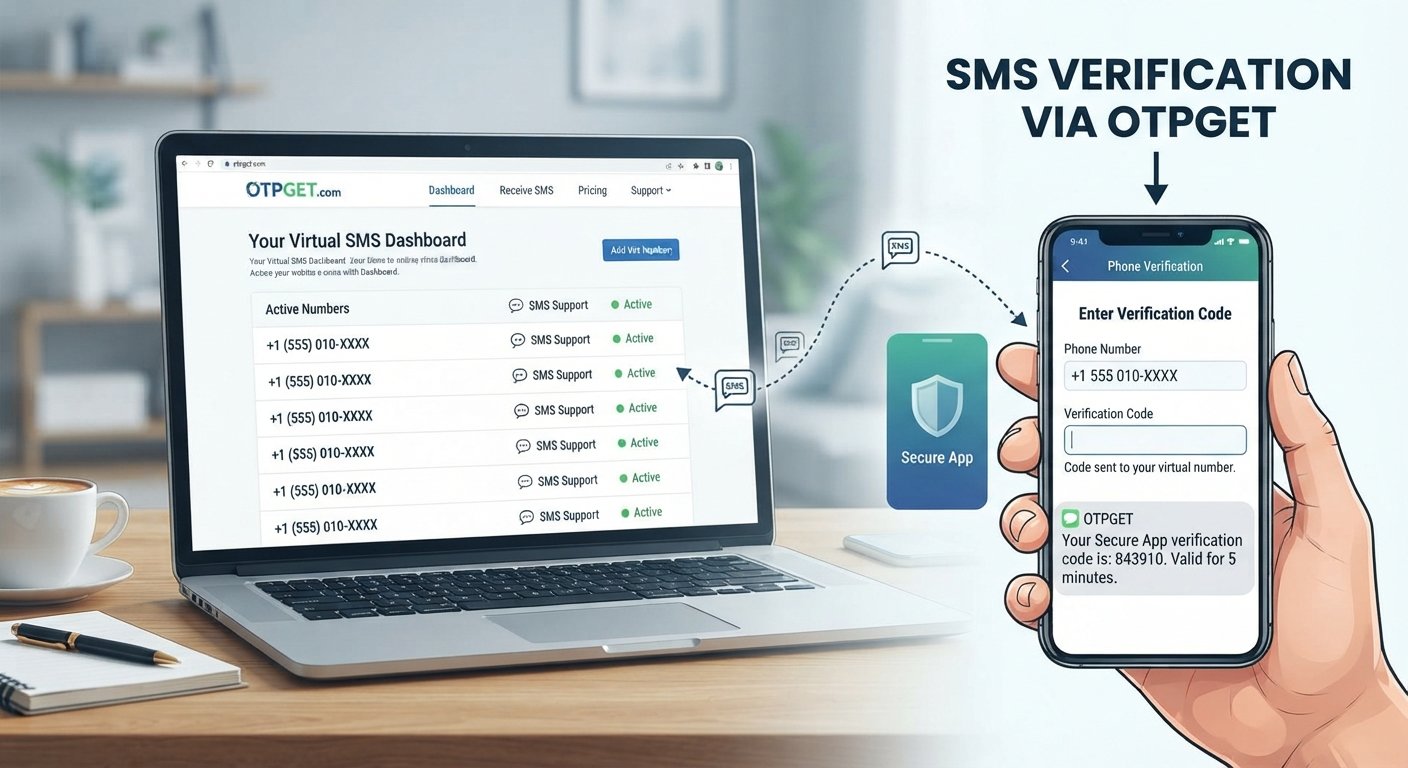
The basic idea is simple:
- A website asks for a phone number.
- You provide an eligible virtual number.
- The website sends an SMS.
- The verification service receives the message.
- You access the code and enter it where requested.
The exact experience varies by provider. Some numbers may be private, while others may be shared or temporary. Some may remain available for longer periods, while others are intended for short-term use.
This distinction matters because a virtual number is not automatically the same thing as a disposable phone number. The terminology can vary between providers.
How Does SMS Verification Work?
Although every platform has its own verification process, the general workflow is straightforward.
1. A website requests a phone number
During registration, login, or another security-related action, the platform asks you to provide a phone number.
2. You provide an eligible number
You enter a virtual phone number from an applicable SMS receiving service.
3. The platform sends a verification code
The website sends an SMS containing a temporary code to the number.
4. The message is received
If the number and service are compatible with the platform, the SMS can be accessed through the applicable virtual number service.
5. You enter the code
You copy the verification code into the original website or application.
6. Verification is completed
The platform checks the code. If the number and code meet its requirements, the verification step is completed.
An important point is that acceptance is controlled by the third-party platform. A virtual number does not guarantee that every website, application, or service will accept it. Platforms can have their own rules concerning virtual, temporary, VoIP, recycled, or shared numbers.
Why Use a Virtual Phone Number for SMS Verification?
There are several legitimate reasons someone might prefer a virtual number over a personal mobile number.
Separate personal and online communications
Using a separate number can help keep verification messages away from your primary phone number.
This can be useful when you regularly sign up for legitimate online services and prefer to keep your personal contact details separate.
Manage verification messages more conveniently
A dedicated online SMS number can make it easier to organize verification messages for certain workflows.
Support testing and development
Developers and businesses may need phone numbers when testing registration, authentication, or SMS-related workflows where the relevant service permits such testing.
Support business workflows
A separate number can help distinguish professional communications from personal communications, depending on the type of virtual number and service being used.
Reduce unnecessary sharing of a personal number
Some users simply prefer not to provide their everyday mobile number to every online service. A virtual number can offer an alternative where the receiving platform permits it.
The important distinction is that virtual numbers should be used for legitimate purposes and in accordance with the terms of the service being verified.
Virtual Phone Number vs. Temporary Phone Number
The terms virtual phone number and temporary phone number are sometimes used interchangeably, but they can describe different things.
| Factor | Virtual Phone Number | Temporary Phone Number |
|---|---|---|
| Definition | A number managed through an online communications service | A number intended for limited or short-term use |
| Typical use | Business, privacy, communications, verification, or other supported workflows | Short-term registrations or one-time communication |
| Duration | Can vary from short-term to longer-term | Usually limited, depending on provider |
| Accessibility | Depends on the provider | Often designed for temporary access |
| Privacy considerations | Can separate activity from a personal number | Can reduce the need to expose a personal number |
| Reliability considerations | Depends on provider and number type | Availability and continuity may be more limited |
| Suitable use cases | Ongoing or specific supported communications | Short-lived communication or verification needs |
Always check the provider's exact definition and policies before choosing a number.
[Internal Link: Virtual Phone Numbers]
What Makes a Good SMS Verification Service?
Choosing an SMS verification service should involve more than simply looking for the cheapest number.
Consider these factors:
- Number availability: Can you obtain a number that fits your intended use?
- SMS reception: Does the service support incoming verification messages?
- Destination compatibility: Does the number type work with the platform you intend to use?
- Number lifespan: How long will the number remain available?
- Privacy practices: What information does the provider collect and retain?
- Shared or private access: Is the number dedicated to you or accessible by multiple users?
- Pricing transparency: Are the costs and any additional fees clearly explained?
- Ease of use: Can you easily find and access incoming messages?
- Support: Is there a clear process for handling technical issues?
- Security: Does the provider explain how access to numbers and messages is protected?
- Number recycling: Could a number later be assigned to another user?
- Terms of service: Does the provider clearly explain permitted and restricted uses?
These details can have a major impact on whether a virtual SMS number is appropriate for a particular situation.
Why Choose OTPGET for Virtual SMS Verification?
For people looking for a virtual number for verification, OTPGET can be considered as one practical option to explore.
The main value proposition is straightforward: users looking for virtual numbers and SMS verification can evaluate whether the service's available options fit their particular requirements.
A practical approach is to focus on the things that actually matter for your use case:
- How easy it is to obtain an applicable virtual number
- Whether SMS reception is available for the intended purpose
- How verification messages are presented to the user
- How long a number remains accessible
- What pricing and usage conditions apply
- What privacy and security information is provided
- Whether the service's terms fit your intended activity
OTPGET should not be viewed as a universal solution for every verification scenario. Third-party websites decide which phone numbers they accept, and their requirements can change.
For that reason, users should check the currently available number options and service conditions before relying on a number for an important account or workflow.
[Internal Link: OTPGET Features]
How to Use a Virtual Phone Number for SMS Verification
The process is generally simple.
Step 1: Choose a suitable service
Start by selecting a virtual phone number or SMS receiving service that fits your intended use.
OTPGET can be one option to evaluate when you are looking for a virtual SMS verification solution.
Step 2: Select an available number
Where applicable, choose a number that meets the requirements of the service you are using.
Step 3: Enter the number
Enter the virtual number on the website or application requesting verification.
Step 4: Wait for the SMS
The third-party platform sends its verification code to the number.
Step 5: Retrieve the code
Access the incoming message through the applicable SMS service.
Step 6: Enter the verification code
Copy the code into the original verification screen.
Step 7: Complete the process
If the platform accepts the number and the code is valid, the verification step can be completed.
If the SMS does not arrive, avoid repeatedly requesting codes without checking the platform's rules. There may be delivery delays, number restrictions, rate limits, or compatibility issues.
Common Uses of Virtual Phone Numbers
Virtual numbers have applications beyond basic online registration.
Privacy-conscious registrations
Some users prefer to separate online activity from their personal mobile number when a platform allows alternative numbers.
Business communications
Businesses can use virtual numbers to separate professional communication from employees' personal numbers, depending on the communications setup.
Software testing
Developers may use virtual numbers when testing SMS-based authentication or registration flows where the relevant platform permits it.
App development and QA
Testing teams may need controlled phone-number environments for development and quality assurance workflows.
Customer-support workflows
Some virtual communications services can support dedicated business communication channels.
International communication
Depending on provider availability, virtual numbers can support communication needs across different markets.
Separating personal and professional activity
A separate number can make it easier to keep business-related communications distinct from personal messages.
The suitability of a virtual number depends on the provider, number type, and rules of the service where it will be used.
Are Virtual Phone Numbers Safe?
A virtual phone number can provide useful privacy and convenience benefits, but it should not automatically be treated as equivalent to a personal mobile number.
One important consideration is number recycling. If a number is later reassigned, an old account connected to that number could potentially create complications.
For important accounts, consider whether you need long-term control of the number and whether the account supports another recovery method.
Other considerations include:
- Whether the number is shared
- How long the number remains available
- How messages are protected
- Whether account recovery depends on the number
- What information the provider collects
- Whether the platform permits virtual numbers
- Whether the number could be reassigned later
For sensitive accounts, a private and long-term phone number may be more appropriate than a temporary or shared number.
Always follow the terms, verification requirements, and security policies of the platform you are using.
Things to Check Before Choosing a Virtual Number
Before selecting an online SMS number, run through this checklist:
- Does the service support the required destination or use case?
- Is SMS reception available?
- Is the number private or shared?
- How long does the number remain available?
- Can the number be reused or reassigned?
- Are there additional charges?
- What privacy information does the provider disclose?
- What happens if an SMS does not arrive?
- Does the provider explain its usage policies clearly?
- Will the intended website or application accept the number type?
This last point is especially important. A technically valid phone number is not necessarily an accepted verification number.
Frequently Asked Questions
What is a virtual phone number for SMS verification?
It is an online-managed phone number that can receive SMS messages, including verification codes, when supported by the provider and accepted by the third-party platform.
Can I receive verification codes with a virtual number?
Yes, virtual numbers can receive SMS verification codes when incoming SMS is supported and the website or service accepts that type of number.
What is the difference between a temporary and virtual phone number?
A virtual number describes how the number is provided or managed, while a temporary number generally emphasizes limited availability or short-term use. The exact terminology varies between providers.
Can I use a virtual number instead of my personal number?
In many situations, a virtual number can be used as an alternative where the third-party service permits it. Whether it works depends on that platform's verification policies.
How does OTPGET work?
OTPGET can be considered by users looking for a virtual SMS verification solution. The specific number availability, supported uses, and applicable service conditions should be checked directly before use.
Are virtual phone numbers suitable for every website?
No. Websites and applications can apply their own rules to virtual, temporary, shared, or other phone-number types. Acceptance is determined by the third-party platform.
What should I consider before choosing an SMS verification service?
Look at number availability, SMS reception, privacy practices, number lifespan, pricing, security, support, recycling policies, and the requirements of the platform where the number will be used.
Final Thoughts
A virtual phone number for SMS verification can be a practical alternative when you want to separate online verification activity from your personal mobile number.
The basic process is simple: obtain an appropriate number, enter it where verification is requested, receive the SMS code, and enter the code on the original platform. The experience, however, depends on both the virtual number provider and the policies of the third-party service.
When comparing providers, look beyond price. Consider number availability, SMS reception, privacy, number lifespan, security, recycling policies, and overall usability.
OTPGET can be worth exploring if you are looking for a convenient virtual SMS verification option. Review its currently available numbers and service conditions, then determine whether they fit your specific verification needs.
The best virtual number is ultimately one that matches your intended use, provides the access you need, and complies with the rules of the platform you are using.