Agencies: Multiple Accounts Without Many SIM Cards | OTPGET
How Agencies Manage Multiple Accounts Without Many SIM Cards
Managing one online account is usually straightforward. Managing dozens of accounts for different clients, campaigns, testing environments, or business functions is another story.
For an agency, phone verification can quickly become an operational task of its own. One account may require a verification code today, another may need a number for onboarding, and a third may need access to an existing verification workflow. If every account depends on a separate physical SIM card, the process can become difficult to organize.
There is a practical alternative: virtual phone numbers and online SMS receiving.
Instead of maintaining a collection of physical SIM cards and devices, agencies can use an online number when a legitimate workflow requires phone verification. OTPGET provides virtual numbers and OTP receiving capabilities designed around this type of workflow. Its documentation describes both temporary number requests and longer-term rental options, along with ways to check received SMS codes.
The important point is that virtual numbers are not a way to bypass platform security. They are simply another method of handling phone-based verification when the relevant website or service permits their use.
Why Agencies End Up Managing So Many Accounts
Agencies often operate several account environments at once. A social media team might manage profiles for multiple clients, while a marketing team handles campaign-related accounts and a technical team maintains testing environments.
Common examples include:
- Social media management: Teams may administer multiple client profiles across different platforms.
- Marketing campaigns: Separate business accounts may be required for different brands, regions, or campaigns.
- Client account management: Agencies may need authorized access to accounts belonging to several businesses.
- Software testing: QA teams may need separate test accounts to reproduce signup and verification workflows.
- Business operations: Different departments can have distinct accounts for legitimate operational purposes.
- Regional requirements: Some services may require phone numbers associated with particular markets.
- Team-based administration: Multiple employees may need structured access to different account environments.
The challenge is not simply creating accounts. It is keeping ownership, credentials, phone numbers, verification messages, and access permissions organized.
That is where account verification can become an administrative bottleneck.
Why Managing Many SIM Cards Becomes a Problem
Physical SIM cards work well when there are only a few numbers to manage. The situation changes when an agency needs several numbers for legitimate business operations.
The problems are often surprisingly mundane.
First, there is physical storage. Someone has to keep track of which SIM belongs to which workflow. Then there is device management. A SIM may need to be placed in a compatible phone or connected device before an SMS can be received.
There is also the question of organization. A team needs to know:
- Which number is associated with which account?
- Which numbers are currently active?
- Where is a particular SIM stored?
- Who has access to the verification device?
- Which incoming message belongs to which account?
- What happens when a number becomes inactive?
SIM swapping between devices can add another layer of manual work. Lost or inactive numbers can create additional complications, particularly when a business depends on consistent account records.
For an agency, these small tasks can consume time even though they are not the core service the agency provides.
How Virtual Phone Numbers Simplify OTP Verification
A virtual phone number is a phone number that can be managed through an online service rather than requiring a physical SIM card in a phone.
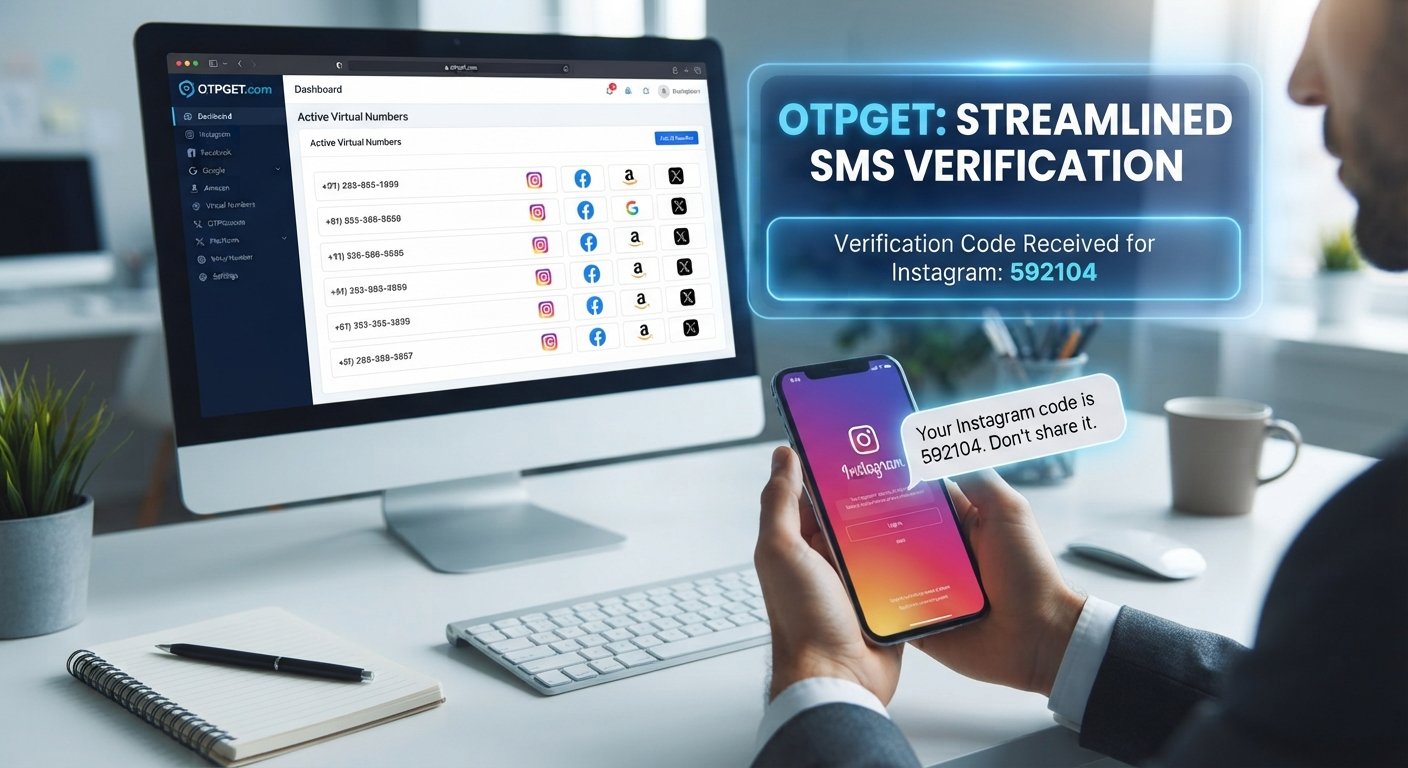
The basic idea is simple. Instead of waiting for a verification SMS to arrive on a physical device, a supported online number can receive the message through an online interface.
An OTP, or one-time password, is a temporary verification code sent to confirm that a user has access to a particular communication channel. Phone-based OTP verification commonly uses SMS.
With an online SMS receiving service, the general workflow looks like this:
- Obtain an appropriate virtual or temporary phone number.
- Enter that number during an authorized verification process.
- Request the verification code.
- Wait for the SMS to be received online.
- Retrieve the verification code.
- Enter it into the relevant service.
This can make receive OTP online workflows easier to organize, particularly when several authorized accounts are being handled by the same team.
It is worth remembering that not every website accepts virtual numbers, and availability or acceptance can vary by service and number type. Virtual numbers should therefore be treated as a workflow option, not a universal replacement for traditional phone verification.
How OTPGET Helps Agencies Manage Verification
For agencies looking to reduce their dependence on physical SIM cards, OTPGET provides a practical online approach to receiving verification messages.
Its published documentation describes a workflow for requesting a virtual number, checking its activation status, and retrieving an SMS verification code when one is received. OTPGET also documents rental-number functionality for longer-term number requirements.
A straightforward agency workflow can look like this:
1. Choose an appropriate number
Select a virtual number through OTPGET based on the legitimate verification requirement and the availability offered by the service.
2. Use it for an authorized verification process
Enter the number into the relevant business, testing, marketing, or account-management workflow where virtual numbers are permitted.
3. Request the verification code
The website or application sends an SMS verification message to the number.
4. Receive the OTP online
The incoming SMS can be checked through the available OTPGET workflow. OTPGET's API documentation also describes status checking for received SMS codes.
5. Complete verification
Enter the verification code into the service requesting it.
6. Keep the account record organized
Record the relevant account, number, ownership details, and access information according to the agency's internal procedures.
For technical teams, OTPGET also publishes API documentation for programmatic number and SMS handling, which can be relevant when verification is part of an authorized software-testing or operational workflow.
The key benefit is not that OTPGET eliminates every verification challenge. Rather, it can provide an online alternative to maintaining numerous physical SIM cards.
Benefits for Agencies Managing Multiple Accounts
For legitimate multiple account management, virtual numbers can provide several practical advantages.
Less dependence on physical SIM cards: Teams do not necessarily need to maintain a large collection of physical cards for every verification workflow.
Easier organization: Online number management can make it simpler to associate a verification number with a particular account or project.
Centralized access: Verification messages can be handled through an online workflow rather than requiring someone to locate a particular physical phone.
Faster setup workflows: When a suitable number is available, obtaining it can be more straightforward than preparing another physical device.
Better team coordination: Agencies can establish internal procedures for who manages numbers and who handles account verification.
Reduced device dependency: The workflow does not have to depend on a specific physical handset for every number.
Greater operational flexibility: Virtual numbers can be useful when an agency has recurring account-management, testing, or verification requirements.
These benefits depend on the service being used, the type of number available, and the rules of the platform being verified.
Virtual Numbers vs. Physical SIM Cards
Neither option is universally right for every situation. The better choice depends on the account, platform, security requirements, and how the number will be used.
| Factor | Physical SIM Card | Virtual Phone Number |
|---|---|---|
| Physical setup | Requires a SIM and compatible device | Managed through an online service |
| Accessibility | Usually tied to a physical device | Accessible through the provider's online workflow |
| Organization | Can become harder to track at scale | Can simplify digital record keeping |
| Scalability | More cards and devices may be required | Additional numbers can be obtained when available |
| Device dependency | Relies on a phone or compatible hardware | Reduces dependence on individual devices |
| SMS access | Received through the SIM/device | Received through the provider's online system |
| Agency convenience | Useful for dedicated, long-term physical use | Useful for online verification workflows |
For sensitive, long-term accounts where persistent control of a specific phone number is essential, a dedicated physical or business-controlled number may still be appropriate.
Best Practices for Managing Multiple Verified Accounts
Using online numbers is only one part of responsible account management. Agencies should also establish clear operational practices.
Keep account ownership documented
Maintain records showing which business or client owns each account and who is authorized to administer it.
Use authorized accounts
Only create, verify, or manage accounts for legitimate business purposes and with appropriate authorization.
Follow platform rules
Check whether the relevant service permits virtual numbers, multiple accounts, or the specific workflow being used. A verification method should never be treated as a way around platform policies.
Maintain organized records
Track account identifiers, assigned numbers, ownership information, and responsible team members without unnecessarily storing sensitive information.
Use strong passwords
Every business account should have its own strong credentials rather than relying on shared or reused passwords.
Enable additional security where available
If a platform offers stronger authentication, recovery options, security keys, or other protections, consider using them according to the organization's security policy.
Avoid unnecessary credential sharing
Limit account access to the people who genuinely need it. Use appropriate permission and access-control procedures whenever a platform supports them.
Monitor account access
Regularly review who can access business accounts and remove access when a team member changes roles or leaves the organization.
Good account management is ultimately about control and documentation, not simply collecting more phone numbers.
Who Can Benefit From OTPGET?
OTPGET may be relevant to organizations and professionals that regularly encounter legitimate phone-based verification workflows.
Potential users include:
- Digital marketing agencies managing authorized client accounts
- Social media agencies handling multiple business profiles
- Freelancers separating business and personal online activities
- SaaS teams testing signup and verification processes
- QA and testing teams working with controlled test environments
- E-commerce businesses managing multiple legitimate service accounts
- Growth teams coordinating authorized marketing workflows
- Client-service agencies administering accounts on behalf of businesses
- Businesses maintaining multiple legitimate online profiles or operational accounts
The suitability of a virtual number depends on the specific service. Businesses should verify the applicable platform rules and legal requirements before using an online number for account verification.
Why OTPGET Can Be a Practical Alternative to Many SIMs
The main advantage of OTPGET in an agency setting is straightforward: it can move part of the phone-verification workflow from physical hardware to an online environment.
Instead of maintaining a drawer full of SIM cards, multiple phones, and a manual system for finding the right device, an agency can use virtual numbers for appropriate verification tasks and handle received SMS through an online workflow.
That can make business account management more organized, especially when verification is one small part of a larger client or testing process.
OTPGET's published materials describe temporary virtual numbers, rental numbers, SMS OTP functionality, and developer-facing API options.
The important distinction is responsible use. A virtual number should support an authorized business process, not be used to evade security controls, create deceptive identities, spam users, or violate a platform's terms.
FAQ
1. How do agencies manage multiple accounts without many SIM cards?
Agencies can use a combination of business-controlled phone numbers, virtual phone numbers, account-management procedures, and centralized records. For suitable verification workflows, an online OTP receiving service can reduce the need for numerous physical SIM cards.
2. What is a virtual phone number?
A virtual phone number is a phone number managed through an online service rather than directly through a physical SIM in a personal device. Depending on the service, it may be used to receive SMS verification messages.
3. Can I receive OTP verification codes online?
Yes, supported virtual numbers can receive SMS verification codes through an online system. However, acceptance varies by website or application, so users should confirm that the relevant service permits the number type.
4. How does OTPGET help with account verification?
OTPGET provides virtual numbers that can be used in appropriate verification workflows. Its documentation describes requesting numbers and checking their status for received SMS codes.
5. Are virtual phone numbers useful for agencies?
They can be useful when agencies need to manage several legitimate verification workflows without assigning a separate physical SIM and device to every process. Their usefulness depends on the platform and account requirements.
6. Can virtual numbers replace physical SIM cards?
Not in every situation. Physical SIM cards can remain appropriate for long-term accounts, sensitive communications, or services that do not accept virtual numbers. Virtual numbers are best viewed as an additional operational option.
7. What should businesses consider when using online SMS verification?
Businesses should consider platform policies, number availability, account ownership, security, privacy, record keeping, and whether the number needs to remain accessible for future account recovery or verification.
Conclusion: A Simpler Way to Handle Account Verification
Managing many accounts does not necessarily mean managing a drawer full of SIM cards.
For agencies, marketers, freelancers, SaaS teams, and businesses, virtual phone numbers can simplify legitimate verification workflows by reducing dependence on physical devices and making SMS access easier to organize.
OTPGET offers an online approach to temporary and rental virtual numbers and SMS OTP handling, giving businesses another option when physical SIM management becomes inconvenient. Its published documentation also provides information for teams that need programmatic access to number and verification workflows.
The right approach still depends on the platform, account type, and business requirements. Virtual numbers are not a guarantee that every service will accept a verification request.
For organizations looking for a more organized way to receive OTP online and reduce physical SIM dependency, exploring OTPGET can be a practical next step.