SMS Verification vs Email Verification: Key Differences Guide
SMS Verification vs Email Verification: Key Differences
Imagine a new user has just created an account. They are ready to continue, but first they need to enter a verification code. Should that code arrive by text message or email?
It may seem like a small product decision, but verification affects account security, user experience, login completion, and even how easily customers can access your application.
SMS verification and email verification are two of the most common ways businesses confirm that a user controls a particular phone number or email address. Both can support OTP authentication and account security, but they work differently and fit different workflows.
Understanding those differences can help businesses choose an authentication approach that matches their users and application. For organizations that need SMS-based OTP workflows, a dedicated service such as OTPGET can also be considered as part of the implementation strategy.
What Is SMS Verification?
SMS verification is a process that confirms a user's mobile number by sending a temporary verification code through a text message.
How does SMS OTP work?
The typical process is straightforward:
- A user enters their phone number.
- The application generates a temporary OTP.
- The OTP is sent to the user's phone through SMS.
- The user enters the verification code.
- The application validates the code and completes the requested action.
This is commonly called SMS OTP verification.
Businesses use mobile number verification for many workflows, including:
- New account registration
- Login verification
- Password recovery
- Two-factor authentication
- Transaction confirmation
- E-commerce account security
- Mobile application authentication
One advantage of SMS authentication is that users are already familiar with receiving text messages. The verification process can also fit naturally into mobile-first applications.
However, SMS verification depends on access to the relevant phone number and mobile connectivity. Delivery can also be affected by factors outside the application's direct control, such as carrier conditions, device availability, or incorrect phone numbers.
For businesses, implementation also requires attention to OTP delivery, rate limits, abuse prevention, and verification failures.
What Is Email Verification?
Email verification confirms that a user has access to a particular email address. It can use either a verification link or a temporary email OTP.
For example, after registration, an application might send an email containing a verification code. The user retrieves the code from their inbox and enters it into the application.
How does email verification work?
A typical email verification workflow looks like this:
- The user provides an email address.
- The application generates a verification code or link.
- An email is sent to that address.
- The user opens the message.
- The application verifies the code or link.
Email verification is particularly common for account creation, newsletter subscriptions, password recovery, and web applications.
Its main advantage is that email is already central to many online accounts. Users can often access their inbox across multiple devices.
There are limitations, too. Messages can be delayed, filtered into spam or promotions folders, or overlooked in a crowded inbox. If a user cannot access their email account, email authentication cannot complete successfully.
For that reason, email verification is useful in many scenarios, but it should be selected based on the actual user journey rather than treated as a universal solution.
SMS Verification vs Email Verification: Key Differences
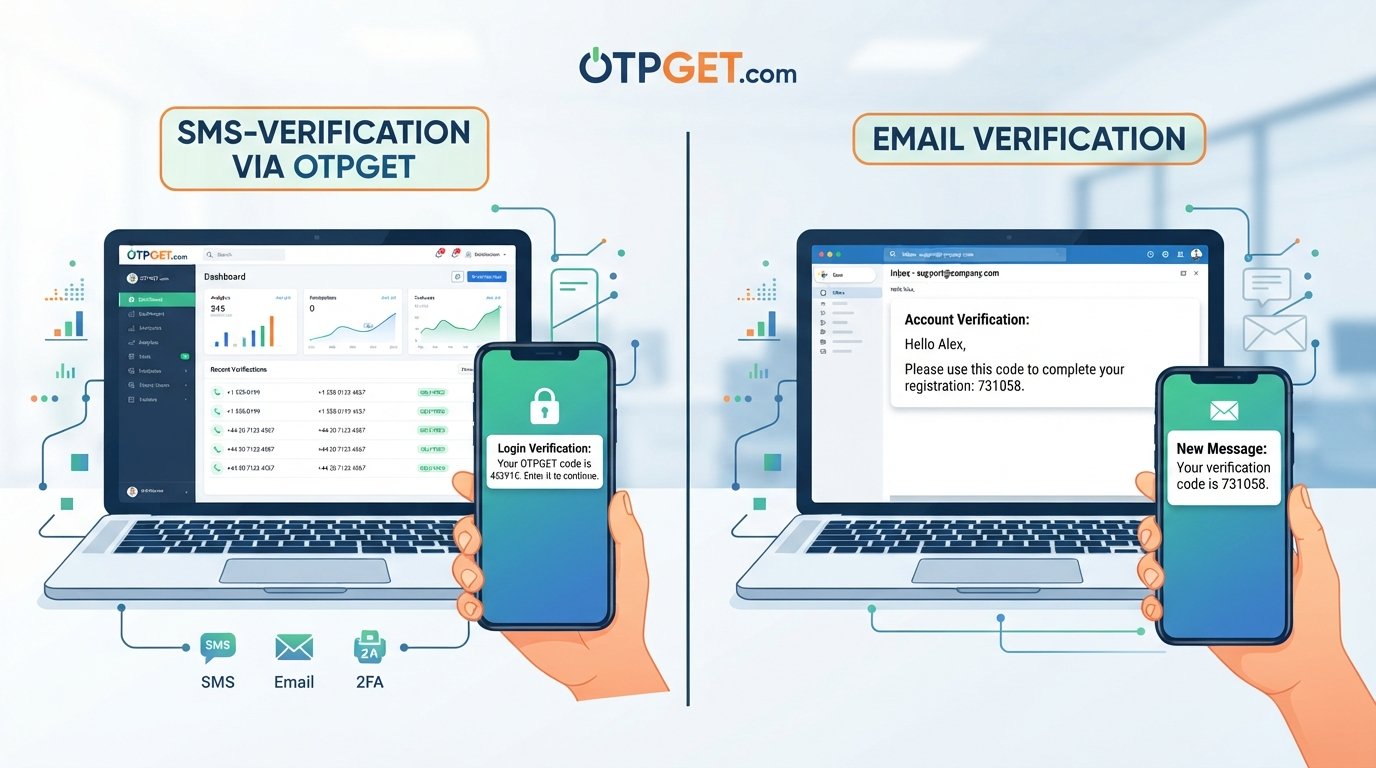
So, what is the difference between SMS and email verification? The most obvious distinction is the delivery channel, but several other factors affect the choice.
| Factor | SMS Verification | Email Verification |
|---|---|---|
| Delivery channel | Mobile text message | Email inbox |
| Typical verification | SMS OTP | Email OTP or verification link |
| User experience | Often direct and mobile-friendly | Requires access to an email inbox |
| Speed | Designed for near-immediate code delivery, subject to network and carrier conditions | Depends on email delivery and inbox access |
| Mobile connectivity | Requires access to the relevant mobile service | Does not require mobile SMS connectivity |
| Email access | Not required | Required |
| Common uses | Login, mobile registration, transaction confirmation, 2FA | Account creation, email ownership, password recovery |
| Security considerations | Protect against SIM-related risks, interception, and OTP abuse | Protect against compromised email accounts, phishing, and malicious links |
| Recovery use cases | Useful when phone ownership needs to be confirmed | Useful when email account access is available |
| Business considerations | Requires SMS delivery infrastructure and OTP controls | Requires reliable email delivery and message management |
Neither approach is automatically right for every application. The best option depends on the user's access, workflow, security requirements, and business priorities.
SMS OTP vs Email OTP: Which Works Better for Different Use Cases?
Instead of asking which method is universally better, businesses should ask which method fits a particular authentication workflow.
New user registration
Email verification can confirm ownership of the email address used to create an account. SMS verification can confirm access to a mobile number.
Some applications may use one method, while others may use both depending on the information they need to validate.
Login verification
SMS OTP can be useful when a business wants to add phone-based verification to a login process. Email OTP can also provide an additional verification step when users have reliable access to their inbox.
The right choice depends on how users normally access the application.
Password reset
Email remains a common password recovery channel because the account's email address is often part of the user's identity. SMS OTP can also be used where a verified mobile number is associated with the account.
Financial or transactional confirmation
Transactions may require an additional authentication step. SMS OTP can be appropriate when phone-based confirmation is part of the security design. However, businesses should consider the risks associated with SMS-based authentication and use additional controls where appropriate.
E-commerce and mobile applications
For mobile-first products, SMS verification can fit naturally into the customer journey. Web-based services may find email verification convenient, particularly when email is already central to account management.
The important point is that SMS vs email verification is not simply a technology choice. It is a user-journey and security decision.
Why Reliable OTP Delivery Matters
A verification system only works when users can actually receive and complete the verification step.
Poor OTP delivery can create friction at critical moments. A user who cannot receive a verification code may abandon registration, struggle to log in, or contact support for an issue that could otherwise have been avoided.
Businesses should therefore consider several factors when selecting an OTP or SMS verification service:
- Delivery reliability: Verification messages need a dependable delivery process.
- User experience: Users should understand what to do and what happens next.
- Verification success: The workflow should make code entry simple while maintaining appropriate security controls.
- Scalability: The solution should fit the application's expected verification volume and growth.
- Developer integration: Implementation should align with the application's technical architecture.
- Monitoring: Businesses benefit from visibility into delivery and verification failures.
- Support: Clear troubleshooting processes can help resolve authentication issues efficiently.
The goal is not simply to send an OTP. It is to create a verification workflow that users can complete securely and consistently.
How OTPGET Can Simplify SMS Verification
For businesses that want to build SMS OTP verification into an application, using a dedicated OTP/SMS platform can reduce the amount of infrastructure they need to manage directly.
OTPGET is a practical option to consider for businesses that need SMS-based OTP verification. Rather than treating OTP delivery as an isolated feature, businesses can evaluate a dedicated solution as part of their broader authentication workflow.
Depending on the application's requirements, an SMS OTP service can support workflows such as:
- User phone number verification
- Account registration
- Login authentication
- Password recovery
- Transaction confirmation
- Two-factor authentication
- Other application-specific verification flows
A platform such as OTPGET can be considered when developers are evaluating an OTP provider, SMS verification service, or broader authentication infrastructure.
The exact implementation should still be based on the application's requirements. Businesses should review the provider's available integration options, supported workflows, security controls, delivery model, and commercial terms before choosing a service.
This is particularly important because OTP verification is not only about sending messages. The surrounding workflow—code generation, expiration, retry handling, rate limiting, validation, logging, and abuse protection—also matters.
For teams looking specifically for an SMS-focused approach, exploring OTPGET can be a useful next step when evaluating potential OTP solutions.
SMS Verification or Email Verification: What Should You Choose?
There is no single verification method that fits every business. Instead, consider the following questions:
Who are your users?
If your application is strongly mobile-focused, phone-based verification may fit naturally. If users primarily interact through web browsers and email is central to their accounts, email verification may be convenient.
What does the authentication workflow require?
Registration, login, password recovery, and transaction confirmation may have different requirements. The same application can use different verification methods for different actions.
What level of security is required?
SMS and email both have security considerations. Businesses should assess the threats relevant to their application and combine OTP verification with appropriate controls rather than relying on a single mechanism.
How important is delivery and accessibility?
Consider whether users are more likely to have immediate access to their phone, their email, or both.
What does implementation involve?
Review integration requirements, monitoring capabilities, verification logic, rate limiting, support processes, and overall operational needs.
For businesses specifically seeking SMS OTP authentication, OTPGET can fit into the evaluation process as a potential SMS verification solution. The decision should ultimately be based on whether its available capabilities align with the application's technical and business requirements.
Best Practices for OTP Verification
Regardless of whether you use SMS OTP or email OTP, a well-designed verification process should prioritize both security and usability.
Follow these practical guidelines:
- Keep OTP expiration periods limited.
- Avoid unnecessarily complicated verification flows.
- Provide clear messages when a code is invalid or expired.
- Offer a controlled resend option.
- Rate-limit OTP requests and verification attempts.
- Protect OTP endpoints against automated abuse.
- Never expose OTPs unnecessarily in application interfaces or logs.
- Monitor delivery and verification failures.
- Make code entry easy on mobile devices.
- Avoid revealing sensitive account information through error messages.
- Consider appropriate fallback verification methods where they make sense.
- Require additional authentication controls for sensitive actions when necessary.
It is also important to treat OTPs as temporary authentication credentials, not as permanent secrets. A short-lived code should be generated, delivered, validated, and invalidated according to a clearly defined security workflow.
Final Takeaway
SMS verification and email verification solve a similar problem through different channels. SMS uses a mobile number and text message, while email verification relies on an email account and may use either a verification link or email OTP.
The right choice depends on your users, application type, authentication workflow, security requirements, accessibility, integration needs, and delivery expectations.
For businesses that specifically need SMS OTP verification, reliable OTP delivery is a central part of the overall user experience. A dedicated platform such as OTPGET can be considered when evaluating solutions for SMS-based user verification and authentication workflows.
If SMS OTP fits your application's requirements, explore OTPGET and assess how its available verification capabilities align with your authentication needs.